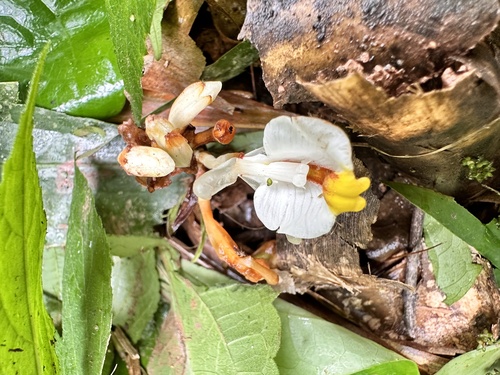
Curcuma alismatifolia
Gagnepain
Siam tulip
iNaturalist· cc-by-nc
(c) mahimahirider, some rights reserved (CC BY-NC)
iNaturalist· cc-by-nc
(c) Eric Gong, some rights reserved (CC BY-NC)
iNaturalist· cc-by
(c) anguspritchard, some rights reserved (CC BY)
Summary
Source: WikipediaCurcuma alismatifolia, Siam tulip or summer tulip (Thai: ปทุมมา, RTGS: pathumma; กระเจียวบัว, RTGS: krachiao bua; ขมิ้นโคก, RTGS: khamin khok) is a tropical plant native to Laos, northern Thailand, and Cambodia. Despite its name, it is not related to the tulip, but is a close relative of turmeric. It can grow as an indoor plant. It is a perennial herb growing up to 2 feet (0.61 metres) tall. Malvidin 3-rutinoside is a pigment responsible for bract color in C. alismatifolia.
Description
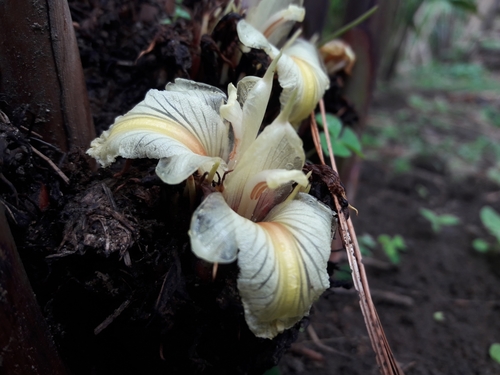
A ginger family herb. It grows 40-60 cm high. The underground stem or rhizome is yellow or white. There are root tubers present. There are about 4 leaves. They are narrowly oval. They are 25-35 cm long by 5-8 cm wide. The flowers are in the tufts of the leaves. They are cylinder shaped and 5-10 cm long.
Edible Uses
The flowers are cooked and eaten as a vegetable.
Traditional Uses
The flowers are cooked and eaten as a vegetable.
This uses section is brief — help expand it
Distribution
A tropical plant. It often grows on limestone soils.
Where It Grows
Asia, Cambodia, Hawaii, Indochina, Laos, Pacific, SE Asia, Thailand, USA,
Cultivation
Plants can be grown from fresh seeds. It germinates best at about 20°C. Plants can be grown by division.
Propagation
Seed - best sown as soon as it is ripe. Germinates best at temperatures around 20°c. Division of the rhizome when the plant is dormant.
Other Information
The flowers are commonly eaten.
Synonyms
Also Known As
Chahouy
References (6)
- Cengel, D. J. & Dany. C., (Eds), 2016, Integrating Forest Biodiversity Resource Management and Sustainable Community Livelihood Development in the Preah Vihear Protected Forest. International Tropical Timber Organization p 110
- Facciola, S., 1998, Cornucopia 2: a Source Book of Edible Plants. Kampong Publications, p 248
- Fern, K., 2012, Tropical Species Database http://theferns.info/tropical/
- Staples, G.W. and Herbst, D.R., 2005, A tropical Garden Flora. Bishop Museum Press, Honolulu, Hawaii. p 762
- Turreira Garcia, N., et al, 2017, Ethnobotanical knowledgeof the Kuy and Khmer people in Prey Lang, Cambodia. Cambodian Journal of Natural History 2017 (1): 76-101
Show all 6 references Hide references
- Uphof,