Mimosa pudica
L.
Sensitive plant, Touch-me-not
iNaturalist· cc0
no rights reserved, uploaded by 葉子
iNaturalist· cc-by-nc
(c) Hong, some rights reserved (CC BY-NC), uploaded by Hong
iNaturalist· cc-by-nc
(c) 🪶🐾🍀Nandan Sreejith🦌🍄🌍, some rights reserved (CC BY-NC), uploaded by 🪶🐾🍀Nandan Sreejith🦌🍄🌍
Summary
Source: WikipediaMimosa pudica (also called sensitive plant, sleepy grass, sleepy plant, action plant, humble plant, touch-me-not, touch-and-die, shame plant or shy plant) is a creeping annual or perennial flowering plant of the pea/legume family Fabaceae. It is often grown for its curiosity value: the sensitive compound leaves quickly fold inward and droop when touched or shaken and re-open a few minutes later. For this reason, this species is commonly cited as an example of rapid plant movement. Like a number of other plant species, it undergoes changes in leaf orientation termed "sleep" or nyctinastic movement. The foliage closes during darkness and reopens in light. This was first studied by French scientist Jean-Jacques d'Ortous. In the UK it has gained the Royal Horticultural Society's Award of Garden Merit. The species is native to the Caribbean and South and Central America, but is now a pantropical weed, and can now be found in the Southern United States, South Asia, East Asia, Micronesia, Australia, South Africa, and West Africa as well. It is not shade-tolerant and is primarily found on soils with low nutrient concentrations.
Description
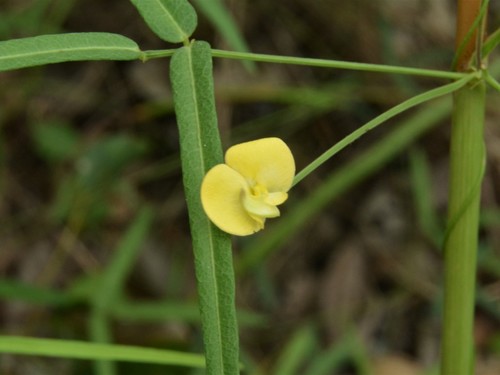
A low spreading shrub. The branches are hairy and prickly. The leaves are sensitive to touch. The leaves are 2.5 cm long and the stalks are grooved and prickly. There re 1-2 pairs of pinnae with 12-20 pairs of leaflets on each. These are 6-8 mm long and 5-6 mm wide. The flowers are in almost round heads. They are yellow on stalks about 2 cm long. The heads are 6-8 mm across. They occur singly or in pairs along the branches. The fruit is a broad, flat, curved pod. It is 12-18 mm long.
Edible Uses
The delicately fragrant flowers can be crystallized or used to prepare distilled flower water. An oil similar to soybean oil is obtained from the seeds.
Traditional Uses
The flowers are crystallised. They are also used in the preparation of distilled flower water.
This uses section is brief — help expand it
Medicinal Uses
According to Ayurveda, the root is bitter, acrid, cooling, vulnerary, and alexipharmic, used to treat biliousness, leprosy, dysentery, vaginal and uterine complaints, inflammations, burning sensation, fatigue, asthma, leucoderma, and blood diseases. In Unani medicine, the root is resolvent and alterative, useful for conditions arising from blood impurities and bile, bilious fevers, piles, jaundice, and leprosy. The root is also used to control alcoholism. The leaves are bitter, mildly sudorific, and tonic; a leaf tincture is given to drunkards to remedy drunkenness. The seed is emetic. The plant contains the alkaloid mimosine. Scientific trials have shown that plant extracts act as a moderate diuretic, depress duodenal contractions similarly to atropine sulphate, promote nerve regeneration, and reduce menorrhagia. The roots contain tannin, ash, calcium oxalate crystals, and mimosin, and root extracts are reported to be a strong emetic.
Known Hazards
When the prickles on the stem and the fruits become too hard, they can cause intestinal inflammation in grazing animals. The roots are toxic in large doses.
Distribution
It is a tropical plant. In China it grows between sea level to 1,500 m above sea level.
Where It Grows
Africa, Asia, Australia, British Indian Ocean Terr., BIOT, Burkina Faso, Cambodia, Central America, China, Christmas Island, Cuba, Dominican Republic, East Africa, Fiji, Guianas, Guyana, Haiti, India, Indochina, Jamaica, Korea, Laos, Lesser Antilles, Madagascar, Maldives, Mexico, Myanmar, Nepal, North America, Pacific, Pakistan, Puerto Rico, Samoa, Sao Tome and Principe, SE Asia, Sierra Leone, Sikkim, Slovenia, South America, Sri Lanka, Suriname, Taiwan, Tokelau, Tuvalu, Vietnam, West Africa, West Indies*, West Timor,
Cultivation
It grows best in areas where annual daytime temperatures are within the range 22 - 28°c, but can tolerate 10 - 32°c. It is intolerant of frost. It prefers a mean annual rainfall in the range 1,000 - 2,000mm, but tolerates 900 - 3,000mm. Prefers a sunny position, but can succeed in quite dense shade. Plants are shade intolerant. Succeeds in most soils, including those that are shallow or poor in nutrients. The plant is well adapted to humid areas with high winds. Prefers a pH in the range 6 - 7, tolerating 5 - 7.5. The plant has become naturalized throughout the Tropics and much of the subtropics. It has become a pest in forest plantations, cropland, orchards and pasture. It is particularly likely to become a noxious weed when growing in dryland field crops, in rainfed wetland rice and in plantation crops. Plants can flower all year round. Plants are a fire hazard when dry. Although they can be perennial, the plants can also complete their life-cycle within 90 days. This species has a symbiotic relationship with certain soil bacteria, these bacteria form nodules on the roots and fix atmospheric nitrogen. Some of this nitrogen is utilized by the growing plant but some can also be used by other plants growing nearby.
Propagation
Sow seed after scarification, as the hard seedcoat can slow germination. Pour a small amount of nearly boiling water over the seeds, taking care not to cook them, then soak in warm water for 12–24 hours. The seeds should swell and absorb moisture during this time. If they have not, carefully nick the seedcoat without damaging the embryo and soak for a further 12 hours before sowing.
Other Uses
The plant forms a dense ground cover and has been used in coconut plantations for this purpose. It has been introduced to subtropical humid areas of the Transcaucasus, where it is cultivated for erosion control, ground cover, and green manure. The plant has also been identified as having potential for phytoremediation of arsenic-polluted areas in Thailand.
Other Information
It is sold in local markets in China.
Notes
Also as Mimosaceae.
Nutrition
| Part | Moisture | kJ | kcal | Protein | Vit A | Vit C | Iron | Zinc |
|---|---|---|---|---|---|---|---|---|
| Leaves | 93 | — | 22 | 1.4 | — | — | 1.4 | — |
Synonyms
Also Known As
Buhari jhar, Chui mui, Kaimatuu, Kaya, Ladhugas, Lajuli, Lajwanti, Macco, Mouku matiotio, Nam-ya-haiawn, Sramežljiva mimoza, Tikayon, Trinhnu, Xiao li cao
References (16)
- Facciola, S., 1998, Cornucopia 2: a Source Book of Edible Plants. Kampong Publications, p 152
- Flora of Pakistan. www.eFloras.org
- Food Composition Tables for use in East Asia FAO http://www.fao.org/infoods/directory No. 729
- Plants of Haiti Smithsonian Institute http://botany.si.edu/antilles/West Indies
- Franklin, J., Keppel, G., & Whistler, W., 2008, The vegetation and flora of Lakeba, Nayau and Aiwa Islands, Central Lau Group, Fiji. Micronesica 40(1/2): 169–225, 2008
Show all 16 references Hide references
- http://www.botanic-gardens-ljubljana.com/en/plants
- Kahlon, L. K. & Singh, R., 2019, Traditional knowledge & Dynamics of edible plants of primitive tribal group ‘Paudi Bhuyan’ with changing demography migration patterns in Northern Odisha. Indian Journal of Traditional Knowledge Vol 18(1), pp 7-15
- Kumar, R. & Saikia, P., 2020, Wild edible plants of Jharkhand and their utilitarian perspectives. Indian Journal of Traditional Knowledge Vol 19 (2), April 2020, pp 237-250
- Li, D. et al, 2017, Ethnobotanical survey of herbal tea plants from the traditional markets in Chaoshan, China. Journal of Ethnopharmacology. 205 (2017) 195-206
- Parham, B. E. V., 1971, The Vegetation of the Tokelau Islands with special reference to the Plants of Nukunonu Atoll. New Zealand Journal of Botany. 9:4, 576-609
- Parham, B. E. V., 1972, Plants of Samoa. New Zealand Department of Scientific and Industrial Research. Information Series. No. 85 p 133
- Sp. pl. 2:518. 1753
- Sujanapal, P., & Sankaran, K. V., 2016, Common Plants of Maldives. FAO & Kerala FRI, p 175
- Thaman, R. R, 2016, The flora of Tuvalu. Atoll Research Bulletin No. 611. Smithsonian Institute p 91
- Topp, J. M. W., 1988, An Annotated Check List of the Flora of Diego Garcia, British Ocean Territory. Atoll Research Bulletin No. 313
- World Checklist of Useful Plant Species 2020. Royal Botanic Gardens, Kew