Melaleuca quinquenervia
(Cavanilles) S. T. Blake
Broad-leaved paperbark, Bellbowrie
iNaturalist· cc-by-nc
(c) gillbsydney, some rights reserved (CC BY-NC), uploaded by gillbsydney
iNaturalist· cc-by-nc
(c) Narelle, some rights reserved (CC BY-NC), uploaded by Narelle
iNaturalist· cc-by-nc
(c) donnasweigart, some rights reserved (CC BY-NC)
Summary
Source: WikipediaMelaleuca quinquenervia, commonly known as the broad-leaved paperbark, paper bark tea tree, punk tree or niaouli, is a small- to medium-sized tree of the myrtle family, Myrtaceae. It grows as a spreading tree up to 20 m (70 ft) tall, with its trunk covered by a white, beige and grey thick papery bark. The grey-green leaves are egg-shaped, and cream or white bottlebrush-like flowers appear from late spring to autumn. It was first formally described in 1797 by the Spanish naturalist Antonio José Cavanilles. Native to New Caledonia, Papua New Guinea and coastal eastern Australia, from Botany Bay in New South Wales northwards into Queensland, M. quinquenervia grows in swamps, on floodplains and near rivers and estuaries, often on silty soil.
Description
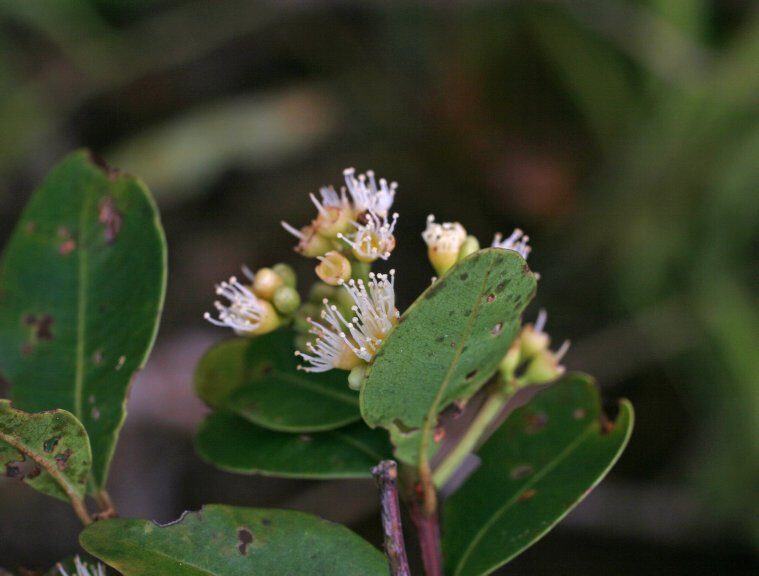
A tree. It grows 12-25 m tall. The young shoots are whitish with silky hairs. The leaves are stiff and bluish and have a sharp point at the tip. There are 5 veins along them. The flowers are creamy-white and like bottle-brushes. The fruit are woody capsules about 4 mm across.
Edible Uses
The paper-like bark is used traditionally for making coolamons and shelters and for wrapping baked food and lining ground ovens. The nectar is extracted traditionally by washing in coolamons of water which is subsequently consumed as a beverage. The scented flower also produces a light to dark amber honey depending on the district. It is strongly flavoured and candies readily. It is not regarded as a high-quality honey but nevertheless is popular. Melaleuca quinquenervia is sometimes used as a bonsai. The timber is tolerant of being soaked and is used in fences. Melaleuca quinquenervia is often used as a street tree or planted in public parks and gardens, especially in Sydney. In its native Australia, it is excellent as a windbreak, screening tree and food source for a wide range of local insect and bird species. It can tolerate waterlogged soils.
Traditional Uses
The blossum and young leaves are used for tea. They young leaves are sour and eaten raw. The nectar from the flowers can be used to make a sweet drink. Caution: The aroma can cause allergies.
Medicinal Uses
Cajeput oil obtained from leaves and twigs of this and related species by steam distillation is used in medicine and local remedies. The foliar leaf oils of M. Quinquenervia fall into 2 classes, based on their chemical composition. One chemotype is rich in nerolidol (90%); the other is 1,8-cineole (30-70%) and sometimes viridiflorol (0-60%). It is the cineole-rich chemotype that is the source of niaouli oil, which is produced in New Caledonia. Niaouli oil is similar to cajuput oil in composition and medicinal use.
Known Hazards
To many people, the species is undesirable because of its reputation for causing respiratory problems.
Distribution
It is a subtropical plant. It grows in swampy places. It can grow in sand and soil that is flooded occasionally.
Where It Grows
Australia, Guiana, Hawaii, Indochina, New Caledonia, Pacific, Papua New Guinea, PNG, SE Asia, Sri Lanka, Thailand, USA,
Cultivation
A plant of tropical and subtropical regions, in the south of its natural range it occurs in the warm subhumid and humid climatic zones and in the north is found in the hot humid zone. It is found at elevations from sea level to 1,000 metres, depending on latitude, growing in areas where the mean annual temperature ranges from 17 - 26°c and the mean annual rainfall is 800 - 3,440 mm. It can tolerate a dry season of 0 - 7 months a year. Plants can tolerate occasional light frosts, but severe frosts will defoliate and kill the branches. The tree will often recover by epicormic sprouting. Grows on most soil types varying from wet clays to saline and dry. Tolerant of salt-laden winds. Plants can tolerate prolonged flooding and a fluctuating water table. Plants have succeeded in calcareous sands and also in acid conditions with a pH as low as 4.5. The species seeds profusely and can become a weed, especially where periodic fires provide a suitable seedbed. The plant has escaped from cultivation and become naturalised in many areas of the tropics and subtropics. In many areas it has become an undesirable weed, being particularly invasive in wetlands. Growth is relatively fast on sites where water is abundant and soils are deep but is not impressive under marginal conditions. The plant flowers prolifically, and in Florida flowering occurs by the age of three. Seedlings less than 1 metre tall have been known to flower. The minute seeds begin to be produced when the trees are 3-4 years old and are only released from the fruit when the branches are subjected to fire, frost, wind breakage, natural pruning, or other damage that disrupts the capsules' vascular systems, causing them to dehisce. Trees are highly fire tolerant during all but the early seedling stages. Trees have the ability to coppice readily, but root suckers are not commonly produced. The leaves have a resinous odour and taste when crushed.
Propagation
Seed - it can be sown either onto germination beds or directly into nursery containers. When the seedlings are 2 - 3 cm high (usually 4 - 8 weeks after sowing), they are either transplanted or thinned, depending on the sowing method used. Because the seeds are so small, care is needed to ensure that the sowing mix does not dry out, any diseases are avoided or controlled, and that seed and small seedlings are not damaged or washed away by careless watering. Seed storage behaviour is orthodox; no loss in viability after 4 years of storage at 30% and up to 75% relative humidity at 10°c. Many species within the genus are vegetatively propagated from cuttings or by micropropagation, and these techniques should also be successful with this species.
Other Uses
The leaves are a source of oil of Cajeput or Tea Tree Oil. It can be used as a mosquito repellent and is also effective against lice and fleas. The oil serves as a solvent and cleaning agent. Dissolving caoutchouc, it creates a good varnish. In dentistry, it is used to relieve the pain of dry sockets. The thick spongy bark is distinctive and can be peeled off in large flakes. It can be used in many of the same ways as cork, being useful for its insulating properties, as a mulch, a float, in life belts, and is also used as a stuffing material for pillows, cushions and mattresses. The sapwood is pale yellow to pink, the heartwood pink to reddish-brown with light and dark rippled figuring. The wood is hard, fine textured, porous, tough, tending to warp and difficult to season. It contains silica that rapidly blunts saws and planes. The wood is used for a wide range of purposes, including mine timber, fence posts and rails, cabinet work, carving, flooring and house timbers. It has been widely used as a source of pulp. Exuding resin as it burns, the wood is an excellent fuel and makes good-quality charcoal. The papery bark is easily ignited and has high heating value. Reported calorific value for the wood is 4400 kcal/kg and for bark 6160 kcal/kg, but there is great variability in these values between trees. The tree is suitable for beach planting and erosion control on degraded and poor soils. It can also be grown as a windbreak. It is an ideal species for revegetating denuded soils.
Other Information
It is cultivated.
Synonyms
References (8)
- Anon., 2003, Native Plants for the Fitzroy basin. Society for Growing Australian Plants Inc. (Rockhampton Branch) p 66
- Facciola, S., 1998, Cornucopia 2: a Source Book of Edible Plants. Kampong Publications, p 142
- Melzer, R. & Plumb, J., 2011, Plants of Capricornia. Belgamba, Rockhampton. p 259
- Proc. Roy. Soc. Queensland 69:76. 1958
- Setalaphruk, C. & Price, L. L., 2007, Children's traditional ecological knowledge of wild food resources: a case study in a rural village in Northeast Thailand. Journal of Ethnobiology and Ethnomedicine. 3:33
Show all 8 references Hide references
- Staples, G.W. and Herbst, D.R., 2005, A tropical Garden Flora. Bishop Museum Press, Honolulu, Hawaii. p 423 (Drawing)
- World Checklist of Useful Plant Species 2020. Royal Botanic Gardens, Kew
- Zeven, A. C. & de West, J. M. J., 1982, Dictionary of cultivated plants and their regions of diversity. Wageningen. p 61