Boesenbergia rotunda
(L.) Mansfield
Chinese keys
iNaturalist· cc-by-nc
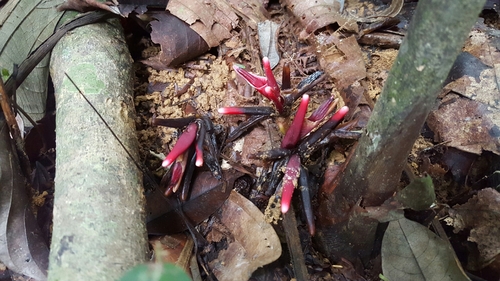
(c) Naufal Urfi Dhiya'ulhaq, some rights reserved (CC BY-NC)
iNaturalist· cc-by-nc
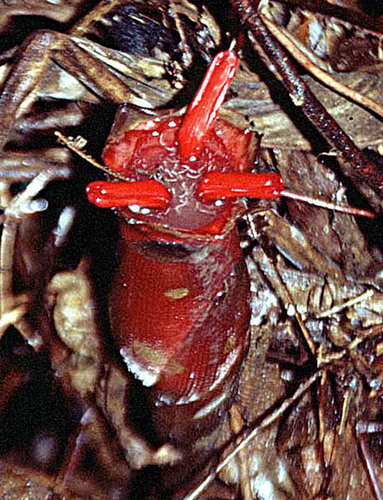
(c) Naufal Urfi Dhiya'ulhaq, some rights reserved (CC BY-NC)
iNaturalist· cc-by-nc
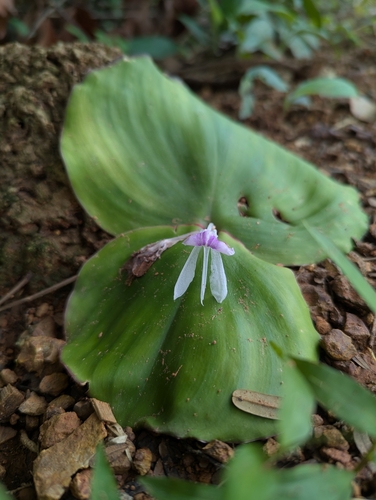
(c) Mitchell Scott, some rights reserved (CC BY-NC)
Summary
Source: WikipediaBoesenbergia rotunda (Thai: กระชาย, romanized: krachai, Khmer: ខ្ជាយ, romanized: k'jeay, Indonesian: temu kunci, Burmese: ဆိတ္ဖူး, romanized: Hsei' Hpu), commonly known as Chinese keys, fingerroot, lesser galangal or Chinese ginger, is a medicinal and culinary herb from China and Southeast Asia. In English, the root has traditionally been called fingerroot, because the shape of the rhizome resembles that of fingers growing out of a center piece.
Description
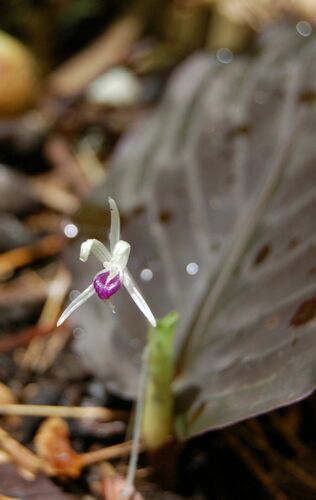
A part of the ginger family. The plant continues to grow from year to year. The plant is 30-50 cm high. The roots are like a long orange brown group of fingers. These rhizomes are the size of fingers. They are 6-10 cm long and 1 cm wide. Inside the brown skin is a yellow sweet smelling tissue. The leaves occur as 3-4 leaves 10-30-50 cm long by 5-10 cm wide. The leaf stalk is 5-12 cm long and has a channel. The leaf sheath is red. The flowers are at the ends of the stalk. There are few flowers surrounded by narrow bracts. Each bract 5 cm long surrounds one flower. The flowers are white or pink. The flowers have a smell. The fruit is oval.
Edible Uses
The swollen rhizomes are eaten raw, used in soups with vegetables, and in fish curries. The roots provide spicy flavoring to many dishes. Young leaves are sometimes used as a spice, and leaves are occasionally used in pickles.
Traditional Uses
The swollen rhizomes are eaten raw, used in soups along with vegetables, and in fish curries. In some places the leaves are used in pickles. The roots give a spicy flavour to many dishes. The rhizome is used to spice food. The very young leaves are sometimes used as a spice.
Medicinal Uses
Fingerroot is known as temu kunci in Indonesian. It is widely used in Javanese cuisine in Indonesia. In addition to its culinary uses, it is also specifically used as a spice, or as flavoring agents, dyes, or also traditional medicine. After its discovery, B. rotunda has been used as research material in rat studies and microbiological studies. In Thai cooking, fingerroot is called krachai (Thai: กระชาย; pronounced [krà.tɕʰāːj]) and is an ingredient in dishes such as kaeng tai pla. It is used in some kroeung pastes of Cambodian cuisine and is known as k'cheay (Khmer: ខ្ជាយ). In the west it is usually found pickled or frozen. The rhizomes are commonly used as vegetables in main dishes or eaten raw when young. It is also used to help make fermented soya bean cake, also called tempeh, a traditional Indonesian food. Its roots and rhizomes are cultivated in Indonesia, Indochina, and India in small homes and is also popularly used in flavorful curry dishes. Fingerroot is also incorporated into tonic mixtures such as the famous Indonesian tonic jamu. It is sometimes confused with Alpinia officinarum, another plant in the family Zingiberaceae which is also known as lesser galangal.
Distribution
It is a tropical plant. In colder regions, leaves will die back in winter. They need a fertile, open, loamy soil. The soil need to be well drained. They shoot best with warmth and humidity. They then grow best in warm shady positions. They need a rainfall of 1000 mm per year. In China it grows in dense forests at about 1000 m in S China. In Cairns Botanical Gardens.
Where It Grows
Andamans, Asia, Australia, Cambodia, Canada, China, Hawaii, India, Indochina, Indonesia, Laos, Malaysia, Myanmar, Northeastern India, Pacific, SE Asia, Sri Lanka, Thailand, USA, Vietnam,
Cultivation
Plants are grown from pieces of root with one or two buds attached. These are planted 5 cm deep.
Propagation
Seed - needs to be sown as soon as it is ripe in containers at a temperature of 20c. Division. A rhizome cutting planted in the open produces 4 - 5 leaves in about 1 month after planting; under shade, only 2 leaves are produced.
Other Information
It is a cultivated food plant. It is commonly used in cooking.
Notes
There are about 50 Boesenbergia species. It has several flavonoids.
Synonyms
Also Known As
Ardong, Bhuchampakamu, Bhuichampa, Chee-puu, Chinese ginger, Dekunchi, Finger root ginger, Kachai, Khchiey, Kondakalava, Kra chaai, Krachai, Kunci, Kunir putih, Merkunchi, Poh-see, Seik-phoo, Suo shi, Temoo kuntji, Temu kechil, Temu kunchi, Temu kunci, Temu putri, Tiha, Tihaso, Yai macha
References (50)
- Ambasta, S.P. (Ed.), 2000, The Useful Plants of India. CSIR India. p 233 (As Gastrochilus panduratus)
- Anderson, E. F., 1993, Plants and people of the Golden Triangle. Dioscorides Press. p 213 (As Kaempferia pandurata)
- Arora, R. K., 2014, Diversity in Underutilized Plant Species - An Asia-Pacific Perspective. Bioversity International. p 100
- Bremness, L., 1994, Herbs. Collins Eyewitness Handbooks. Harper Collins. p 155
- Burkill, I.H., 1966, A Dictionary of the Economic Products of the Malay Peninsula. Ministry of Agriculture and Cooperatives, Kuala Lumpur, Malaysia. Vol 1 (A-H) p 1079 (As Gastrochilus panduratus)
Show all 50 references Hide references
- Ching, A. Y., Wah, T. S., Sukari, M. A., Lian, G. E. C., Rahmani, M. and Khalid, K., 2007, Characterization of flavonoid derivatives from Boesenbergia rotunda (L.), The Malaysian, Journal of Analytical Sciences 11, pp. 154–157.
- Eiadthong, W., et al, 2010, Management of the Emerald Triangle Protected Forests Complex. Botanical Consultant Technical Report. p 23
- e-monocot.org/taxon/urn:kew.org:wcs:taxon:219874
- Ethnobotany of Karbis. Chapter 4 in p 107
- Facciola, S., 1998, Cornucopia 2: a Source Book of Edible Plants. Kampong Publications, p 247 (As Boesenbergia pandurata)
- Foo, J.T.S.(ed), 1996, A Guide to Common Vegetables. Singapore Science Foundation. p 148
- Food Composition Tables for use in East Asia FAO http://www.fao.org/infoods/directory No. 694 (As Kaempferia pandurata)
- Hibbert, M., 2002, The Aussie Plant Finder 2002, Florilegium. p 44
- Hutton, W., 1997, Tropical Herbs and Spices of Indonesia. Periplus. p 22
- J. Straits Branch Roy. Asiat. Soc. 32:110, 114. 1899 (As Gastrochilus panduratus)
- Kulturpflanze 6:239. 1958
- Jacquat, C., 1990, Plants from the Markets of Thailand. D.K. Book House p 115
- Japanese International Research Centre for Agricultural Science www.jircas.affrc.go.jp/project/value_addition/Vegetables
- Jiwajinda, S., et al, 2002, Suppressive Effects of Edible Thai Plants on Superoxide and Nitric Oxide Generation. Asian Pacific Journal of Cancer Prevention, Vol 3, 2002 (As Boesenbergia pandurata)
- Kachenchart, B., et al, 2008, Phenology of Edible Plants at Sakaerat Forest. In Proceedings of the FORTROP II: Tropical Forestry Change in a Changing World. Bangkok, Thailand.
- Kew, Plants of the World on Line
- Kirana, C., and Jones, G. P., 2007, Record IR, McIntosh GH. Anticancer properties of panduratin A isolated from Boesenbergia pandurata (Zingiberaceae), Journal of Natural Medicine 61: pp. 131–136.
- Larsen, K., Ibrahim, H., Khaw, S.H., & Saw, L.G., 1999, Gingers of Peninsula Malaysia and Singapore. Natural History Publications (Borneo). p 9, 42
- Lembaga Biologi Nasional, 1977, Ubi-Ubian, Balai Pustaka, Jakarta. p 82
- Lembogi Biologi Nasional, 1980, Sayur-sayuran. Balai Pustaka, Jakarta. p 74
- Lim, T. K., 2015, Edible Medicinal and Non Medicinal Plants. Volume 9, Modified Stems, Roots, Bulbs. Springer p 16, 50
- Martin, F.W. & Ruberte, R.M., 1979, Edible Leaves of the Tropics. Antillian College Press, Mayaguez, Puerto Rico. p 225 (As Kaempferia pandurata)
- Md-Mustafa, N. D., et al, 2014, Transcriptome profiling shows gene regulation patterns in a flavonoid pathway in response to exogenous phenylalanine in Boesenbergia rotunda cell culture. BMC Genomics, 15:984
- Nakahara, K. et al, 2002, Antimutagenicity of Some Edible Thai Plants, and a Biocative Carbazole Alkaloid, Mahanine, Isolated from Micromelum minutum. Journal of Agricultural and Food Chemistry. 50: 4796-4892 (As Boesenbergia pandurata)
- Norrington, L., & Campbell, C., 2001, Tropical Food Gardens. Bloomings Books. p 68
- Ochse, J. J. et al, 1931, Vegetables of the Dutch East Indies. Asher reprint. p 750 (As Kaempferia pandurata)
- Phon, P., 2000, Plants used in Cambodia. © Pauline Dy Phon, Phnom Penh, Cambodia. p 97
- PROSEA (Plant Resources of South East Asia) handbook, Volume 2, 1991, Edible fruits and nuts.
- Recher, P, 2001, Fruit Spirit Botanical Gardens Plant Index. www.nrg.com.au/~recher/ seedlist.html p 3 (As Bosenberg pandurata)
- Seidemann J., 2005, World Spice Plants. Economic Usage, Botany, Taxonomy. Springer. p 67
- Shindo, K., Kato, M., Kinoshita, A., Kobayashi, A. and Koike, Y., 2006, Analysis of antioxidant activities contained in the Boesenbergia pandurata Schult. rhizome. Bioscience, Biotechnology and Biochemistry, vol. 70, no. 9, pp. 2281–2283.
- Singh, H.B., Arora R.K.,1978, Wild edible Plants of India. Indian Council of Agricultural Research, New Delhi. p13 (As Gastrochilus panduratus)
- Solomon, C., 2001, Encyclopedia of Asian Food. New Holland. p 197
- Sukarya, D. G., (Ed.) 2013, 3,500 Plant Species of the Botanic Gardens of Indonesia. LIPI p 1084
- Tanaka,
- Teron, R. & Borthakur, S. K., 2016, Edible Medicines: An Exploration of Medicinal Plants in Dietary Practices of Karbi Tribal Population of Assam, Northeast India. In Mondal, N. & Sen, J.(Ed.) Nutrition and Health among tribal populations of India. p 157
- Terra, G.J.A., 1973, Tropical Vegetables. Communication 54e Royal Tropical Institute, Amsterdam, p 54 (As Kaempferia pandurata)
- Uphof,
- van Wyk, B., 2005, Food Plants of the World. An illustrated guide. Timber press. p 92
- Wiersema, J. H. & Leon, B., 2013, World Economic Plants. A Standard Reference CRC Press. 2nd Ed. p 106
- Woodward, P., 2000, Asian Herbs and Vegetables. Hyland House. p 34
- World Checklist of Useful Plant Species 2020. Royal Botanic Gardens, Kew
- Wu Delin, Larsen, K., Zingiberaceae. Flora of China.
- Zainin, N. S., Lau, K. Y., Zakaria, M., Son, R., Abdull Razis, A. F. and Rukayadi, Y., 2013, Antibacterial activity of Boesenbergia rotunda (L.) Mansf. A. extract against Escherichia coli, International Food Research Journal 20(6), pp. 3320-3321
- Zeven, A. C. & de West, J. M. J., 1982, Dictionary of cultivated plants and their regions of diversity. Wageningen. p 64 (As Boesenbergia pandurata)