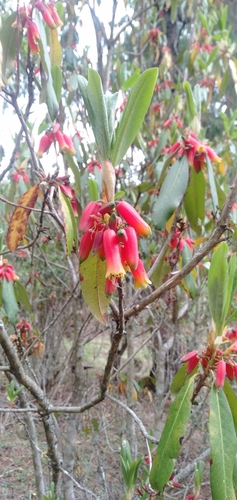
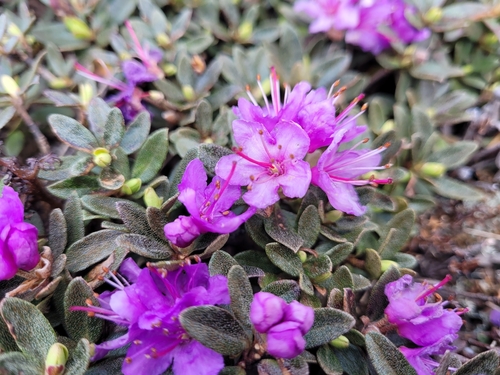
Vaccinium deliciosum
Piper
Alpine blueberry, Cascade bilberry, Blue huckleberry, Rainier bilberry
iNaturalist· cc-by-nc
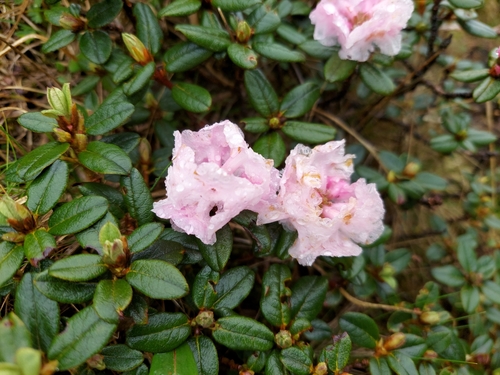
(c) Joan Septembre, some rights reserved (CC BY-NC), uploaded by Joan Septembre
iNaturalist· cc-by-nc
(c) Boreal_exploration, some rights reserved (CC BY-NC)
iNaturalist· cc-by-nc
(c) Ольга Курякова, some rights reserved (CC BY-NC), uploaded by Ольга Курякова
Summary
Source: WikipediaVaccinium deliciosum is a species of bilberry known by the common names Cascade bilberry, Cascade blueberry, and blueleaf huckleberry. It is a flowering plant in the heath family Ericaceae. The species is native to western North America.
Description
A small shrub. It forms tufted mats. They are usually 10-30 cm high. It spreads by rhizomes. The young twigs are grey-green and rounded. The leaves are 15-30 mm long and 5-8 mm wide. There are broad teeth on the upper parts of the leaves. The leaves turn bright red in autumn. The flowers occur singly. They are round and creamy pink. They are 5-8 mm wide. The fruit are blue-black berries. These are 5-8 mm across and are edible.
Edible Uses
The fruit can be eaten raw or cooked. When fully ripe it is sugary sweet with a delightful aroma and a full, rich flavour, making it excellent for eating straight off the bush. It can also be dried for later use. The fruit is about 6mm in diameter.
Traditional Uses
The ripe fruit are eaten fresh. They are stewed and made into a sauce. The fruit are canned and used as winter food. They can be dried and stored.
Medicinal Uses
None known
Known Hazards
None known
Distribution
It is a temperate plant. It grows naturally in alpine meadows and subalpine pine forests. It is hardy to frosts.
Where It Grows
Canada, North America*, USA,
Cultivation
Requires a moist but freely-draining lime free soil, preferring one that is rich in peat or a light loamy soil with added leaf-mould. Prefers a very acid soil with a pH in the range of 4.5 to 6, plants soon become chlorotic when lime is present. Succeeds in full sun or light shade though it fruits better in a sunny position. Requires shelter from strong winds. Grows well in a moist position in a rock garden. Plants spread rapidly when growing in a suitable position. Dislikes root disturbance, plants are best grown in pots until being planted out in their permanent positions. This species is closely allied to V. caespitosum. Plants in this genus are notably resistant to honey fungus.
Propagation
Sow seed in late winter in a greenhouse using a lime-free potting mix, barely covering the seed. Stored seed may need up to 3 months of cold stratification. Alternatively, sow fresh seed in a greenhouse as soon as it is ripe. Prick seedlings out into individual pots once they reach about 5cm tall, and grow on in a lightly shaded position in the greenhouse through at least their first winter. Plant out into permanent positions in late spring or early summer, after the last expected frosts. Cuttings of half-ripe wood, 5–8cm with a heel, can be taken in August and rooted in a frame, though this is slow and difficult. Layering can be done in late summer or early autumn, or in spring according to some sources, and takes 18 months. Suckers can be divided in spring or early autumn.
Other Uses
None known
Dangerous Lookalikes
This plant can be confused with the following toxic species. Always verify identification carefully before consuming any wild plant.
Deadly Nightshade
Atropa belladonna
Joan Simon from Barcelona, España
Alpine blueberry
Vaccinium deliciosum
(c) Joan Septembre, some rights reserved (CC BY-NC), uploaded by Joan Septembre
Deadly Nightshade: Tall herbaceous plant (1-2m), single shiny black cherry-sized berries, star-shaped calyx, large oval leaves, sweet but dangerous taste.
Alpine blueberry: Low woody shrub, berries in clusters with crown/remnant calyx ring, sweet taste.
References (8)
- Facciola, S., 1998, Cornucopia 2: a Source Book of Edible Plants. Kampong Publications, p 97
- Kermath, B. M., et al, 2014, Food Plants in the Americas: A survey of the domesticated, cultivated and wild plants used for Human food in North, Central and South America and the Caribbean. On line draft. p 893
- Lyle, S., 2006, Discovering fruit and nuts. Land Links. p 223
- Mazama 2:103. 1901
- Moerman, D. F., 2010, Native American Ethnobotany. Timber Press. p 583
Show all 8 references Hide references
- Plants for a Future database, The Field, Penpol, Lostwithiel, Cornwall, PL22 0NG, UK. http://www.scs.leeds.ac.uk/pfaf/
- Trehane, J., 2004, Blueberries, Cranberries and Other Vacciniums. Timber Press. p 224
- Turner, N., et al, 2011, "Up on the Mountain": Ethnobotanical Important of Montane Sites in Pacific Coastal North America. Journal of Ethnobiology 31(1): 4-43