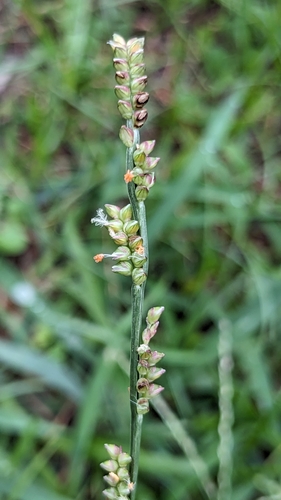
Indocalamus tessellatus
(Munro) Keng f.
Large-leaved bamboo, Zong ye zhu
iNaturalist· cc-by-nc
(c) bscrl, some rights reserved (CC BY-NC), uploaded by bscrl
iNaturalist· cc-by-nc-nd
(c) Henryr10, some rights reserved (CC BY-NC-ND)
iNaturalist· cc-by-nc
(c) Hugo Sun, some rights reserved (CC BY-NC)
Summary
Source: WikipediaIndocalamus tessellatus, the large-leaved bamboo, is a species of flowering plant in the grass family Poaceae, native to China. A medium-sized, hardy evergreen bamboo growing to 2 m (6.6 ft), it forms a clump of broad leaves 60 cm (24 in) long and up to 10 cm (3.9 in) wide – the broadest of any bamboo – which cause the slender cane to bend under their weight. Though hardy down to −15 °C (5 °F) and able to survive conditions in most of the UK, it prefers a sheltered site in semi-shade with moist, rich soil. Given the best conditions possible, it will eventually form large thickets or groves, but can be kept in a large container. In cultivation in the UK it has gained the Royal Horticultural Society's Award of Garden Merit.
Description
A bamboo. It grows 1-2 m tall. The stems are 4-7 mm across. The internodes are 25 cm long. It has the largest leaves of any bamboo. They can be 20-60 cm long and 10 cm wide.
Edible Uses
The leaves are used as flavouring, with rice dishes wrapped in or cooked in the leaves to absorb their flavour.
Traditional Uses
Rice dishes are wrapped in or cooked in the leaves to absorb the flavour of the leaves.
This uses section is brief — help expand it
Distribution
It is a temperate plant. It grows in open forests and on mountain slopes between 300-1,400 m above sea level.
Where It Grows
Asia, China*,
References (5)
- Cotterell,
- Facciola, S., 1998, Cornucopia 2: a Source Book of Edible Plants. Kampong Publications, p 46
- Y.-L. Keng, Clav. gen. spec. gram. sinic. 152. 1957
- Lee,
- Ryan, S., 2008, Dicksonia. Rare Plants Manual. Hyland House. p 84