Kirkia wilmsii
Engl.
Mountain syringa
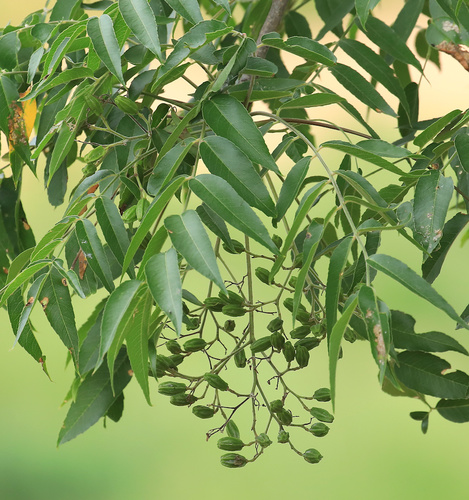
iNaturalist· cc-by-nc
(c) Charles Hopkins, some rights reserved (CC BY-NC), uploaded by Charles Hopkins
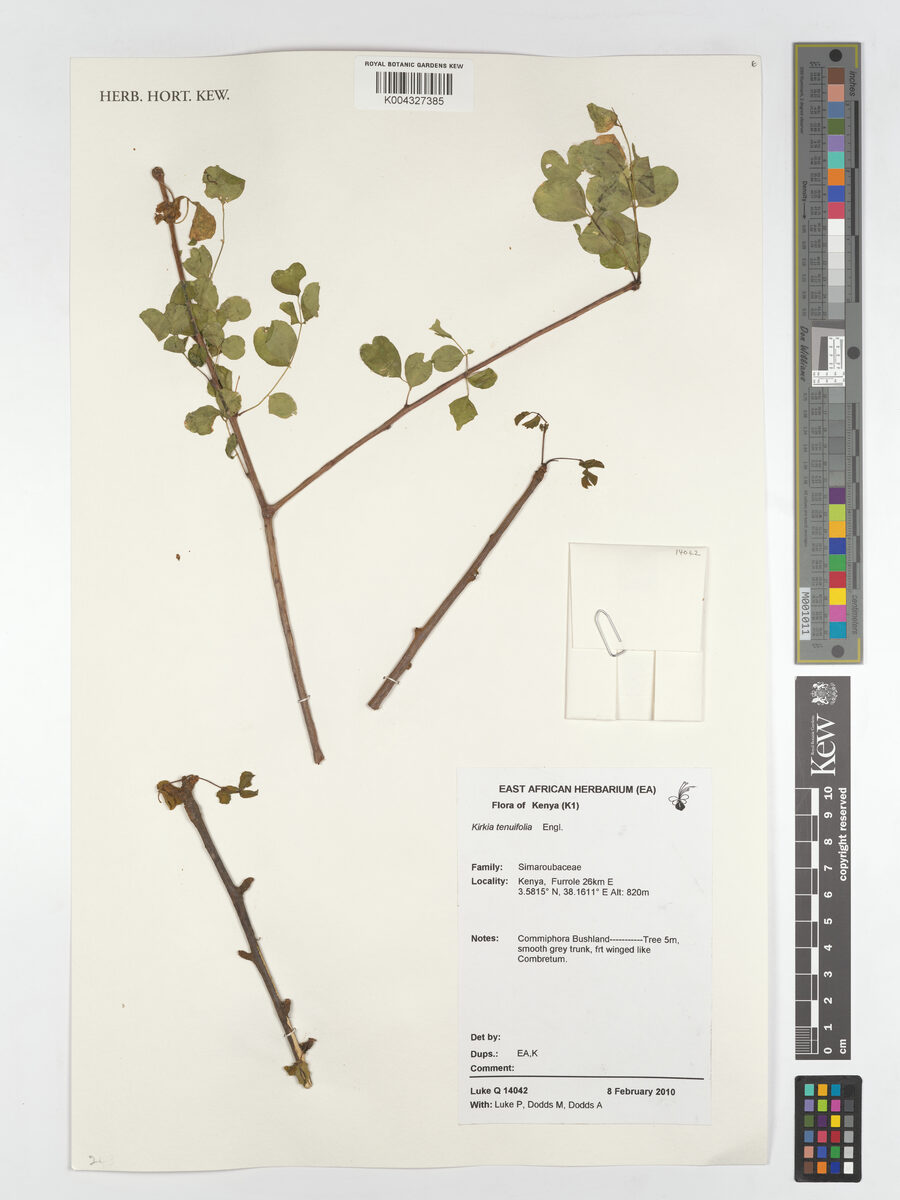
iNaturalist· cc-by-nc
(c) Troos van der Merwe, some rights reserved (CC BY-NC), uploaded by Troos van der Merwe
iNaturalist· cc-by-nc
(c) Troos van der Merwe, some rights reserved (CC BY-NC), uploaded by Troos van der Merwe
Description
It is a deciduous tree. It grows 8-18 m tall. The crown is round or spreading. The leaves are crowded at the tips. They are 10-20 cm long. They are compound with 20-40 leaflets. These are shiny and grey-green. The flowers are greenish-white and in compound heads. The fruit are small and light brown. They are 4 valved capsules.
Edible Uses
The swollen roots are chewed to quench thirst and can be eaten for their water content.
Traditional Uses
The swollen roots are chewed to quench thirst.
This uses section is brief — help expand it
Distribution
It is a tropical plant. It is frost and drought resistant once established. It can grow in arid places.
Where It Grows
Africa, South Africa, Southern Africa,
Cultivation
Plants can be grown from seeds. The seeds are small and sown with fine sand. They can also be grown from cuttings or large branch sections.
Propagation
Seed - easy. Cuttings root easily.
Other Uses
A rather strong fibre is obtained from the bark. It can be used for weaving.
Production
The large swollen tubers can be 30 cm long.
Notes
It is also put in the family Simaroubaceae.
References (12)
- Fox, F. W. & Young, M. E. N., 1982, Food from the Veld. Delta Books. p 342
- Heywood, V.H., Brummitt, R.K., Culham, A., and Seberg, O. 2007, Flowering Plant Families of the World. Royal Botanical Gardens, Kew. p 177
- Notizbl. Koenigl. Bot. Gart. Berlin 2:25. 1897
- Palmer & Pitman, 1972,
- Peters & Maguire, 1981,
Show all 12 references Hide references
- Peters, C. R., O'Brien, E. M., and Drummond, R.B., 1992, Edible Wild plants of Sub-saharan Africa. Kew. p 186
- Royal Botanic Gardens, Kew (1999). Survey of Economic Plants for Arid and Semi-Arid Lands (SEPASAL) database. Published on the Internet; http://www.rbgkew.org.uk/ceb/sepasal/internet [Accessed 11th June 2011]
- Ruiters-Welcome, A. K., 2019, Food plants of southern Africa. Ph.D. thesis. Univ. of Johannesburg p 69
- Schmidt, E., Lotter, M., & McCleland, W., 2007, Trees and shrubs of Mpumalanga and Kruger National Park. Jacana Media p 242
- Venter, F & J., 2009, Making the most of Indigenous Trees. Briza. p 204
- Welcome, A. K. & Van Wyk, B.-E., 2019, An inventory and analysis of the food plants of southern Africa. South African Journal of Botany 122 (2019) 136–179
- World Checklist of Useful Plant Species 2020. Royal Botanic Gardens, Kew