Kirkia acuminata
Oliver
White syringa, Mountain kirkia, Common kirkia
iNaturalist· cc-by
(c) Wynand Uys, some rights reserved (CC BY), uploaded by Wynand Uys
iNaturalist· cc-by-nc
(c) Grant Reed, some rights reserved (CC BY-NC), uploaded by Grant Reed
iNaturalist· cc-by-nc
(c) Alex Dreyer, some rights reserved (CC BY-NC), uploaded by Alex Dreyer
Description
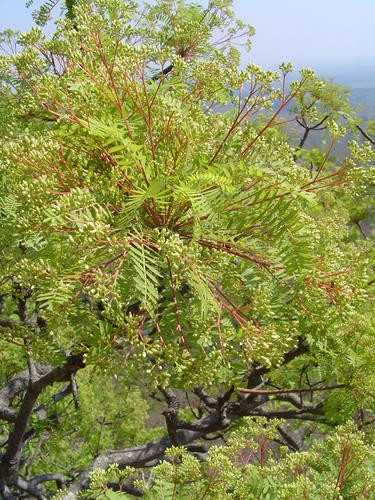
It is a deciduous tree. It grows 6-16 m tall. It has a clean trunk. The branches are straight. The bark is grey and smooth when young but becomes corrugated in old age. The leaves are 10-45 cm long. The leaves have 6-10 pairs of leaflets. They are larger towards the tip. The leaflets are 2-8 cm long by 1-3 cm wide. The flowering stalks are branched and hairy with several flowers. The flowers are pale green to cream and of 2 forms some being male and others female. The fruit are 1-2 cm long and about 1 cm wide. They are woody.
Edible Uses
The swollen roots are chewed to quench thirst. The fruits are also edible.
Traditional Uses
The swollen root is chewed to quench thirst.
This uses section is brief — help expand it
Medicinal Uses
An infusion of the bark is taken as a remedy against vomiting and abdominal pain. An infusion of the root is taken to treat coughs. The pulverized roots are a remedy for toothache. The fruit sap is applied on wounds and is used as an antidote on snake bites.
Known Hazards
Frost damage.
Distribution
It is a tropical plant. It grows in woodland on well drained soils. It is usually at about 1,200 m altitude but can grow up to 1,500 m altitude. It can grow on rocky soils and in a range of other soil types. They are drought resistant but damaged by frost. It can grow in arid places.
Where It Grows
Africa, Angola, Botswana, Central Africa, Congo, East Africa, Eswatini, Malawi, Mozambique, Namibia, South Africa, Southern Africa, Swaziland, Tanzania, Zambia, Zimbabwe,
Cultivation
Plants can be grown from seeds. Seeds are sown in sand. They germinate in 8-14 days. Seedlings can be planted out at the 2 leaf stage. It can also be grown from large cuttings of branches.
Propagation
Seed - easy. Cuttings root easily.
Other Uses
A fibre obtained from the bark is made into cloth. The heartwood is pale brown or green-brown, with an attractive dark brown veining; the up to 75mm wide band of sapwood is yellow-white or pale grey. The grain is usually straight, locally interlocked, the texture is fine. The wood is fairly light in weight, soft to moderately hard, moderately durable but the sapwood is susceptible to Lyctus borers. Thin boards dry easily, but thick boards are difficult to season; splitting and surface checking may occur. The wood saws easily, but rapidly blunts tools, due to the presence of silica crystals; frequent sharpening of cutting edges is necessary. It planes easily and turns fairly well; polishes readily; glues satisfactorily and slices and peels well. The wood is used for poles and planks, household utensils (bowls, spoons), carts, musical instruments, tourist items, veneer and plywood. In South Africa the wood is made into furniture and floor blocks. It is also considered suitable for light construction, flooring, vehicle bodies, cabinet work, interior trim, agricultural implements, boxes and crates, core stock, matches, toys and novelties, turnery, hardboard and particle board, and as pulpwood. The wood is made into charcoal. The tree is often planted to form a live fence.
Production
Plants are fast growing.
Notes
It is also put in the family Simaroubaceae.
Synonyms
Also Known As
Mubvumba, Mubvumira, Mulembalemba, Mutsakaridze, Mutuhwa, Mutumbi, Tumbue, Umila, Umvumile, Witsering
References (18)
- East African Herbarium records, 1981,
- Flora Zambesiaca. http://apps.kew.org/efloras
- Fowler, D. G., 2007, Zambian Plants: Their Vernacular Names and Uses. Kew. p 42
- Fox, F. W. & Young, M. E. N., 1982, Food from the Veld. Delta Books. p 342
- Heywood, V.H., Brummitt, R.K., Culham, A., and Seberg, O. 2007, Flowering Plant Families of the World. Royal Botanical Gardens, Kew. p 177
Show all 18 references Hide references
- Hooker's Icon. Pl. 11: t. 1036. 1868 Jun; Fl. trop. Afr. 1:311. 1868 Oct
- Joffe, P., 2007, Creative Gardening with Indigenous Plants. A South African Guide. Briza. p 132
- Long, C., 2005, Swaziland's Flora - siSwati names and Uses http://www.sntc.org.sz/flora/
- Mannheimer, C. A. & Curtis. B.A. (eds), 2009, Le Roux and Muller's Field Guide to the Trees and Shrubs of Namibia. Windhoek: Macmillan Education Namibia. p 194
- Palmer, & Pitman, 1972,
- Peters, C. R., O'Brien, E. M., and Drummond, R.B., 1992, Edible Wild plants of Sub-saharan Africa. Kew. p 186
- Royal Botanic Gardens, Kew (1999). Survey of Economic Plants for Arid and Semi-Arid Lands (SEPASAL) database. Published on the Internet; http://www.rbgkew.org.uk/ceb/sepasal/internet [Accessed 11th June 2011]
- Ruiters-Welcome, A. K., 2019, Food plants of southern Africa. Ph.D. thesis. Univ. of Johannesburg p 69
- Schmidt, E., Lotter, M., & McCleland, W., 2007, Trees and shrubs of Mpumalanga and Kruger National Park. Jacana Media p 240
- Venter, F & J., 2009, Making the most of Indigenous Trees. Briza. p 202
- Welcome, A. K. & Van Wyk, B.-E., 2019, An inventory and analysis of the food plants of southern Africa. South African Journal of Botany 122 (2019) 136–179
- World Checklist of Useful Plant Species 2020. Royal Botanic Gardens, Kew
- www.zimbabweflora.co.zw 2011