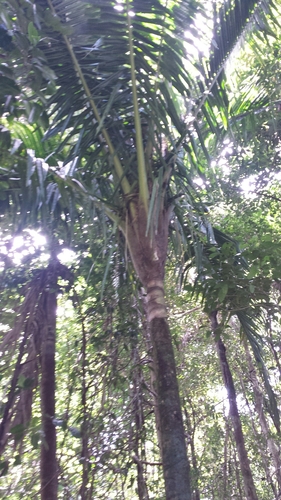
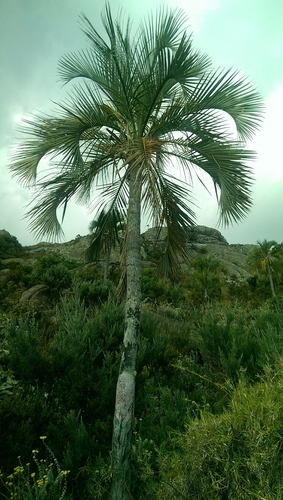
Chamaedorea graminifolia
H. Wendl.
Chapai, Pacaya, Monkeytail pacaya
iNaturalist· cc-by-nc
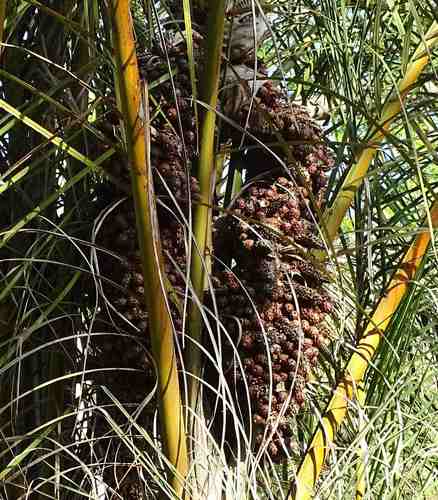
(c) Juan Carlos López Domínguez, some rights reserved (CC BY-NC), uploaded by Juan Carlos López Domínguez
iNaturalist· cc-by-nc
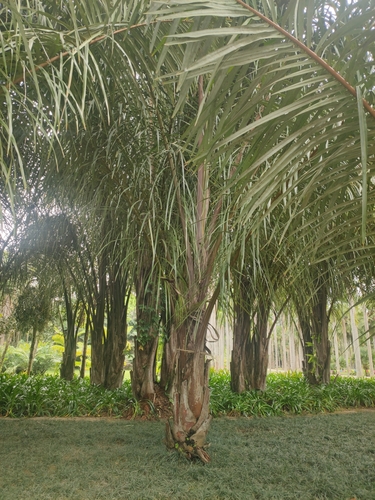
(c) Juan Carlos López Domínguez, some rights reserved (CC BY-NC), uploaded by Juan Carlos López Domínguez
iNaturalist· cc-by-nc
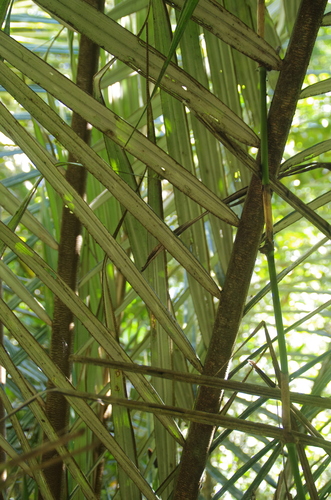
(c) Juan Carlos López Domínguez, some rights reserved (CC BY-NC), uploaded by Juan Carlos López Domínguez
Description
A palm. The stems are in clusters. They are 3 m tall and 2-3 cm across. There are 4-6 leaves. They have leaflets along the stalk. There are 22-42 leaflets on each side. The leaflets are narrow. They are arranged regularly and in the same plane. The few leaflets at the base can be clustered and spread in different planes. The leaflets are 40 cm long and 1.5-2.5 cm wide. The flowering stalk is erect and male and female flowers are similar. There are 10-35 flowering branches. The fruit are round and 0.6-1 cm wide.
Edible Uses
The flowers are cooked in egg batter. The fruit are eaten fresh when ripe or fried in lard and served with tortillas.
Traditional Uses
The flower is cooked in egg batter. The fruit are eaten fresh when ripe. They are also fried in lard and eaten with tortillas.
This uses section is brief — help expand it
Distribution
A tropical plant. It grows in rainforest often on limestone soils. It grows between 700-1500 m altitude in Central America.
Where It Grows
Belize, Central America, Costa Rica, El Salvador, Guatemala, Honduras, Mexico, North America,
Cultivation
A dioecious species, both male and female forms need to be grown if fruit and seed are required.
Notes
There are about 100 Chamaedorea species. They are mostly in Central America. There are 77 species in tropical America.
Synonyms
References (8)
- Balick, M.J. and Beck, H.T., (Ed.), 1990, Useful palms of the World. A Synoptic Bibliography. Colombia p 275
- Facciola, S., 1998, Cornucopia 2: a Source Book of Edible Plants. Kampong Publications, p 27 (?Also as Chamaedorea costaricana)
- Grandtner, M. M., 2008, World Dictionary of Trees. Wood and Forest Science Department. Laval University, Quebec, Qc Canada. (Internet database http://www.WDT.QC.ca)
- Henderson, A., Galeano, G and Bernal, R., 1995, Field Guide to the Palms of the Americas. Princeton. p 96
- Index palm. 62. 1854
Show all 8 references Hide references
- Lentz, D. L., 1993, Medicinal and Other Economic Plants of the Paya of Honduras. Economic Botany, Vol. 47, No. 4, pp. 358-370
- Tanaka,
- Uphof,