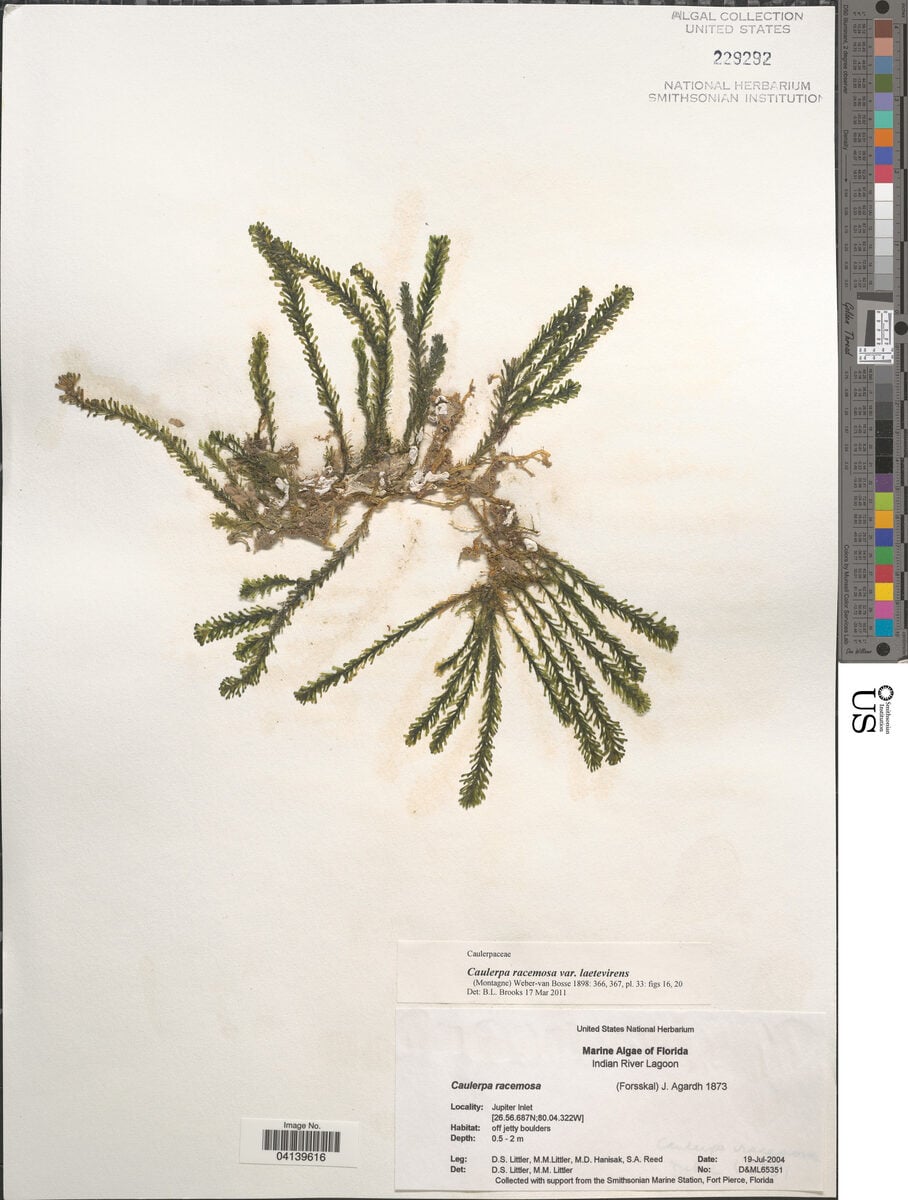
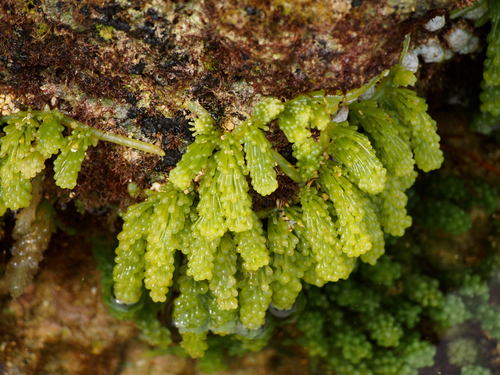
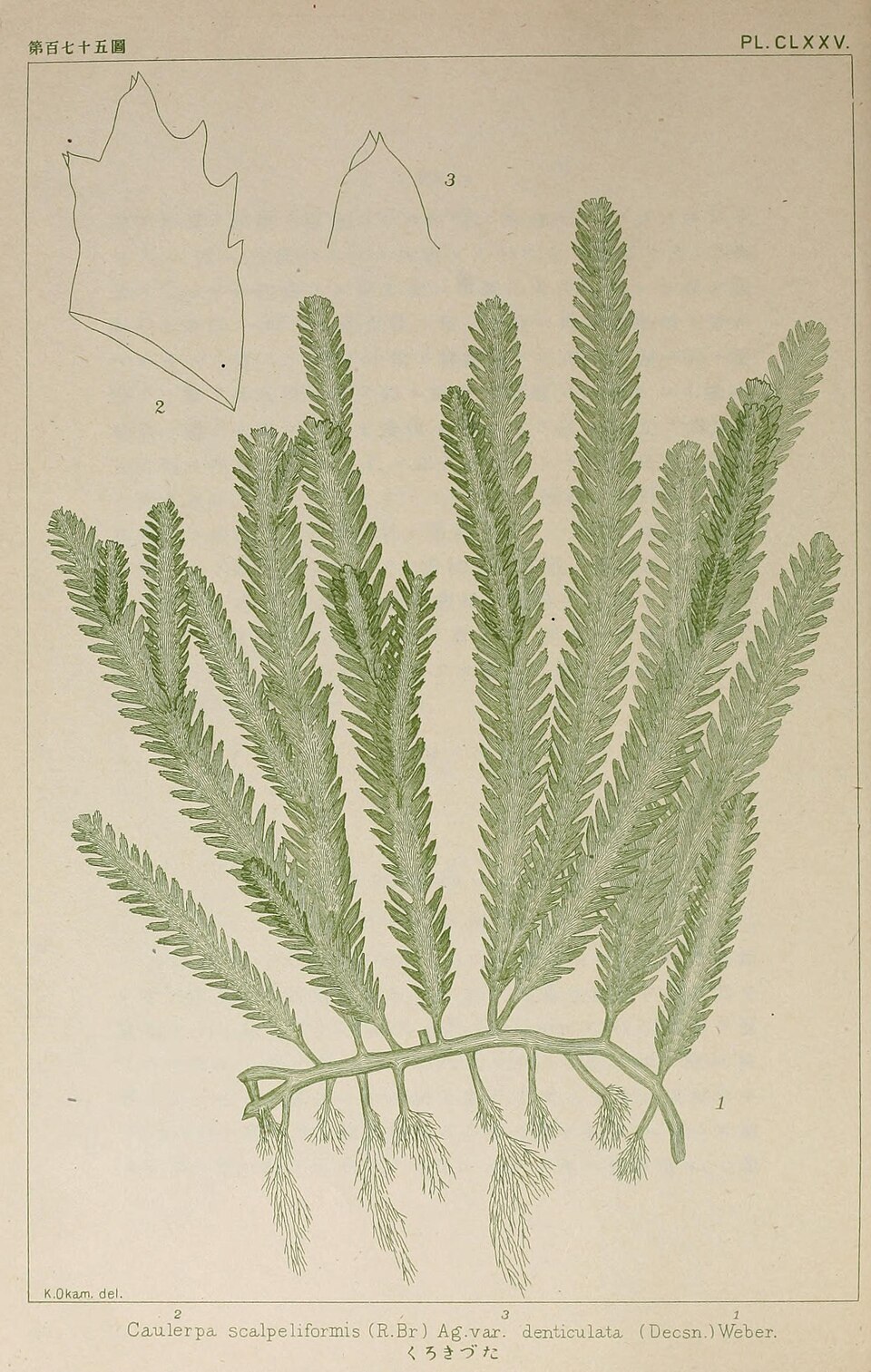
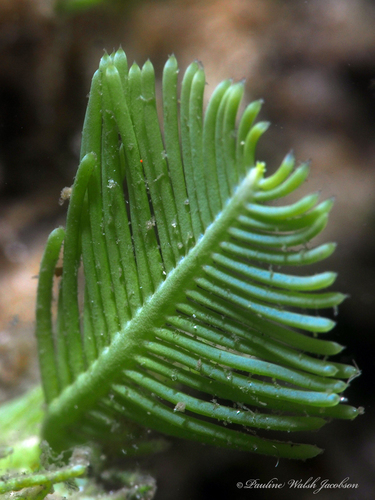
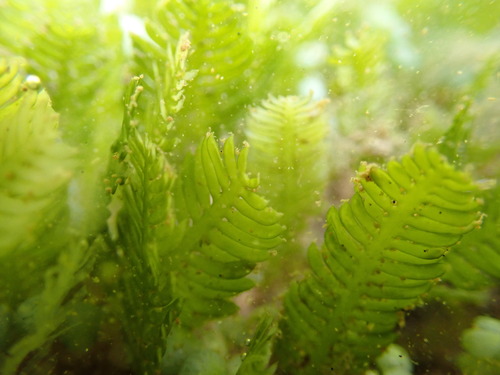
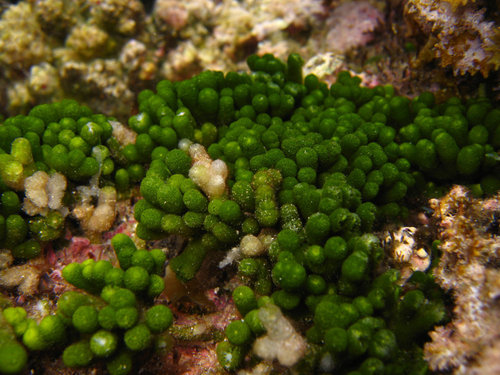
Caulerpa racemosa var. occidentalis
(J. Agardh) Boergesen
gbif· cc0
Conveyor Belt
gbif· cc-by-nc
University of North Carolina at Chapel Hill Herbarium; Max & Fran Hommersand Algae Herbarium: Algae (NCU-Algae)
gbif· cc-by-nc
University of North Carolina at Chapel Hill Herbarium; Max & Fran Hommersand Algae Herbarium: Algae (NCU-Algae)
Summary
Source: WikipediaCaulerpa racemosa is a species of edible green alga, a seaweed in the family Caulerpaceae. It is commonly known as sea grapes (along with the related Caulerpa lentillifera) and is found in many areas of shallow sea around the world. Despite the name, it is not related to grapes. There are a number of different forms and varieties, and one that appeared in the Mediterranean Sea in 1990, which is giving cause for concern as an invasive species.
Description
A seaweed. It has small branches with longer stalks and more gradually inflated near the end. Now Caulerpa chemnitzia (Esper) J. V. Lamouroux.
This description is brief — help expand it
Edible Uses
Like the closely related C. lentillifera, C. racemosa is edible. It is consumed widely in salads in Japan, Fiji, the Philippines, and Thailand. It is also eaten by local fishermen in Malaysia and Indonesia. They are rich in fiber, proteins, minerals (calcium and magnesium), folic acid, ascorbic acid, vitamin A, and vitamin B1 while also being low in fat. In addition to the nutritional qualities of C. racemosa, it also has anti bacterial and anti-oxidant properties but these characteristics are not yet fully explored. These different biological activities provide a glimpse of biomedical innovations for the future. The properties are believed to come from a strain of rare endophytic actinomycetes that lives in symbiosis with C. racemosa and more particularly of the secondary metabolites produced (flavonoids and alkaloids). Extracts of C. racemosa are already tested to reduce different types of cancer but also to fight against multi-drug resistant uropathogens (as K. pneumoniae and P. aeruginosa). The multi drug resistance is a major public health problem because by 2050 (World Health Organization WHO), 10 million people could die each year as a result of this evolution of bacteria against the current families of antibiotics. Moreover, a multitude of potential treatments for various pathologies have been identified, particularly for diabetes and herpes.
Traditional Uses
It is eaten as a salad vegetable. It is rinsed in fresh water and lemon juice added. It can also be fried.
This uses section is brief — help expand it
Distribution
A tropical plant. It grows on coral reefs in tropical waters. It grows in the lower intertidal zones. It is on partly exposed shores.
Where It Grows
Africa, Asia, Australia, Bahamas, Bangladesh, Belize, Brazil, Central America, China, Colombia, Costa Rica, Cuba, East Africa, Europe, Fiji, France, Hispaniola, India, Indochina, Indonesia, Japan, Kenya, Mauritius, Mexico, North America, Pacific, Pakistan, Papua New Guinea, PNG, Philippines, SE Asia, Solomon Islands, South America, Taiwan, Tanzania, Vietnam, West Indies,
References (3)
- Cribb, A.B., 1996, Seaweeds of Queensland A Naturalist's Guide. The Queensland Naturalists' Club Handbook No. 2. p 19
- South, G. R., 1993, Edible Seaweeds of Fiji: An Ethnobotanical Study. Botabica Marina. Vol. 36 pp 335-349
- Womersley, H.B. S. & Bailey, A., 1970, Marine algae of the Solomon Islands. Philosophical Transactions of the Royal Society of London. B. Biological Sciences 259:257-352