Caulerpa lentillifera
J. Agardh
Bubble Caulerpa
iNaturalist· cc-by-nc-sa
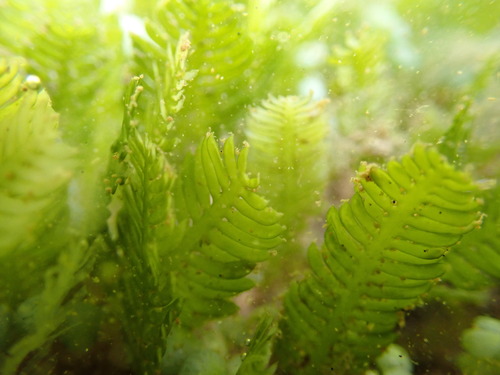
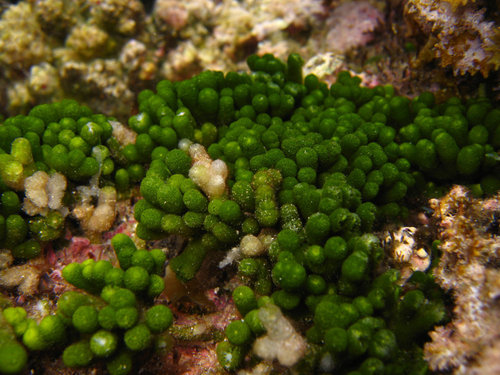
(c) Ria Tan, some rights reserved (CC BY-NC-SA)
iNaturalist· cc-by-sa
(c) 663highland, some rights reserved (CC BY-SA)
iNaturalist· cc-by-nc-nd
(c) Blogie Robillo, some rights reserved (CC BY-NC-ND), uploaded by Blogie Robillo
Summary
Source: WikipediaCaulerpa lentillifera or sea grape is a species of ulvophyte green algae from coastal regions in the Asia-Pacific. This seaweed is one of the favored species of edible Caulerpa due to its soft and succulent texture. It is traditionally eaten in the cuisines of Southeast Asia, Oceania, and East Asia. It was first commercially cultivated in the Philippines in the 1950s, followed by Japan in 1968. Both countries remain the top consumers of C. lentillifera. Its cultivation has since spread to other countries, including Vietnam, Taiwan, and China. C. lentillifera, along with C. racemosa, are also known as sea grapes or green caviar in English. It is a siphonous macroalgae, meaning it is a giant single cell with multiple nuclei, and can grow to 30 cm in length. Instead of leaves, the algae has bubbles that burst in the mouth, releasing an umami taste.
Description
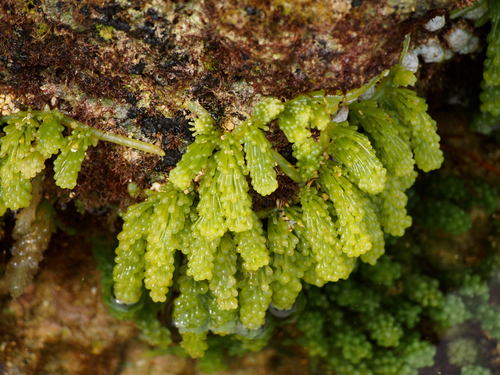
A green seaweed. It has erect branches. These has small round swellings on short cone shaped stalks. These small pea like seeds are edible.
This description is brief — help expand it
Edible Uses
Caulerpa lentillifera, along with C. racemosa, have been traditionally eaten in the cuisines of Southeast Asia, Oceania, and East Asia. They are almost always eaten raw on their own or in salads. They have been described as tasting "like the ocean." It is known to be rich in iodine. In the Philippines, C. lentillifera is usually known as latô or arosep. After being washed in clean water, it is usually eaten raw in salads (ensaladang latô), with chopped raw shallots and fresh tomatoes, and dressed with a blend of fish sauce or bagoóng (fish paste) and vinegar. Its popularity has also spread to the Malaysian state of Sabah (where it is spelled latok) due to the migrations of the Bajau peoples. They are also coveted by coastal Malay communities (as latoh) in the Riau Archipelago and Singapore, the latter until they were displaced inland late 20th century. In Okinawa, Japan, it is known as umi-budō (海ぶどう), meaning "sea grapes", or kubiretsuta. It is served dipped in ponzu, made into sushi, added into salads, or eaten as is. Caulerpa lentillifera is also eaten in Vietnam, where it is known as rong nho or rong nho biển, meaning "grape algae" or "sea grape algae"; in Korea, where it is known as bada podo (바다포도), also meaning "sea grapes"; and in Indonesia (particularly Bali), where it is known as bulung.
Traditional Uses
It is eaten raw as a salad vegetable.
This uses section is brief — help expand it
Distribution
A tropical plant. It grows just below the tidal region on sand or rocks in sheltered positions.
Where It Grows
Asia, Australia, East Africa, Eritrea, Ethiopia, Federated States of Micronesia, FSM, Hawaii, India, Indian Ocean, Indonesia, Japan, Kenya, Madagascar, Malaysia, Maldives, Marshall Islands, Middle East, Pacific, Pakistan, Papua New Guinea, PNG, Philippines, Red Sea, Saudi Arabia, SE Asia, Solomon Islands, Somalia, South Africa, Southern Africa, Sri Lanka, Taiwan, Tanzania, Thailand, Vietnam,
Other Information
It is popular. It is cultivated in the Philippines.
Nutrition
| Part | Moisture | kJ | kcal | Protein | Vit A | Vit C | Iron | Zinc |
|---|---|---|---|---|---|---|---|---|
| Seaweed | 97 | 17 | 4 | 0.5 | — | — | — | — |
| Seaweed | — | — | 10.4 | — | — | — | — | — |
Also Known As
Ar-arosep, Green caviar, Iwazuta, Kadalchiratchai, Lato, Latok, Sea grapes, Umbido
References (8)
- Cherry, P., et al, 2019, Risks and benefits of consuming edible seaweeds. Nutrition ReviewsVR Vol. 77(5):307–329
- Cribb, A.B., 1996, Seaweeds of Queensland A Naturalist's Guide. The Queensland Naturalists' Club Handbook No. 2. p 17
- Daillande, C. de, et al, 2016, Caulerpa consumption, nutritional value and farming in the Indo-Pacific region. Journal of Applied Phycology. July 2016
- Pereira L., 2011, A Review of the Nutrient Composition of Selected Edible Seaweeds. Nova Science Publishers, Inc. p 18
- Ratwanati, et al, 2019, Fruits of Enhalus acoroides as a source of nutrition for coastal communities. IOP Conf. Ser.: Earth Environ. Sci. 235 012073
Show all 8 references Hide references
- Womersley, H.B. S. & Bailey, A., 1970, Marine algae of the Solomon Islands. Philosophical Transactions of the Royal Society of London. B. Biological Sciences 259:257-352
- Wikipedia Sea vegetables.
- Zemke-White, W. L. & Ohno, M., 1999, World seaweed utilisation: An end-of-century summary. Journal of Applied Phycology 11: 369-376