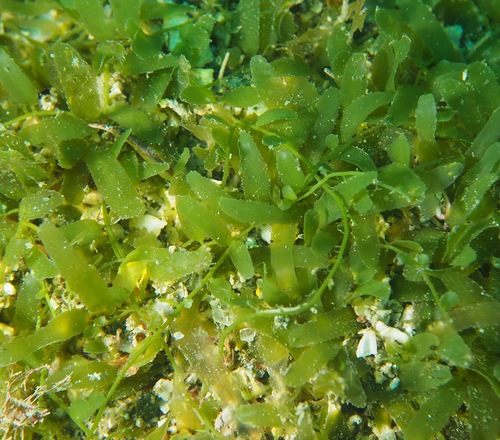
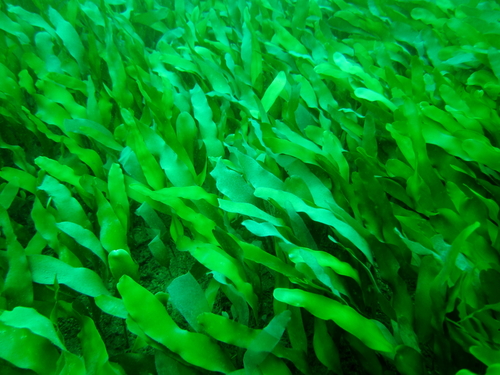
Caulerpa racemosa
(Forsskal) Weber van Bosse
Sea Grapes, Green algae
iNaturalist· cc-by-sa
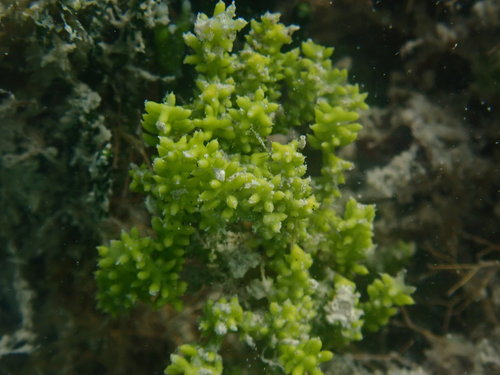
(c) Nhobgood, some rights reserved (CC BY-SA)
iNaturalist· cc-by-nc
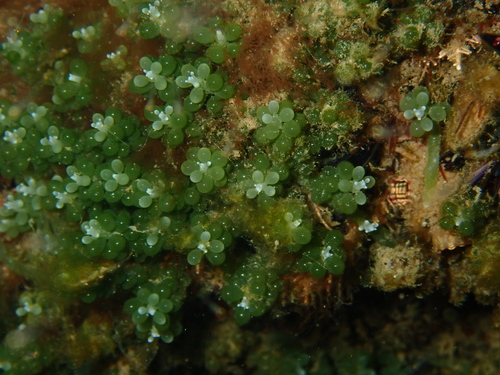
(c) Wendy Feltham, some rights reserved (CC BY-NC), uploaded by Wendy Feltham
iNaturalist· cc-by-nc
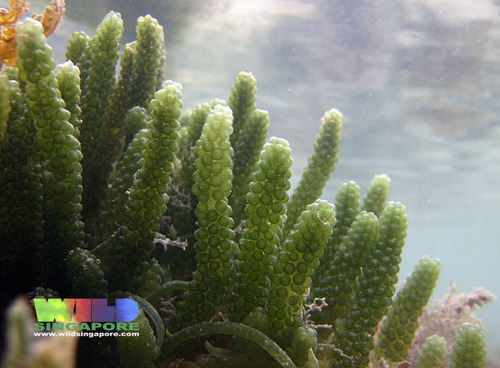
(c) mikkel65, some rights reserved (CC BY-NC), uploaded by mikkel65
Summary
Source: WikipediaCaulerpa racemosa is a species of edible green alga, a seaweed in the family Caulerpaceae. It is commonly known as sea grapes (along with the related Caulerpa lentillifera) and is found in many areas of shallow sea around the world. Despite the name, it is not related to grapes. There are a number of different forms and varieties, and one that appeared in the Mediterranean Sea in 1990, which is giving cause for concern as an invasive species.
Description
A green seaweed or algae. It has erect branches. These have club shaped small branches. It can vary a lot and some varieties have been named. The branches end in grape like bunches. There are several forms or varieties.
Edible Uses
Like the closely related C. lentillifera, C. racemosa is edible. It is consumed widely in salads in Japan, Fiji, the Philippines, and Thailand. It is also eaten by local fishermen in Malaysia and Indonesia. They are rich in fiber, proteins, minerals (calcium and magnesium), folic acid, ascorbic acid, vitamin A, and vitamin B1 while also being low in fat. In addition to the nutritional qualities of C. racemosa, it also has anti bacterial and anti-oxidant properties but these characteristics are not yet fully explored. These different biological activities provide a glimpse of biomedical innovations for the future. The properties are believed to come from a strain of rare endophytic actinomycetes that lives in symbiosis with C. racemosa and more particularly of the secondary metabolites produced (flavonoids and alkaloids). Extracts of C. racemosa are already tested to reduce different types of cancer but also to fight against multi-drug resistant uropathogens (as K. pneumoniae and P. aeruginosa). The multi drug resistance is a major public health problem because by 2050 (World Health Organization WHO), 10 million people could die each year as a result of this evolution of bacteria against the current families of antibiotics. Moreover, a multitude of potential treatments for various pathologies have been identified, particularly for diabetes and herpes.
Traditional Uses
It is eaten raw or as a salad. It is often eaten with freshly grated coconut or coconut milk.
This uses section is brief — help expand it
Distribution
A tropical plant. It grows on sand and rocks along the coast line. It also occurs in mangrove swamps.
Where It Grows
Africa, Asia, Australia, Bangladesh, Brazil, Caribbean, Central Africa, Chile, China, Colombia, Cook Islands, Djibouti, East Africa, East Timor, Ethiopia, Europe, Fiji, France, French Polynesia, Gabon, Ghana, Greece, Guam, Hawaii, Hispaniola, India, Indochina, Indonesia, Iran, Israel, Italy, Jamaica, Japan, Jordan, Kenya, Kiribati, Korea, Lebanon, Liberia, Madagascar, Malaysia, Maldives, Mauritius, Mediterranean, Mexico, Middle East, Myanmar, New Caledonia, New Zealand, North Africa, North America, Pacific, Pakistan, Papua New Guinea, PNG, Philippines, Polynesia, Samoa, Saudi Arabia, SE Asia, Sierra Leone, Singapore, Solomon Islands, South Africa, Southern Africa, South America, Sri Lanka, Sudan, Syria, Tanzania, Thailand, Timor-Leste, Tokelau Islands, Tonga, Tunisia, Turkey, Türkiye, USA, Venezuela, Vietnam, West Africa, West Indies, Yemen,
Other Information
It is a commercially important seaweed in Bangladesh.
Nutrition
| Part | Moisture | kJ | kcal | Protein | Vit A | Vit C | Iron | Zinc |
|---|---|---|---|---|---|---|---|---|
| Seaweed | 90 | — | — | — | — | — | — | — |
Synonyms
Also Known As
Ararucip lai-lai, Budu tasi, Fuafua, Konini, Lelatu, Letato, Limu eka, Limu fuafua, Ofu limu, Na, Nama, Nama levulevu, Te'emoa, Te'epuaka, Toke
References (23)
- Ambasta S.P. (Ed.), 2000, The Useful Plants of India. CSIR India. p 112
- Barrau, J., 1976, Subsistence Agriculture in Polynesia and Micronesia. Bernice P. Bishop Museu, Bulletin 223 Honolulu Hawaii. Kraus reprint. p 57
- Borelli, T., et al, 2020, Born to Eat Wild: An Integrated Conservation Approach to Secure Wild Food Plants for Food Security and Nutrition. Plants 2020, 9, 1299 p 9
- Burkill, H. M., 1985, The useful plants of west tropical Africa, Vol. 5. Kew.
- Burkill, I.H., 1966, A Dictionary of the Economic Products of the Malay Peninsula. Ministry of Agriculture and Cooperatives, Kuala Lumpur, Malaysia. Vol 1 (A-H) p 504
Show all 23 references Hide references
- Cherry, P., et al, 2019, Risks and benefits of consuming edible seaweeds. Nutrition ReviewsVR Vol. 77(5):307–329
- Chia, Y. Y. et al, 2015, Antioxidant and cytotoxic activities of three species of tropical seaweeds. Complementary and Alternative Medicine (2015) 15:33
- Cribb, A.B. & J.W., 1976, Wild Food in Australia, Fontana. p 191
- Crowe, A., 1997, A Field Guide to the Native Edible Plants of New Zealand. Penguin. p 147
- Daillande, C. de, et al, 2016, Caulerpa consumption, nutritional value and farming in the Indo-Pacific region. Journal of Applied Phycology. July 2016
- http://www.seavegetables.com
- Jansen, A. A. J., et al, (Eds), 1990, Food and Nutrition in Fiji. Volume One. p 55
- Kiple, K.F. & Ornelas, K.C., (eds), 2000, The Cambridge World History of Food. CUP p 234
- Massal, E. and Barrau, J., 1973, Food Plants of the South Sea Islands. SPC Technical Paper No 94. Noumea, New Caledonia. p 38
- McClatchey, W. C., 2012, Wild food plants of Remote Oceania. Acta Societatis Botanicorum Poloniae 81(4) 371-380
- Novaczek, I., 2001, A Guide to the Common Edible and Medicinal Plants of the Pacific Islands. SPC. p 4
- Pereira L., 2011, A Review of the Nutrient Composition of Selected Edible Seaweeds. Nova Science Publishers, Inc. p 18
- South, G. R., 1993, Edible Seaweeds of Fiji: An Ethnobotanical Study. Botabica Marina. Vol. 36 pp 335-349
- Subba Rao, G.N., 1965, Uses of seaweed directly as human food. Indo-Pacific Fisheries Council Regional Studies 2:1-32
- World Checklist of Useful Plant Species 2020. Royal Botanic Gardens, Kew
- www.algaebase/org
- Xia, B., and Abbott, I.A., 1987, Edible seaweeds of China and their place in the Chinese diet. Economic Botany 41:341-53
- Zemke-White, W. L. & Ohno, M., 1999, World seaweed utilisation: An end-of-century summary. Journal of Applied Phycology 11: 369-376