Xylocarpus granatum
K. D. Koenig
Cannonball mangrove, Monkey-puzzle nuts
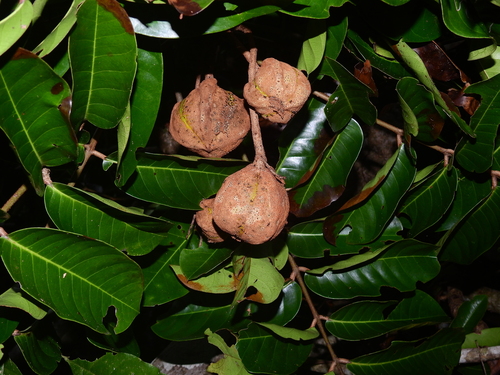
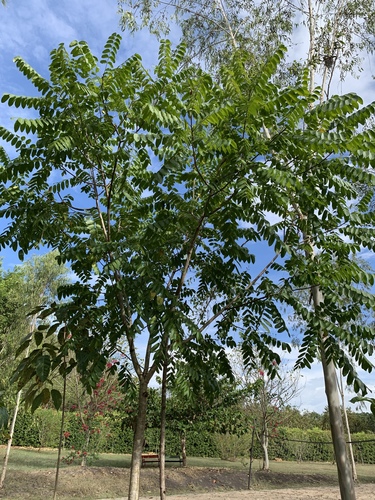
iNaturalist· cc-by-nc
(c) Pete Woodall, some rights reserved (CC BY-NC), uploaded by Pete Woodall
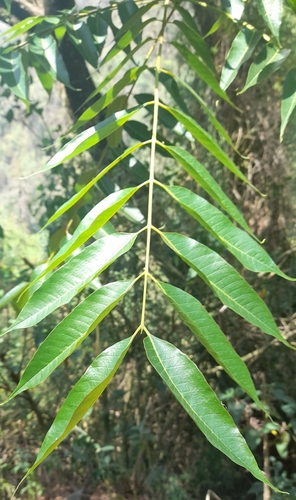
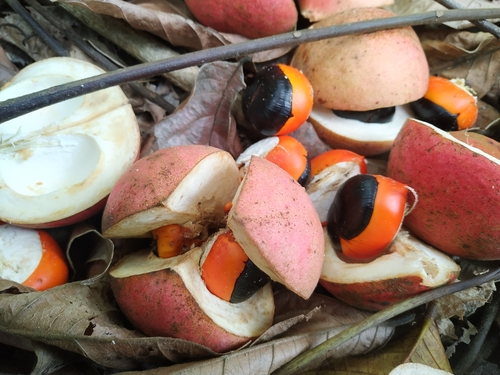
iNaturalist· cc-by-nc
(c) Endro Setiawan, some rights reserved (CC BY-NC)
Summary
Source: WikipediaXylocarpus granatum, commonly known as the cannonball mangrove, cedar mangrove, or puzzlenut tree, is a species of mangrove in the mahogany family (Meliaceae). It is found in Africa, Asia, Australasia and the Pacific Islands. It is a common species of mangrove, and the International Union for Conservation of Nature has assessed its conservation status as being of "least concern".
Description
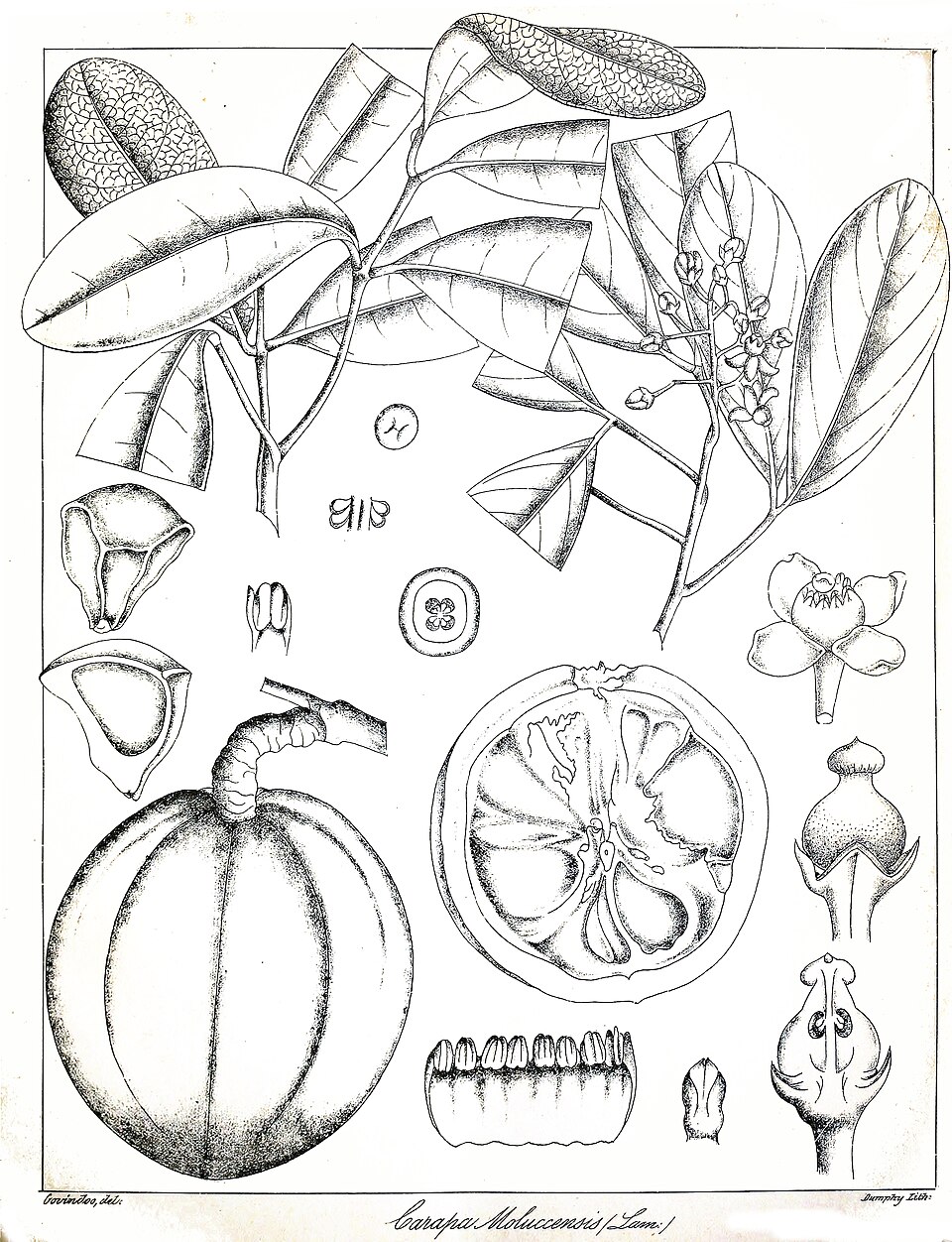
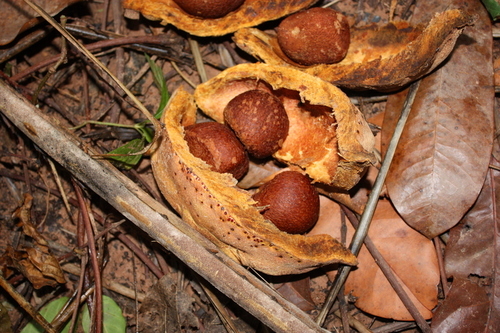
A tall evergreen tree. It grows 15 m high. It has a single trunk. They are shorter in low rainfall areas. Often the trunk is crooked when grown in mangrove swamps. The buttresses extend across the mud. The bark is bright orange brown and smooth. It can have buttresses and aerial roots. The bark is yellowish green. The leaves are alternate and tend to be pointed upwards. The leaves are dark green and oval. The are leathery and have a rounded tip. The base tapers. The leaves are 6 cm long by 3 cm wide. The flowers are very small and white or cream. The flowers are four parted and about 1 cm wide. They occur at the ends of branches in small clusters. The fruit is very large and brown. They are round and occur singly. They have a long stalk. The fruit is round and 12-15 cm across and brown when ripe. The seeds are like four faced triangles.
Edible Uses
The seeds and fruit are edible; the fruit is traditionally chewed with betel leaf.
Traditional Uses
The fruit are chewed with betel leaf.
This uses section is brief — help expand it
Medicinal Uses
The wood is hard and durable and can be used for boat-building, construction and making furniture, however the trees are twisted and often hollow so large pieces of timber may not be available; the wood is also used for tool handles and other small items, and can be used as firewood but burns rather quickly. The bark is rich in tannins and has been used for strengthening rope and dying cloth. The bark, fruits and seeds have been used in traditional medicine.
Distribution
It is a tropical plant. They occur in open forest and near mangrove. It grows on flooded areas of mangrove swamps that are occasionally inundated. It grows up to 10 m above sea level. It occurs on sandy beaches. It grows near tidal streams. They occur from East Africa, India to Polynesia. They only occur in the drier parts of mangrove swamps which are only occasionally flooded. It can tolerate heavy shade.
Where It Grows
Africa, Asia, Australia, Bangladesh, Brunei, China, Chuuk, East Africa, Fiji, Guam, India, Indochina, Indonesia, Japan, Madagascar, Malaysia, Micronesia, Mozambique, Myanmar, New Caledonia, Pacific, Palau, Papua New Guinea, PNG, Philippines, Pohnpei, Rotuma, SE Asia, Singapore, Solomon Islands, Southern Africa, Sri Lanka, Tanzania, Thailand, Tonga, Truk, Vietnam, Yap,
Cultivation
Plants are grown from seed. The seed float easily. The young shoot can be 60-90 cm long before producing leaves.
Propagation
Seed - after falling from the parent plant, they float just below the water surface and are dispersed by ocean currents. Seed viability decreases rapidly upon storage. Seeds should be sown with the convex side upwards. They show about 70% germination in 4 - 10 weeks. Seedlings can attain 50cm height in 3 months. Direct sowing has been successfully applied in a trial plantation
Other Uses
The bark is a fairly rich source of tannins, containing 20 - 34% on a dry matter basis. It is used for strengthening rope that needs to be used in the water. The bark is sometimes used to dye cloth brown. A dark-red dye is obtained from the bark. A resin is obtained from the tree. A whitish, semi-solid oil is obtained from the seed. This becomes fluid at higher temperatures. The oil is used in India for burning, and in some places as a hair oil. The heartwood is reddish-brown, clearly demarcated from the thin band of whitish sapwood. The grain is straight to slightly crossed, the texture fine and glossy.The wood is very hard, moderately heavy, strong and durable, it is rarely, if ever, attacked by beetles, but is not resistant to termites. The wood shrinks little and is usually easy to work and finish; it takes a high polish. A good mahogany-like timber, but as the trunk is usually crooked and hollow, long straight pieces often cannot be cut. It is used for making small objects such as pins, tool handles etc, and house posts. When large enough pieces are available they are used for boat-building and construction as well as for good quality furniture. Larger pieces, when available, provide one of the best and most beautiful timbers in the Philippines. The wood is also used for firewood. It produces a great heat but burns very quickly, so other sources are generally preferred.
Production
It grows rapidly.
Notes
There are 3 Xylocarpus species. The fruit are used in medicine.
Synonyms
Also Known As
Brok, Cedar mangrove, Dhundul, Emogul, Kandalangay, Lalanyog, Meduulokebong, Mkomafi, Mtonga, Murudokobon, Pulbun, Pussur, Pwulok, Pwunopwun, Tabun khao, Yamgur
References (26)
- Ambasta, S.P. (Ed.), 2000, The Useful Plants of India. CSIR India. p 694 (As Carapa granatum)
- Borrell, O.W., 1989, An Annotated Checklist of the Flora of Kairiru Island, New Guinea. Marcellin College, Victoria Australia. p 100+11, 102, 199
- Cooper, W. and Cooper, W., 2004, Fruits of the Australian Tropical Rainforest. Nokomis Editions, Victoria, Australia. p 294
- Dharani, N., 2002, Field Guide to common Trees & Shrubs of East Africa. Struik. p 306
- Exell, A.W. et al, (Ed), 1963, Flora Zambesiaca Vol 2 Part 1 Crown Agents, London. p 296, 297
Show all 26 references Hide references
- Floyd, A.G., 1977, Ecology of the Tidal Forests in the Kikori-Romilly Sound Area Gulf of Papua. Ecology Report No 4 Division of Botany, Lae, Papua New Guinea. p 48
- Franklin, J., Keppel, G., & Whistler, W., 2008, The vegetation and flora of Lakeba, Nayau and Aiwa Islands, Central Lau Group, Fiji. Micronesica 40(1/2): 169–225, 2008
- French, B.R., 2010, Food Plants of Solomon Islands. A Compendium. Food Plants International Inc. p 306 (As Carapa granatum)
- Frodin, D.G. & Leach, G.L., 1982, Mangroves of the Port Moresby Region. Biology Department Occasional Paper No 3 Revised edition. Papua New Guinea, p 72
- Havel, J.J., 1975, Forest Botany, Volume 3 Part 2 Botanical taxonomy. Papua New Guinea Department of Forests, p 131
- Johns, R.J., 1976, Common Forest Trees of Papua New Guinea. Part 5 Angiospermae, Forestry College Bulolo, PNG p 206
- Kitalong, A. H., DeMeo, R. A., & Holm, T., 2013, A Field Guide to the Native Trees of Palau. 2nd edition. USDA p168
- Lazarides, M. & Hince, B., 1993, Handbook of Economic Plants of Australia, CSIRO. p 250
- Melzer, R. & Plumb, J., 2011, Plants of Capricornia. Belgamba, Rockhampton. p 180
- Naturf. 20:2. 1784 [As J. Konig]
- Paczkowska, G. & Chapman, A.R., 2000, The Western Australian Flora. A Descriptive Catalogue. Western Australian Herbarium. p 295
- Palgrave, K.C., 1996, Trees of Southern Africa. Struik Publishers. p 377
- Peekel, P.G., 1984, (Translation E.E.Henty), Flora of the Bismarck Archipelago for Naturalists, Division of Botany, Lae, PNG. p 285
- Scarth-Johnson, V., 2000, National Treasures. Flowering Plants of Cooktown and Northern Australia. Vera Scarth-Johnson Gallery Association. Cooktown, Australia. p 31
- Schatz, G.E., 2001, Generic Tree Flora of Madagascar. Royal Botanical Gardens, Kew and Missouri Botanical Garden. p 267
- Slik, F., www.asianplant.net
- Smith, A.C., 1985, Flora Vitiensis Nova, Lawaii, Kuai, Hawaii, Volume 3 p 575
- Wheeler, J.R.(ed.), 1992, Flora of the Kimberley Region. CALM, Western Australian Herbarium, p 667
- Wongprasert, T. et al, 2011, A Synoptic Account of the Meliaceae of Thailand. Thai For. Bull. 39:210-266
- World Checklist of Useful Plant Species 2020. Royal Botanic Gardens, Kew
- Yuncker, T.G., 1959, Plants of Tonga, Bernice P. Bishop Museum, Hawaii, Bulletin 220. p 156