Beta vulgaris
L.
Beetroot
wikimedia· cc0
Evan-Amos (via Wikimedia Commons)
wikimedia· cc-by-sa
John Alan Elson (via Wikimedia Commons)
wikimedia· cc0
Walther Otto Müller (via Wikimedia Commons)
iNaturalist· cc-by
(c) Michael Bakker Paiva, some rights reserved (CC BY), uploaded by Michael Bakker Paiva
iNaturalist· cc-by-nc
(c) Ron Vanderhoff, some rights reserved (CC BY-NC), uploaded by Ron Vanderhoff
iNaturalist· cc-by-sa
(c) Tony Wills, some rights reserved (CC BY-SA), uploaded by Tony Wills
Summary
Source: WikipediaBeta vulgaris (beet) is a species of flowering plant in the subfamily Betoideae of the family Amaranthaceae. It is a perennial plant usually growing up to 120 centimetres (4 ft) tall. Three subspecies are typically recognised. The wild ancestor of all the cultivated beets is the sea beet (Beta vulgaris subsp. maritima), with several modern cultivars all belonging to B. vulgaris subsp. vulgaris. Some of the most popular cultivar groups include: the sugar beet (used to produce table sugar), the root vegetable known as the beetroot or garden beet, the leaf vegetable known as chard or spinach beet or silverbeet, and mangelwurzel (a fodder crop).
Description
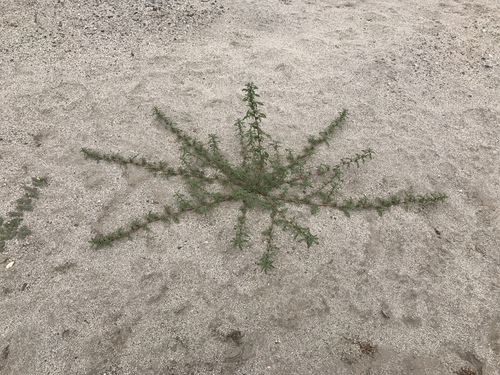
A dark green leafed plant. The plant is upright and about 20 cm tall. It can be grown as an annual plant. Normally it gives a thickened root in the first year then flowers in the second year. The leaves vary in shape and colour. They can be oval with an irregular wavy edge. They can be dark green or reddish. It has a round or elongated fattened root. The root is red in colour. (White varieties also occur). The flowers are small and green and have both sexes. They occur in flower arrangements with the end bud a flower bud. This forms a tall, branching, spike-like arrangement. The fruit are one seed. Often 2 or more seeds are joined together in a "seedball". Plants are wind cross pollinated.
Edible Uses
Spinach beet leaves are eaten as a pot herb. Young leaves of the garden beet are sometimes used similarly. The midribs of Swiss chard are eaten boiled while the whole leaf blades are eaten as spinach beet. In some parts of Africa, the whole leaf blades are usually prepared with the midribs as one dish. The leaves and stems of young plants are steamed briefly and eaten as a vegetable; older leaves and stems are stir-fried and have a flavour resembling taro leaves. The usually deep-red roots of garden beet can be baked, boiled, or steamed, and often served hot as a cooked vegetable or cold as a salad vegetable. They are also pickled. Raw beets are added to salads. A large proportion of the commercial production is processed into boiled and sterilised beets or into pickles. In Eastern Europe beet soup, such as cold borsch, is a popular dish. Yellow-coloured garden beets are grown on a very small scale for home consumption. The consumption of beets causes pink urine in some people. Jewish people traditionally eat beet on Rosh Hashana (New Year). Its Aramaic name סלקא sounds like the word for "remove" or "depart"; it is eaten with a prayer "that our enemies be removed".
Traditional Uses
The red tubers are eaten after cooking. The root is also dried and powdered and the flour mixed with barley or wheat. They can be pickled or fermented as beetroot juice. They are often boiled, sliced and served with vinegar. Tops or leaves are edible. They are cooked in soups and stews. The leaves are used for sarma in Turkey. They are rolled around a filling of rice or minced meat.
Medicinal Uses
The roots and leaves of the beet have been used in traditional medicine to treat a wide variety of ailments. Ancient Romans used beetroot as a treatment for fevers and constipation, amongst other ailments. Apicius in De re coquinaria gives five recipes for soups to be given as a laxative, three of which feature the root of beet. Platina recommended taking beetroot with garlic to nullify the effects of 'garlic-breath'. Beet greens and Swiss chard are both considered high oxalate foods which are implicated in the formation of kidney stones.
Distribution
It is a temperate climate plant. It is mainly in the highlands between 1150 and 2600 m altitude in the tropics. Plants are frost resistant. Plants grow best at 18-22°C. Temperatures below 10°C cause the plant to start its seeding phase. It is sensitive to acid soils but can grow in alkaline soils up to pH 10.
Where It Grows
Africa, Albania, Andorra, Argentina, Armenia, Asia, Australia, Austria, Balkans, Bangladesh, Bosnia, Britain, Bulgaria, Cape Verde, Caucasus, Central America, Central Asia, Chile, China, Costa Rica, Croatia, Cuba, Cyprus, Dominican Republic, East Africa, Ecuador, Egypt, Eswatini, Ethiopia, Europe, Georgia, Haiti, Hawaii, India, Indochina, Indonesia, Italy, Korea, Kyrgyzstan, Lithuania, Macedonia, Malawi, Malaysia, Mediterranean, Middle East, Moldova, Myanmar, Niger, North Africa, North America, Pacific, Pakistan, Papua New Guinea, PNG, Peru, Philippines, Poland, Puerto Rico, Qatar, Romania, Russia, Sahel, Saudi Arabia, SE Asia, Serbia, Sicily, Singapore, Slovenia, South Africa, Southern Africa, South America, Spain, Sri Lanka, Swaziland, Switzerland, Tajikistan, Tasmania, Thailand, Tonga, Tunisia, Turkey, Türkiye, Ukraine, Uruguay, USA, Uzbekistan, Vietnam, West Africa, West Indies, Zimbabwe,
Cultivation
Plants are grown from seed. Normally the plants are planted in the final site because transplanting is difficult. When the small clump of seeds or seed ball are planted more than one seedling will result. Plants get a soft heart due to boron deficiency. This is treated with borax.
Propagation
Seed - sow in situ.
Other Information
It is a commercially cultivated vegetable. Not often seen in Papua New Guinea.
Notes
Chemical composition: Fat = 5.75% (dry). Albumenoids = 13.92% (dry). Carbohydrates = 45.55% (dry). Fibre = 17.85% (dry). Ash = 16.93% (dry). Nitrogen - 2.23% (dry). Phosphoric acid = .50% (dry). Silicates = .86% (dry). Probably all Beta are one species and 2 main forms - Cicla - for leaves, and Contiva - for roots. Also put in the family Chenopodiaceae. It has anticancer properties.
Nutrition
| Part | Moisture | kJ | kcal | Protein | Vit A | Vit C | Iron | Zinc |
|---|---|---|---|---|---|---|---|---|
| Root - boiled flesh | 82.7 | 189 | 45 | 1.8 | 4 | 5 | 0.4 | 0.4 |
| Root - raw flesh | 87.1 | 118 | 28 | 1.3 | 4 | 6 | 0.8 | 0.4 |
| Leaves - boiled | 89 | 113 | 27 | 2.6 | 510 | 25 | 1.9 | 0.5 |
| Leaves - raw | 92 | 80 | 19 | 1.8 | 610 | 30 | 3.3 | 0.4 |
| Leaves | 89 | 77 | — | 3.4 | — | — | — | — |
Synonyms
Also Known As
Aitiace, Barba, Barbabietola, Bendjar, Beteraba, Betterave, Bit palang, Bittsu, Caiduong, Chaouender, Chukandar, Cu den, Divlja blitva, Giri, Hatrab, Hezab, Left m 'ta el-baqar, Palak, Palang sag, Palang, Palanki, Remolacha, Remolatsa, Rossa, Rote bete, Rote rube, Salachi, Selk, Sellak, Semlakh, Serj, Sildj, Silk el Belebcha, Silk, Table beet, Tian cai
References (57)
- Ambasta S.P. (Ed.), 2000, The Useful Plants of India. CSIR India. p 72
- Bernholt, H. et al, 2009, Plant species richness and diversity in urban and peri-urban gardens of Niamey, Niger. Agroforestry Systems 77:159-179
- Bianchini, F., Corbetta, F., and Pistoia, M., 1975, Fruits of the Earth. Cassell. p 80
- BOUQUET,
- Brouk, B., 1975, Plants Consumed by Man. Academic Press, London. p 85
Show all 57 references Hide references
- Burkill, I.H., 1966, A Dictionary of the Economic Products of the Malay Peninsula. Ministry of Agriculture and Cooperatives, Kuala Lumpur, Malaysia. Vol 1 (A-H) p 323
- Bussman, R. W., et al, 2016, A comparative ethnobotany of Khevsureti, Samtskhe-Javakheti, Tusheti, Svaneti, and Racha-Lechkhumi, Republic of Georgia (Sakartvelo), Caucasus. Journal of Ethnobiology and Ethnomedicine (2016) 12:43
- Bussman, R. W. et al, 2017, Ethnobotany of Samtskhe-Javakheti, Sakartvelo (Republic of Georgia), Caucasus. Indian Journal of Traditional Knowledge Vol. 16(1) pp 7-24
- Bussman, R. W., et al, 2021, Unity in diversity—food plants and fungi of Sakartvelo (Republic of Georgia), Caucasus. Journal of Ethnobiology and Ethnomedicine (2021) 17:72 p 4
- Ciftcioglu, C. G., 2015, Sustainable wild-collection of medicinal and edible plants in Lefke region of North Cyprus. Agroforest Syst. Springer p
- Cribb, A.B. & J.W., 1976, Wild Food in Australia, Fontana. p 116
- Dashorst, G.R.M., and Jessop, J.P., 1998, Plants of the Adelaide Plains & Hills. Botanic Gardens of Adelaide and State Herbarium. p 60
- Dogan, Y., et al, 2015, Of the importance of a leaf: the ethnobotany of sarma in Turkey and the Balkans. Journal of Ethnobiology and Ethnomedicine, 11:56
- Dolina, K. & Luczaj, L., 2014, Wild food plants used on the Dubrovnik coast (south-eastern Croatia) Acta Soc Bot Pol 83(3):175–181
- Duarte, M. C., et al, 2022, Diversity of Useful Plants in Cabo Verde Islands: A Biogeographic and Conservation Perspective. Plants 2022, 11, 1313 p 8
- Facciola, S., 1998, Cornucopia 2: a Source Book of Edible Plants. Kampong Publications, p 76
- Flora of China. www.eFloras.org
- Foo, J.T.S.(ed), 1996, A Guide to Common Vegetables. Singapore Science Foundation. p 22
- French, B.R., 1986, Food Plants of Papua New Guinea, A Compendium. Asia Pacific Science Foundation p
- Geraci, A., et al, 2018, The wild taxa utilized as vegetables in Sicily (Italy): a traditional component of the Mediterranean diet. Journal of Ethnobiology and Ethnomedicine (2018) 14:14
- Gonzalez, J. A., et al, 2011, The consumption of wild and semi-domesticated edible plants in the Arribes del Duero (Salamanca-Zamora, Spain): an analysis of traditional knowledge. Genetic. Resour Crop Evolution 58:991-1006
- Hadfield, J., 2001, The A-Z of Vegetable Gardening in South Africa. Struik p 95
- Hedrick, U.P., 1919, (Ed.), Sturtevant's edible plants of the world. p 100
- HOOPER
- Kapelle, M., et al, 2000, Useful plants within a Campesino Community in a Costa Rican Montane Cloud Forest. Mountain Research and Development, 20(2): 162-171.
- Kays, S. J., and Dias, J. C. S., 1995, Common Names of Commercially Cultivated Vegetables of the World in 15 languages. Economic Botany, Vol. 49, No. 2, pp. 115-152
- Kiple, K.F. & Ornelas, K.C., (eds), 2000, The Cambridge World History of Food. CUP p 1809
- Lembaga Biologi Nasional, 1977, Ubi-Ubian, Balai Pustaka, Jakarta. p 20
- Luczaj, L. et al, 2014, Wild Food Plants of Dalmatia (Croatia). in A. Pieroni, C. L. Quave (eds.), Ethnobotany and Biocultural Diversities in the Balkans, p 138
- Mabey, R., 1973, Food for Free. A Guide to the edible wild plants of Britain, Collins. p 88
- Molla, A., Ethiopian Plant Names. http://www.ethiopic.com/aplants.htm
- Ochse, J.J. et al, 1931, Vegetables of the Dutch East Indies. Asher reprint. p 102
- Pham-Hoang Ho, 1999, An Illustrated Flora of Vietnam. Nha Xuat Ban Tre. p 723
- Pieroni, A., et al, 2005, Food for two seasons: Culinary uses of non-cultivated local vegetables and mushrooms in a south Italian village. International Journal of Food Sciences and Nutrition, 56(4): 245-272 (As subsp. vulgaris)
- Pieroni, A. & Soukand, R., 2017, Are Borders more Important than Geographical Distance? The Wild Food Ethnobotany of the Boykos and its Overlap with that of the Bukovinian Hutsuls in Western Ukraine. Journal of Ethnobiology 37(2): 326–345
- Plants of Haiti Smithsonian Institute http://botany.si.edu
- Purseglove, J.W., 1968, Tropical Crops Dicotyledons, Longmans. p 630
- Rashid, H. E., 1977, Geography of Bangladesh. Westview. p 270
- Redzic, S. J., 2006, Wild Edible Plants and their Traditional Use in the Human Nutrition in Bosnia-Herzegovina. Ecology of Food and Nutrition, 45:189-232
- Schneider, E., 2001, Vegetables from Amaranth to Zucchini: The essential reference. HarperCollins. p 78
- Sharma, B.B., 2005, Growing fruits and vegetables. Publications Division. Ministry of Information and broadcasting. India. p 209
- Siemonsma, J. S. and Piluek, K. (Eds), 1994, Plant Resources of South-East Asia No. 8 Vegetables. Prosea Foundation, Bogor, Indonesia, p 98
- Small, E., 2009, Top 100 Food Plants. The world's most important culinary crops. NRC Research Press. p 117
- Smith, K., 1998. Growing Uncommon Fruits and Vegetables. New Holland. p 123
- Sp. pl. 1:222. 1753
- Thaman, R.R., 1976, The Tongan Agricultural System, University of the South Pacific, Suva, Fiji. p 383
- Tindall, H.D., 1983, Vegetables in the tropics. Macmillan p. 75
- Torre, de la L., et al, 2008, Enciclopedia de las Plantas Útiles del Ecuador. Herbario QCA. Pontificia Universidad Católica del Ecuador. p 155
- USDA, ARS, National Genetic Resources Program. Germplasm Resources Information Network - (GRIN). [Online Database] National Germplasm Resources Laboratory, Beltsville, Maryland. Available: www.ars-grin.gov/cgi-bin/npgs/html/econ.pl (10 April 2000)
- van Wyk, B., 2005, Food Plants of the World. An illustrated guide. Timber press. p 88
- Welcome, A. K. & Van Wyk, B.-E., 2019, An inventory and analysis of the food plants of southern Africa. South African Journal of Botany 122 (2019) 136–179
- Wiersema, J. H. & Leon, B., 2013, World Economic Plants. A Standard Reference CRC Press. 2nd Ed. p 99
- Williamson, J., 2005, Useful Plants of Malawi. 3rd. Edition. Mdadzi Book Trust. p 36
- World Checklist of Useful Plant Species 2020. Royal Botanic Gardens, Kew
- Yasukawa, K., Medicinal and Edible Plants as Cancer Preventive Agents. Drug Discovery Research in Pharmacognosy. p185 www.intechopen.com
- Youssef, R. S. A., 2013, Medicinal and non-medicinal uses of some plants found in the middle region of Saudi Arabia. Journal of Medicinal Plants Research. Vol. 7(34), pp. 2501-2517
- Zeven, A. C. & de West, J. M. J., 1982, Dictionary of cultivated plants and their regions of diversity. Wageningen. p 71, p 82, 104