Morella cordifolia
(L.) Killick
Myrica, Wax berry, Candle berry
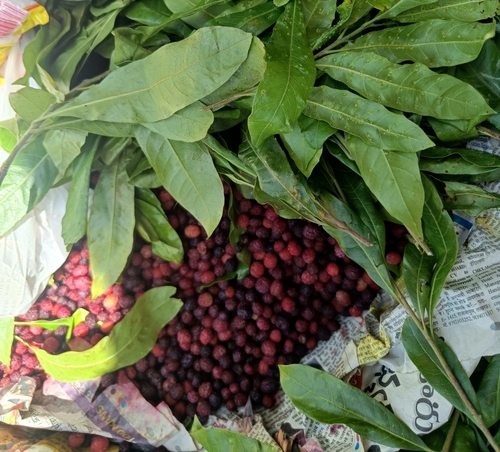
iNaturalist· cc-by-nc
(c) Craig Peter, some rights reserved (CC BY-NC), uploaded by Craig Peter
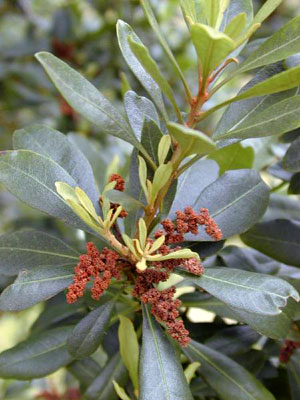
iNaturalist· cc-by-sa
(c) Tony Rebelo, some rights reserved (CC BY-SA), uploaded by Tony Rebelo
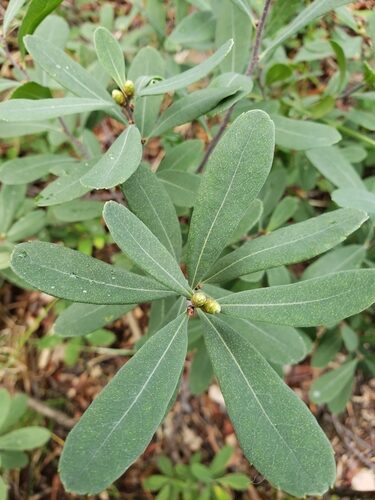
iNaturalist· cc-by-sa
(c) Tony Rebelo, some rights reserved (CC BY-SA), uploaded by Tony Rebelo
Description
A spreading shrub. It sends out slender branches that lie along the ground. These have upright shoots that reach 2-3 m tall. The leaves are small and shiny. They are heart shaped and have teeth along the edge. They do not have stalks and overlap along the branches. Male and female flowers are on separate plants. The male flowers are in dense catkin like clusters along the stem. The female flowers occur singly and are usually lower down. The fruit are purple blue berries 5-8 mm across.
Edible Uses
The fruit are edible and contain a waxy coating.
Traditional Uses
The fruit are edible.
This uses section is brief — help expand it
Distribution
It is a subtropical plant. It grows in loose sand. It grows in coastal sand dunes.
Where It Grows
Africa, South Africa, Southern Africa,
Synonyms
Also Known As
Ilethi
References (7)
- East African Herbarium records, 1981, (As Myrica cordifolia)
- Fox, F. W. & Young, M. E. N., 1982, Food from the Veld. Delta Books. p 274 (As Myrica cordifolia)
- Hedrick, U.P., 1919, (Ed.), Sturtevant's edible plants of the world. p 429 (As Myrica cordifolia)
- Peters, C. R., O'Brien, E. M., and Drummond, R.B., 1992, Edible Wild plants of Sub-saharan Africa. Kew. p 153 (As Myrica cordifolia)
- Petersen, L. M., et al, 2012, Development of a Compendium of Local, Wild-Harvested Species Used in the Informal Economy Trade, Cape Town, South Africa. Ecology and Society 17(2):26
Show all 7 references Hide references
- Ruiters-Welcome, A. K., 2019, Food plants of southern Africa. Ph.D. thesis. Univ. of Johannesburg p 80
- Welcome, A. K. & Van Wyk, B.-E., 2019, An inventory and analysis of the food plants of southern Africa. South African Journal of Botany 122 (2019) 136–179