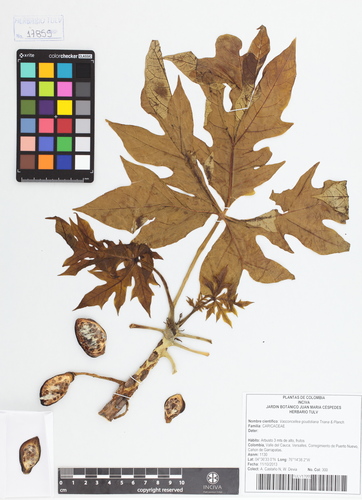
Vasconcellea microcarpa
(Jacq.) A. DC.
Wapai, Tsambunumi
iNaturalist· cc-by-nc
(c) Sébastien SANT, some rights reserved (CC BY-NC), uploaded by Sébastien SANT
iNaturalist· cc-by-nc
(c) hippiejulian, some rights reserved (CC BY-NC), uploaded by hippiejulian
Description
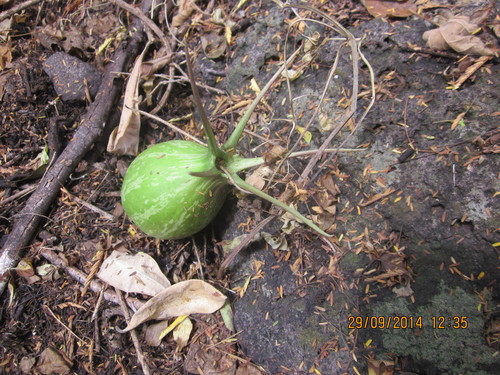
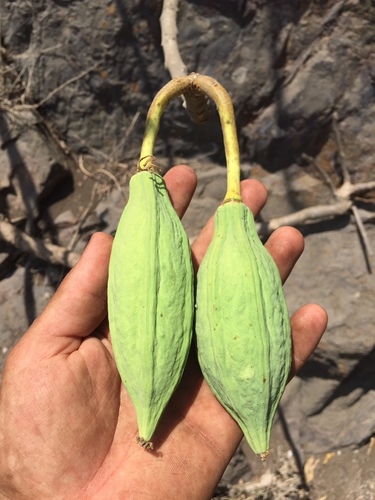
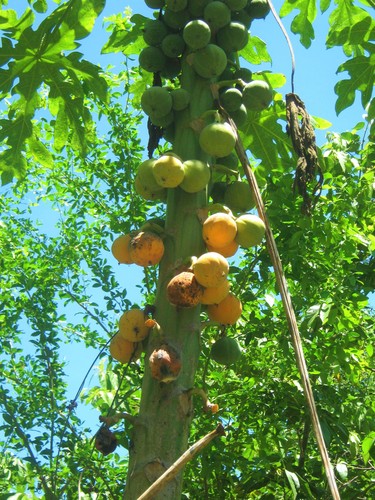
A tree like plant. It grows 3 m tall. The trunk is 10-20 cm across. The leaves are simple and alternate. They are 40 cm long. The flowers are yellow. The fruit are the size of a cherry and 2.5 cm across. They are red or orange.
Edible Uses
The fruit can be eaten raw or cooked and is used in salads and soups. The leaves are eaten cooked.
Traditional Uses
The fruit are eaten raw or cooked. They are used in salads and soups. The leaves are eaten cooked.
This uses section is brief — help expand it
Distribution
It is a tropical plant.
Where It Grows
Amazon, Andes, Bolivia, Brazil, Central America, Colombia, Ecuador, Guiana, Mexico, Panama, Peru, South America, Venezuela,
Cultivation
Plants can be grown from seeds and seedlings transplanted.
Propagation
Seed - sow in individual containers or in a nursery seedbed in light shade. Germination can be slow and difficult, taking about 30 days. Seedlings can be planted out when 4 - 6 months old.
Other Information
It is cultivated.
Notes
There are at least 22-40 species of Carica.
Synonyms
Also Known As
Airo huati jico, Chunta ruku papaya, Col de monte, Ikiam tsampu, Kenegapoka, Papailla, Pundu papaya, Sacha papaya, Taruku papaya, Tsambunumi, Wapai
References (17)
- Badillo, V.M. 1993. Caricaceae. Segundo esquema. Revista de la Facultad de Agronomía de la Universidad Central de la Universidad Central de Venezuela. Alcance 43.
- Bendezu, Y. F., 2018, Arboles nativos de lad Region Ucayali. Instituto Nacional de Innovacion Agraria. p 84
- Duchelle, A. E., 2007, Observations on Natural Resource use and Conservation by the Shuar In Ecuador's Cordillera del Condor. Ethnobotany Research & Applications 5:005-023
- Etkin, N.L. (Ed.), 1994, Eating on the Wild Side, Univ. of Arizona. p 137
- Ferns, Tropical plants
Show all 17 references Hide references
- Flores, Y., 2018, Arboles nativos de la Region Ucayili. Estacion Experimental Agragia Pucallpa. Pucallpa Peru, 375 p. p 84
- Grandtner, M. M. & Chevrette, J., 2013, Dictionary of Trees, Volume 2: South America: Nomenclature, Taxonomy and Ecology. Academic Press p 686
- Hedrick, U.P., 1919, (Ed.), Sturtevant's edible plants of the world. p 162
- Kermath, B. M., et al, 2014, Food Plants in the Americas: A survey of the domesticated, cultivated and wild plants used for Human food in North, Central and South America and the Caribbean. On line draft. p 901
- Penafield Anchundia, D. D., 2017, Traditional food consumption and its nutritional contribution in Guasaganda, Central Ecuador. PhD Ghent University p 71
- Pl. hort. schoenbr. 3:32, t. 309-310. 1798
- Roa, J. A. G. & Boada, D. S. G., 2018, Fundación para el Fortalecimiento de la Fruticultura y Plantas Alimenticias no Convencionales en Colombia.
- Segura, S., et al, 2018, The edible fruit species in Mexico. Genet Resour Crop Evol (2018) 65:1767–1793
- Torre, de la, L., et al, 2008, Enciclopedia de las Plantas Útiles del Ecuador. Herbario QCA. Pontificia Universidad Católica del Ecuador. p 275
- Van den Eynden, V., E. Cueva and O. Cabrera. 1999. Plantas silvestres comestibles del sur del Ecuador – Wild edible plants of southern Ecuador. Ediciones Abya-Yala, Quito, Ecuador.
- Van den Eynden, V., et al, 2003, Wild Foods from South Ecuador. Economic Botany 57(4): 576-603
- Van den Eynden, V., et al, 2004, Regional and ecological variations of wild edible plants in southern Ecuador. Lyonia. 7(2)