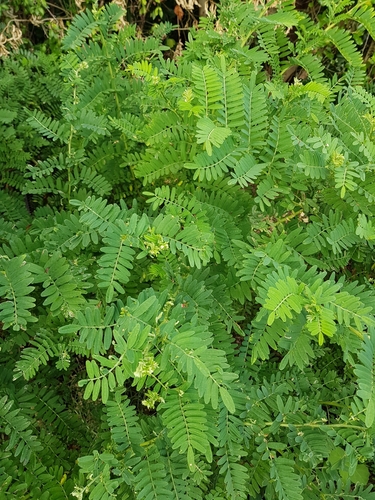
Vachellia tortilis subsp. spirocarpa
(Hochst. ex A Rich.) Kyal. & Boatwr.
Umbrella thorn
gbif· cc-by-nc
Troos van der Merwe
gbif· cc-by-nc
Troos van der Merwe
gbif· cc-by-nc
Troos van der Merwe
Summary
Source: WikipediaVachellia tortilis, widely known as Acacia tortilis but now attributed to the genus Vachellia in the Fabaceae subfamily Mimosoideae, is the umbrella thorn acacia, also known as umbrella thorn and Israeli babool, a medium to large canopied tree native to most of Africa, primarily to the savanna and Sahel of Africa (especially the Somali peninsula and Sudan), but also occurring in the Middle East.
Description
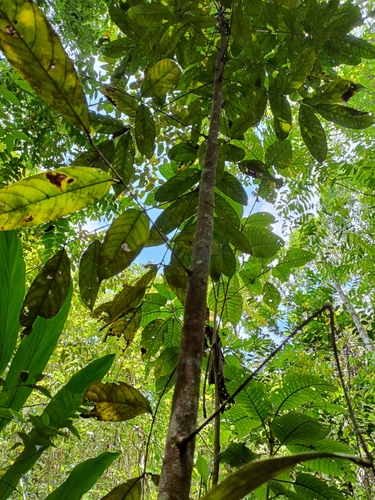
A shrub or tree. It grows 3-20 m high. It loses its leaves during the year. It is spiny. The leaves have 3-10 pairs of pinnae with 7-15 pairs of leaflets. The flowers are creamy-white. In this subspecies the pods are curved or coiled and hairy. They are yellow brown. They are slightly constricted between the seeds.
Edible Uses
The bark is chewed to relieve thirst. The sweet ripe pods are eaten especially by children, either raw as a snack or with seeds removed and cooked. The seeds and leaves are occasionally eaten.
Traditional Uses
The bark is chewed to relieve thirst. The pods are eaten after the seeds have been removed. The seeds are occasionally eaten.
This uses section is brief — help expand it
Distribution
It is a subtropical plant. It grows in hot arid places with a marked dry season. It grows in areas with an annual rainfall above 150 mm. It can grow in alkaline soils. It grows between 520-1,275 m above sea level. It can tolerate drought. It can grow in arid places.
Where It Grows
Africa, Angola, Botswana, Central Africa, Djibouti, East Africa, Ethiopia, Israel, Kenya, Libya, Malawi, Mediterranean, Middle East, Mozambique, Namibia, North Africa, Oman, Saudi Arabia, Somalia, Southern Africa, Sudan, Syria, Tanzania, Uganda, Yemen, Zambia, Zimbabwe,
Production
It grows quickly.
Other Information
The sweet ripe pods are eaten especially by children.
Notes
There are about 1,350 Acacia species. Over 1,000 occur in Australia. Also as Mimosaceae.
Synonyms
Also Known As
Chirimrii, Etirir, Ew, Mezunga, Mnozwa, Mulamba, Nchongwe
References (10)
- Fowler, D. G., 2007, Zambian Plants: Their Vernacular Names and Uses. Kew. p 33
- Goode, P., 1989, Edible Plants of Uganda. FAO p 30
- ILDIS Legumes of the World http:www;ildis.org/Legume/Web
- Jardin, C., 1970, List of Foods Used In Africa, FAO Nutrition Information Document Series No 2.p 24
- Kew Bull. 12:88. 1957
Show all 10 references Hide references
- Peters, C. R., O'Brien, E. M., and Drummond, R.B., 1992, Edible Wild plants of Sub-saharan Africa. Kew. p 128
- Roodt, V., 1998, Trees & Shrubs of the Okavango Delta. Medicinal Uses and Nutritional value. The Shell Field Guide Series: Part 1. Shell Botswana. p 195
- Royal Botanic Gardens, Kew (1999). Survey of Economic Plants for Arid and Semi-Arid Lands (SEPASAL) database. Published on the Internet; http://www.rbgkew.org.uk/ceb/sepasal/internet [Accessed 27th April 2011]
- van Wyk, B, van Wyk, P, and van Wyk B., 2000, Photographic guide to Trees of Southern Africa. Briza. p 44
- Williamson, J., 2005, Useful Plants of Malawi. 3rd. Edition. Mdadzi Book Trust. p 11