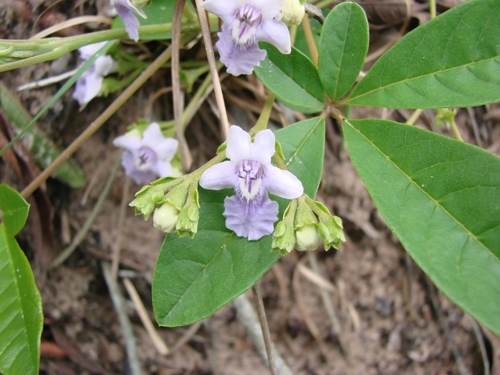
Salvia moorcroftiana
Wall. ex Benth.
Moorcroft's salvia, Kashmir salvia
iNaturalist· cc-by-nc
(c) Bikram Gyawali, some rights reserved (CC BY-NC), uploaded by Bikram Gyawali
Summary
Source: WikipediaSalvia moorcroftiana is a herbaceous perennial native to the Himalayan mountains from Pakistan to western Nepal, and is especially common in the Kashmir Valley. It grows between 5,000 and 9,000 feet elevation on disturbed areas and open slopes. The leaves are used medicinally in Kashmir. Salvia moorcroftiana grows to 2.5 feet tall, with large long-stemmed basal leaves with a toothed margin that appear to be covered with white wool. The 1-inch pale lilac flowers grow on many inflorescences that rise above the leaves. The flowers are held in a hairy calyx, with showy, green-veined, bracts adding to the plant's charm. In cultivation, it prefers full sun, loose soil, good drainage, and regular watering. The plant also contains essential oil. [Manzoor A. Rather, Bilal A. Dar, Khursheed A. Bhat, Abdul S. Shawl, Mushtaq A. Qurishi, Mohd Yusuf Dar & Bashir A. Ganai (2011): Mono-sesquiterpenoid Composition in the Leaves and Flowers of Salvia moorcroftiana Wall ex Benth. Growing Wild in Kashmir, India, Journal of Essential Oil Research, 23:4, 21–25]
Description
A herb that keeps growing from year to year. The stems are sturdy and angular. They come from a woody rootstock. The leaves are 10-24 cm long by 4-18 cm wide. They are broadly oval.
Edible Uses
The peeled stems are occasionally eaten.
Traditional Uses
The stems are peeled and the centre eaten.
This uses section is brief — help expand it
Medicinal Uses
The roots are used in the treatment of colds and coughs. The seed is emetic and is used in the treatment of dysentery, haemorrhoids, colic, and externally for boils. A poultice of the leaves is applied as a dressing for wounds and to relieve itchy skin.
Distribution
It is a subtropical plant.
Where It Grows
Afghanistan, Asia, Australia, Himalayas, India, Nepal, Pakistan,
Cultivation
Requires a very well-drained light sandy soil in a sunny position. Prefers a rich soil. Plants can be killed by excessive winter wet. Closely related to S. argentea. Members of this genus are rarely if ever troubled by browsing deer.
Propagation
Sow seed in March or April in a greenhouse; germination usually takes place within 2 weeks. Prick out seedlings into individual pots when large enough to handle and plant out in early summer. In areas at the limits of the plant's hardiness, grow on under glass through the first winter and plant out in late spring the following year. Cuttings of half-ripe wood can be taken at almost any time during the growing season.
Other Uses
None known
Also Known As
Belangoo, Dersai, Ghadikan, Gurgumna, Halu, Jungle tamookh, Kali jarri, Kallijari, Kharwag, Khesari daal, Laphra, Lapra, Papra, Shobri, Shwanko, Sidrai, Thut, Tokham belaga
References (9)
- Ahmad, K. & Pieroni, A., 2016, Folk knowledge of wild food plants among the tribal communities of Thakht-e-Sulaiman Hills, North-West Pakistan. Journal of Ethnobiology and Ethnomedicine, 12:17
- Ambasta, S.P. (Ed.), 2000, The Useful Plants of India. CSIR India. p 543
- Facciola, S., 1998, Cornucopia 2: a Source Book of Edible Plants. Kampong Publications, p 135
- Flora of Pakistan. www.eFloras.org
- Hibbert, M., 2002, The Aussie Plant Finder 2002, Florilegium. p 285
Show all 9 references Hide references
- Khan, A. H., et al, 2023, Traditional foraging for ecological transition? Wild food ethnobotany among three ethnic groups in the highlands of the eastern Hindukush, North Pakistan. Journal of Ethnobiology and Ethnomedicine 19:9
- Majeed, M., et al, 2021, Gathered Wild Food Plants among Diverse Religious Groups in Jhelum District, Punjab, Pakistan. Foods 2021, 10, 594.
- N. Wallich, Pl. asiat. rar. 1:67. 1830
- Watt,