Landolphia kirkii
Dyer ex Hook.f.
Sand apricot-vine, Coast rubber vine, Wildpeach
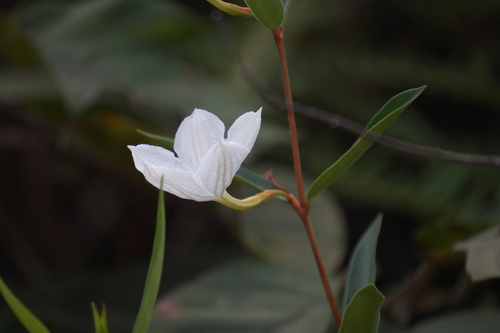
iNaturalist· cc-by-nc
(c) Ricky Taylor, some rights reserved (CC BY-NC), uploaded by Ricky Taylor
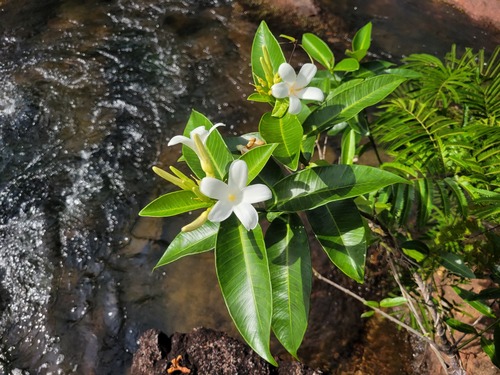
iNaturalist· cc-by-nc
(c) Graeme White, some rights reserved (CC BY-NC), uploaded by Graeme White
iNaturalist· cc-by-nc
(c) Graeme White, some rights reserved (CC BY-NC), uploaded by Graeme White
Description
Landolphia kirkii is an evergreen Climber growing to 15 m (49ft) by 0.3 m (1ft in) at a fast rate. See above for USDA hardiness. It is hardy to UK zone 10. Suitable for: light (sandy), medium (loamy) and heavy (clay) soils and prefers well-drained soil. Suitable pH: mildly acid, neutral and basic (mildly alkaline) soils. It can grow in semi-shade (light woodland) or no shade. It prefers moist soil.
Edible Uses
Fruit - raw. A juicy pulp, it is sweet with a slightly acid flavour. They are popular with those in the know, but their tartness can put off the uninitiated. The rounded to oval, dull green but spotted, fruit is a many-seeded berry with a hard skin up to 15cm in diameter.
Distribution
Eastern Africa - Kenya, Tanzania, DR Congo, S. Africa.
Where It Grows
AFRICA: Somalia, Kenya, Tanzania, Uganda, Central African Republic, Democratic Republic of the Congo, Mozambique, Malawi, Zambia, Zimbabwe, South Africa (Kwa. Zulu-Natal, Limpopo)
Cultivation
Industrial Crop: Hydrocarbon Management: Coppice Regional CropA plant of subtropical to tropical areas, where it is usually found growing in moister areas.
Propagation
Seed
Other Uses
A good quality latex, suitable for making into rubber, is obtained from the stems. It is only used locally. The latex can be coagulated with sea water or with lime juice. The flexible stems can be used as rope.
Synonyms
Also Known As
Anggur karet, Ibungu, Kirk's landolphia, Mabungo, Matwatwa, Maungo, Melktog, Mlimbo, Mpila, Mpira, Mubungu, Muhonga-ulume, Mukanga, Muungu, Muvhungo, Muwungu, Runyangarwapene, Sand apricot, Ugooto, Umkuzi, Zanzibar rubber