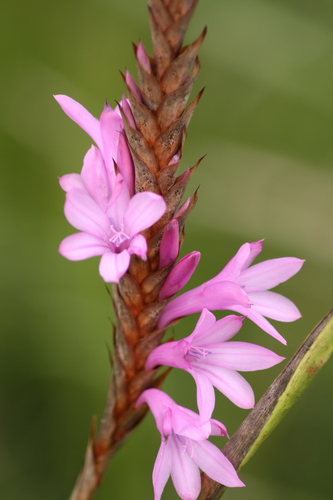
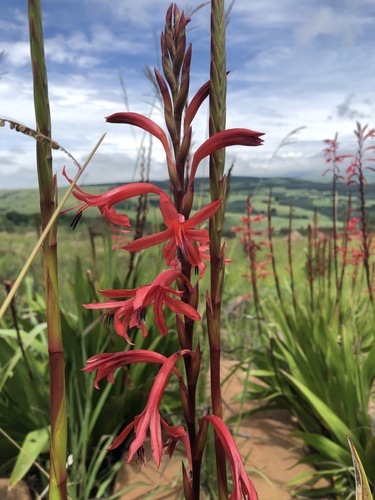
Iris pallida
Lam.
Dalmatian Iris, Sweet iris
iNaturalist· cc-by-nc
(c) Valerio Lazzeri, some rights reserved (CC BY-NC), uploaded by Valerio Lazzeri
iNaturalist· cc-by
(c) Roman, some rights reserved (CC BY), uploaded by Roman
iNaturalist· cc-by
(c) Michael Andresek, some rights reserved (CC BY), uploaded by Michael Andresek
Summary
Source: WikipediaIris pallida, the Dalmatian iris or sweet iris, is a hardy flowering perennial plant of the genus Iris, family Iridaceae. It is native to the Dalmatian coast (Croatia) but widely naturalised elsewhere. It is a member of the subgenus Iris, meaning that it is a bearded iris, and grows from a rhizome. It adapts well to different environments and is used in many different ways.
Description
A fleshy stemmed iris. It grows 90-120 cm high and spreads 30 cm wide. The leaves are stiff and sword like. They are bluish-green. They are thick and have fine ribs. The flowers are large and fragrant. They are blue with yellow beards.
Edible Uses
The root can be dried and ground into a powder for use as a food flavouring, though it may take several years of drying to fully develop its fragrance. 'Orris oil', an essential oil derived from the dried root, is used as a flavouring in soft drinks, sweets, and chewing gum.
Traditional Uses
The peeled and dried rhizome is used in flavouring. Oris oil derived from the rhizome is used to flavour soft drinks, candy and chewing gum.
This uses section is brief — help expand it
Medicinal Uses
The juice of the fresh root is a strongly cathartic, acting as a powerful purge and considered highly effective in the treatment of dropsy.
Known Hazards
Many plants in this genus are thought to be poisonous if ingested, so caution is advised. The roots are especially likely to be toxic. Plants can cause skin irritations and allergies in some people.
Distribution
It is a temperate plant. It grows in rocky habitats and scrub. They suit hardiness zones 5-9.
Where It Grows
Alps, Australia, Balkans, Europe, Italy, Macedonia, Mediterranean, Slovenia, Tasmania, Yugoslavia,
Cultivation
Requires a sunny position and a well-drained soil containing lime. Easily cultivated in a sunny position in ordinary garden soil. Prefers a pH between 6 and 7.5 or higher. Established plants are drought tolerant. Cultivated, especially in Italy, for the essential oil in its root. The flowers are sweetly scented, reminding some people of orange blossom, others of vanilla and others of civet. A very vigorous species. The rhizome should be planted partly above the soil. Members of this genus are rarely if ever troubled by browsing deer or rabbits.
Propagation
Seed is best sown as soon as it is ripe in a cold frame. Stored seed should be sown as early in the year as possible in a cold frame. Prick seedlings into individual pots when large enough to handle and grow on in the greenhouse or cold frame for their first year, then plant out in late spring or early summer. Division is best done after flowering but can be carried out at almost any time. Larger clumps can go directly into permanent positions; smaller clumps are better potted up and grown on in a cold frame until rooting well, then planted out in spring.
Other Uses
The dried and ground root yields Orris powder, which carries the scent of violets and is widely used as a fixative in perfumery and pot-pourri, as an ingredient of toothpastes and breath fresheners, and as a food flavouring. The root takes several years of drying to fully develop its fragrance — when fresh it has an acrid flavour and almost no smell. An essential oil obtained from the fresh root has the same range of uses. The root juice is sometimes applied cosmetically and used for the removal of freckles from the skin. A black dye is obtained from the root, and a blue dye from the flowers. Plants can also be grown for ground cover, as their dense mat of roots excludes weeds effectively.
Notes
There are about 300 Iris species.
Synonyms
Also Known As
Bleda perunika
References (8)
- Ambasta, S.P. (Ed.), 2000, The Useful Plants of India. CSIR India. p 294
- Blamey, M and Grey-Wilson, C., 2005, Wild flowers of the Mediterranean. A & C Black London. p 494
- Cundall, P., (ed.), 2004, Gardening Australia: flora: the gardener's bible. ABC Books. p 742
- Facciola, S., 1998, Cornucopia 2: a Source Book of Edible Plants. Kampong Publications, p 122
- Hibbert, M., 2002, The Aussie Plant Finder 2002, Florilegium. p 164
Show all 8 references Hide references
- http://www.botanic-gardens-ljubljana.com/en/plants
- J. B. A. P. M. de Lamarck & L. A. J. Desrousseaux, Encycl. 3:294. 1789
- Lim, T. K., 2015, Edible Medicinal and Non Medicinal Plants. Volume 9, Modified Stems, Roots, Bulbs. Springer p 49