Alpinia calcarata
(Haw.) Rosc.
Indian ginger, Snap ginger, Miniature ginger
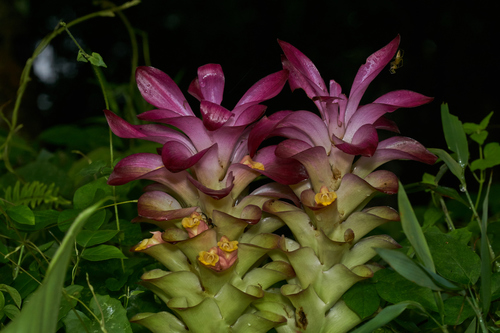
iNaturalist· cc-by
(c) Paulmathi Vinod, some rights reserved (CC BY), uploaded by Paulmathi Vinod
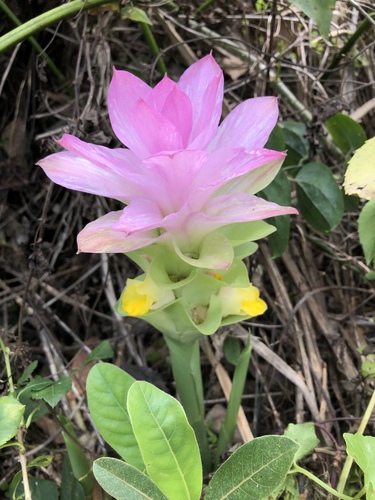
iNaturalist· cc-by-nc
(c) H.T.Cheng, some rights reserved (CC BY-NC)
iNaturalist· cc-by-nc
(c) H.T.Cheng, some rights reserved (CC BY-NC)
Description
An evergreen herb with underground stems. It grows 1-1.3 m high. The leaves are narrowly sword shaped. They are 25 cm long by 5 cm wide. They are glossy dark green. They are prickly along the edge. The flowers are greenish white. They have a lip which is shell shaped. It has pointed erect bracts at the base of the flower. The bracts are red.
Edible Uses
The rhizome is used as a spice and as a substitute for galangal. The ripe fruit, flowers, and roots are also edible and the ripe fruit are especially eaten by children.
Traditional Uses
The rhizome is used as a spice. It is used as a substitute for galangal.
This uses section is brief — help expand it
Distribution
It is a subtropical and tropical plant. It needs regular moisture. It needs fertile, organically rich, well-drained soil. It needs some sunlight. It suits hardiness zones 8-11. In Yunnan.
Where It Grows
Asia, Australia, Bangladesh, China, Hawaii, India*, Indonesia, Myanmar, Northeastern India, Pacific, Papua New Guinea, PNG, SE Asia, Sri Lanka, USA, Vietnam,
Other Information
It is a cultivated food plant in Indonesia. The ripe fruit are especially eaten by children.
Notes
There are about 200-230 Alpinia species. They are mostly tropical and subtropical.
Synonyms
Also Known As
Amkolinji, Hor rangve, Kattuchena, Toroni
References (12)
- Ambasta S.P. (Ed.), 2000, The Useful Plants of India. CSIR India. p 30
- A Rapid Participatory Biodiversity Assessment. 2007, Southern Lao PDR. IUCN p 105 (As Alpinia bracteata)
- Cundall, P., (ed.), 2004, Gardening Australia: flora: the gardener's bible. ABC Books. p 139
- e-monocot.org/taxon/urn:kew.org:wcs:taxon:218695
- Ethnobotany of Karbis. Chapter 4 in p 103
Show all 12 references Hide references
- Lamberton, K (Ed.), 2004, The Australian gardening encyclodepia. Murdoch Books, NSW Australia. p 161
- Lim, T. K., 2015, Edible Medicinal and Non Medicinal Plants. Volume 9, Modified Stems, Roots, Bulbs. Springer p 6
- Liu, Yi-tao, & Long, Chun-Lin, 2002, Studies on Edible Flowers Consumed by Ethnic Groups in Yunnan. Acta Botanica Yunnanica. 24(1):41-56 (As Alpinia bracteata)
- Llamas, K.A., 2003, Tropical Flowering Plants. Timber Press. p 361
- Seidemann J., 2005, World Spice Plants. Economic Usage, Botany, Taxonomy. Springer. p 29
- Staples, G.W. and Herbst, D.R., 2005, A tropical Garden Flora. Bishop Museum Press, Honolulu, Hawaii. p 760
- Teron, R. & Borthakur, S. K., 2016, Edible Medicines: An Exploration of Medicinal Plants in Dietary Practices of Karbi Tribal Population of Assam, Northeast India. In Mondal, N. & Sen, J.(Ed.) Nutrition and Health among tribal populations of India. p 156