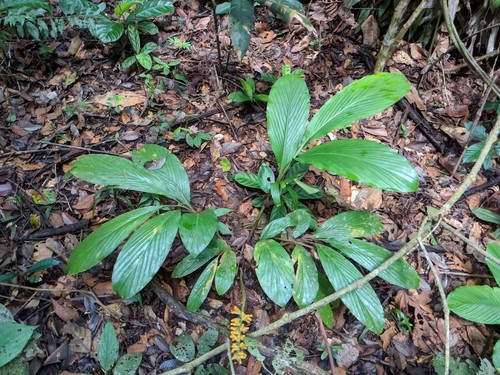
Zingiber spectabile
Griff.
Beehive ginger, Pinecone ginger, Golden-shampoo ginger, Nodding gingerwort
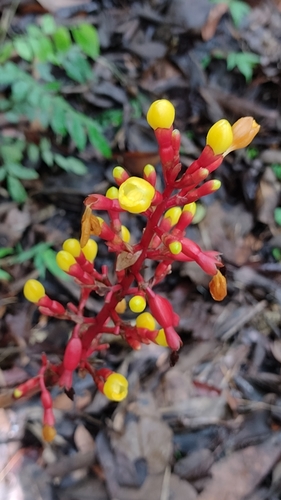
iNaturalist· cc-by-nc
(c) mamolins, some rights reserved (CC BY-NC), uploaded by mamolins
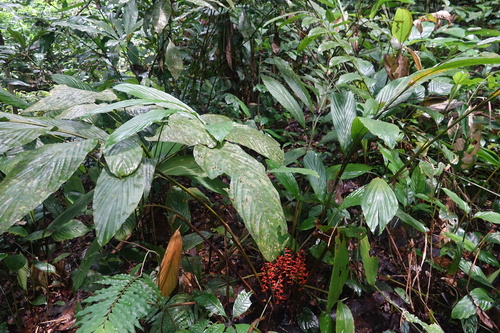
iNaturalist· cc-by-nc
(c) Julio Campis, some rights reserved (CC BY-NC), uploaded by Julio Campis
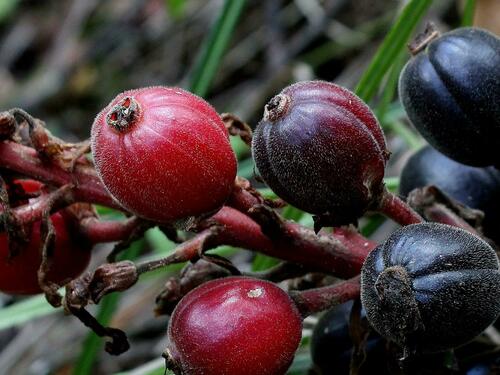
iNaturalist· cc-by-nc
(c) Kari, some rights reserved (CC BY-NC)
Summary
Source: WikipediaZingiber spectabile is a species of true ginger, native to Maritime Southeast Asia. It is primarily grown in the West as an ornamental plant, although it has been used in South-East Asia as a medicinal herb.
Description
A ginger family herb which is dormant for part of the year. It has underground stems. It is the largest of the gingers. It can be 4 m tall. The leaves are sword shaped and 50 cm long. They are softly downy underneath. The bracts which enclose the flower are yellow at first but can become red later. They are scoop shaped and waxy. The flowers are produced at ground level on separate shoots. These are 25 cm long. The flowers are cream with purple near the edges.
Edible Uses
The rhizome is used as a flavoring and can be prepared as a spice.
Traditional Uses
The rhizome is sometimes used as a flavouring.
This uses section is brief — help expand it
Medicinal Uses
In Indonesia, the plant has been used in traditional medicine to treat inflammation of the eyes. It is prepared for use by pounding the leaves of the plant into a thick paste, and then topically applying it to the required part of the body. It has also been recorded being used to treat burns, as a treatment for headaches and back pain, and as an agent for food preservation. Academic research has found that the plant has antimicrobial properties, and significant concentrations of the Zerumbone synthase enzyme, which may be effective in treating colon cancer.
Distribution
It is a tropical plant. It suits seasonally moist and dry climates. It needs fertile, organically-rich, well-drained soils. It does well in bright shade. It suits hardiness zones 9-12. Cairns Botanical Gardens.
Where It Grows
Andaman Is., Asia, Australia, British Indian Ocean Terr., BIOT, Hawaii, Indochina, Indonesia, Malaysia*, Pacific, SE Asia, South America, Thailand, USA,
Cultivation
Prefers a position in partial shade. Plants grow best in a moist, fertile, humus-rich, freely-draining soil. Plants have a distinct flowering flush, but can flower intermittently throughout the year.
Propagation
Seed - Division of the rhizome.
Also Known As
Chadak, Tepai, Tepus haliya puar, Tepus tanah, Tepus tundok
References (14)
- Burkill, I.H., 1966, A Dictionary of the Economic Products of the Malay Peninsula. Ministry of Agriculture and Cooperatives, Kuala Lumpur, Malaysia. Vol 2 (I-Z) p 2345
- Cundall, P., (ed.), 2004, Gardening Australia: flora: the gardener's bible. ABC Books. p 1496
- Facciola, S., 1998, Cornucopia 2: a Source Book of Edible Plants. Kampong Publications, p 249
- Hibbert, M., 2002, The Aussie Plant Finder 2002, Florilegium. p 311
- Lim, T. K., 2015, Edible Medicinal and Non Medicinal Plants. Volume 9, Modified Stems, Roots, Bulbs. Springer p 87
Show all 14 references Hide references
- Lim, T. K., 2016, Edible Medicinal and Non-Medicinal Plants: Volume 12 Modified Stems, Roots p 8
- Llamas, K.A., 2003, Tropical Flowering Plants. Timber Press. p 372
- Morley, B. & Everard, B., 1970, Wild Flowers of the World. Ebury press. Plate 124
- Recher, P, 2001, Fruit Spirit Botanical Gardens Plant Index. www.nrg.com.au/~recher/ seedlist.html p 4
- Smith, N., Mori, S.A., et al, 2004, Flowering Plants of the Neotropics. Princeton. Plate 64 (Photo)
- Staples, G.W. and Herbst, D.R., 2005, A tropical Garden Flora. Bishop Museum Press, Honolulu, Hawaii. p 769
- Tanaka,
- Topp, J. M. W., 1988, An Annotated Check List of the Flora of Diego Garcia, British Ocean Territory. Atoll Research Bulletin No. 313
- World Checklist of Useful Plant Species 2020. Royal Botanic Gardens, Kew