Selaginella willdenowii
(Desvaux ex Poir.) J. G. Baker
Electric fern, Peacock fern
iNaturalist· cc-by-nc
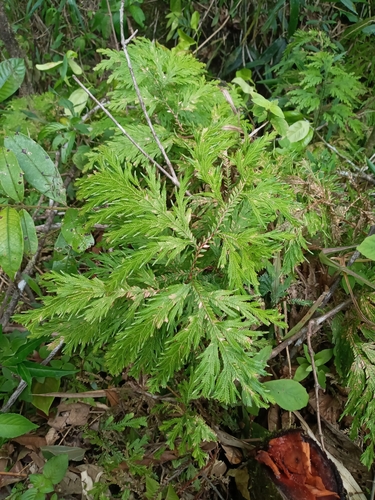
(c) Nurul, some rights reserved (CC BY-NC)
iNaturalist· cc-by-nc
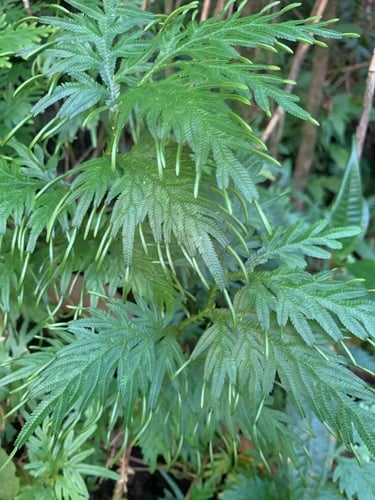
(c) avocat, some rights reserved (CC BY-NC)
iNaturalist· cc-by-nc
(c) avocat, some rights reserved (CC BY-NC)
Summary
Source: WikipediaSelaginella willdenowii is a species of vascular plant in the Selaginellaceae family. It is a spikemoss known by the common names Willdenow's spikemoss and peacock fern (a name shared with S. Uncinata) due to its iridescent blue leaves. Like other Selaginallales, it is fern ally and not a true fern. Selaginella willdenowii is sometimes spelt incorrectly as Selaginella willdenovii.
Description
An erect and climbing fern. The stems are erect and wiry. It climbs to 7 m long. The main stem is smooth and pale yellow. Along this there are much branched triangle shaped fronds. There are 2 kinds of leaves. The leaves on the fronds are blue-green with a metallic shine.
Edible Uses
The young bitter shoots, leaves, and fronds are eaten, traditionally consumed with other food.
Traditional Uses
The young bitter shoots are eaten with other food. (It is partly considered a medicine.)
This uses section is brief — help expand it
Medicinal Uses
It is partly considered a medicine.
Distribution
A tropical plant. It needs moist, shaded conditions. In Indonesia it grows from sea level to 1,200 m above sea level. In China it grows in forests and under shrubs between 100-1,000 m above sea level.
Where It Grows
Asia, Australia, Cambodia, China, Hawaii, India, Indochina, Indonesia, Jamaica, Laos, Malaysia, Myanmar, Pacific, Philippines, Puerto Rico, SE Asia, Thailand, Vietnam, West Indies,
Synonyms
Also Known As
Akar tulong, Daun menter, Ligonai, Menter, Pakis rane halus, Pakis merak, Paku lumut, Paku merak, Paku tanjong, Palu selemah, Rane, Rane paul, Sikili batu, Vine spike-moss
References (9)
- Acevedo-Rodriguez, P., 2005, Vine and Climbing Plants of Puerto Rico and the Virgin islands. Contributions to the United States National Herbarium. Volume 51:1-483 p 25
- Ambasta, S.P. (Ed.), 2000, The Useful Plants of India. CSIR India. p 565
- Burkill, I.H., 1966, A Dictionary of the Economic Products of the Malay Peninsula. Ministry of Agriculture and Cooperatives, Kuala Lumpur, Malaysia. Vol 2 (I-Z) p 2025
- Gard. Chron. 1867:783, 950. 1867
- Ochse, J. J. et al, 1931, Vegetables of the Dutch East Indies. Asher reprint. p 664
Show all 9 references Hide references
- Staples, G.W. and Herbst, D.R., 2005, A tropical Garden Flora. Bishop Museum Press, Honolulu, Hawaii. p 53 (Drawing)
- Sukarya, D. G., (Ed.) 2013, 3,500 Plant Species of the Botanic Gardens of Indonesia. LIPI p 881
- World Checklist of Useful Plant Species 2020. Royal Botanic Gardens, Kew
- www.eFloras.org Flora of China