Belamcanda chinensis
(L.) DC.
Leopard lily, Shooting stem
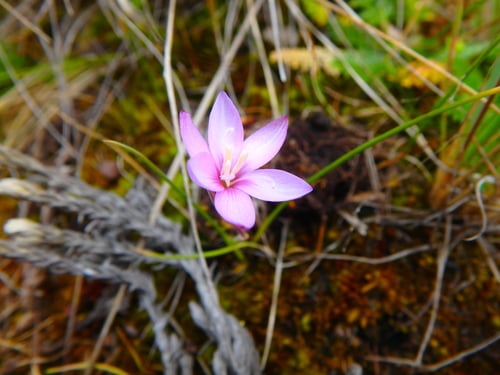
iNaturalist· cc-by-nc
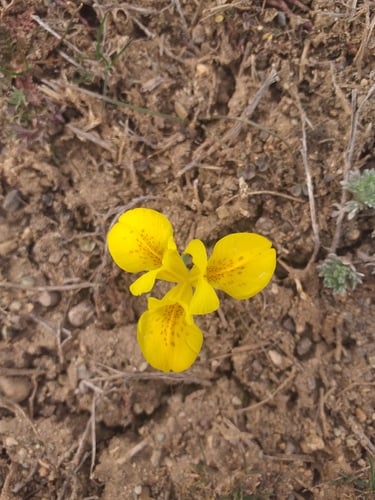
(c) Mikey, some rights reserved (CC BY-NC)
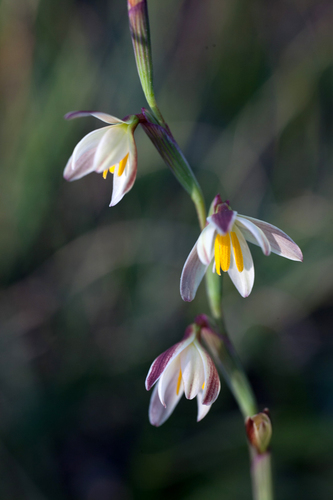
iNaturalist· cc-by-nc
(c) karinamc, some rights reserved (CC BY-NC)
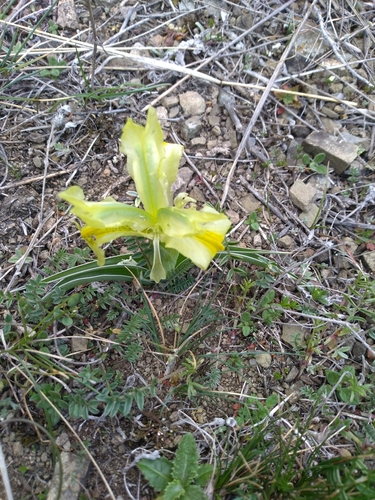
iNaturalist· cc-by-nc
(c) karinamc, some rights reserved (CC BY-NC)
Summary
Source: WikipediaA fast-growing 1 m tall perennial spreading to 30 cm, hardy to UK zone 8. Hermaphrodite flowers bloom August to October with seeds maturing September to November. Prefers light sandy and medium loamy well-drained soils with mildly acid to mildly alkaline pH. Tolerates semi-shade or full sun and prefers moist soil conditions.
Description
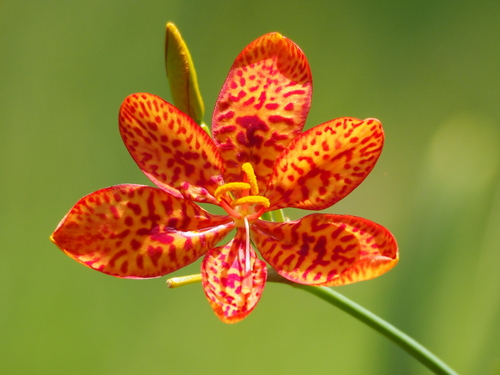
A lily-like herb. It is evergreen. It has an underground rhizome. There are many branch roots. It grows 0.5-1.5 m high. It spreads 30 cm wide. The stem is yellow. The leaves are sword like. They are 30-60 cm long by 2-4 cm wide. They have veins along them. The flowers are on slender stems. The flowers are orange-red with 6 lobes. There are spots on the flowers. The fruit are 1.5-2.5 cm long. The capsules open to reveal shiny seeds. The seeds are black. Probably now Iris domestica
Edible Uses
Edible Parts: Leaves Edible Uses: Leaves - cooked. Caution is advised, see the notes above on toxicity.
Medicinal Uses
Abortifacient Analgesic Antibacterial Antidote Antifungal Antiinflammatory Depurative Expectorant Febrifuge Hepatic Pectoral Purgative Stomachic Tonic The leopard lily has a very long history of use in traditional Chinese medicine. It is a bitter cooling herb that acts mainly on the lungs and the liver, lowering fevers and reducing inflammation. It is effective against a number of bacterial, fungal and viral organisms and has also been used as an antidote to snakebites. The root contains several medically active constituents including flavonoids and isoflavonoids. It also contains the glucosides belamcandin, tectoridin, shekanin and iridin. It is analgesic, antibacterial, antifungal, anti-inflammatory, depurative, expectorant, febrifuge, pectoral, purgative, stomachic and tonic. It is used in the treatment of acute laryngitis, acute tonsillitis, oedema of the glottis and cough with profuse sputum. The juice of the root is used in Nepal to treat liver complaints, where it has the added benefit of improving the appetite. This juice is also used to abort a foetus during the first trimester of pregnancy. The root should not be prescribed for pregnant women. The root is harvested in the summer and autumn, and dried for later use.
Distribution
It is a warm temperate plant. It grows in forests and on farms. It grows well in warmer places. It needs well drained and moderately fertile soil. Melbourne Botanical gardens. It suits hardiness zones 8-10. In Sichuan and Yunnan.
Where It Grows
Asia, Australia, Bhutan, Brazil, Britain, China*, Europe, Fiji, Hawaii, Himalayas, India, Indochina, Indonesia, Japan, Korea, Laos, Myanmar, Nepal, North America, Pacific, Philippines, Rotuma, Russia, SE Asia, Siberia, Taiwan, Thailand, Tibet, USA, Vietnam,
Cultivation
Plants can be grown from seed or division of the rhizome.
Propagation
Seed - best sown as soon as it is ripe in a cold frame. Pre-chill stored seed for 7 days and sow spring in a cold frame. The seed germinates in 2 - 8 weeks at 20°c. Prick out the seedlings into individual pots as soon as they are large enough to handle. They can be planted out in early autumn and should flower in the following year. Division in spring or early autumn. Larger divisions can be planted straight into their permanent positions whilst smaller clumps are best potted up and kept in a cold frame until they are growing away well.
Other Uses
Tannin The root contains tannin. Special Uses
Production
It is a perennial but does not live a long time.
Notes
There is only one (2) Balemcanda species. It is used in medicine in Indonesia and China. Probably now Iris domestica.
Synonyms
Also Known As
Blackberry lily, Brojo lintang, Kyathit-hninpan, Pardanthus, Repene, She gan, Surjakanti, Wan-hahng-chang
References (14)
- Ambasta S.P. (Ed.), 2000, The Useful Plants of India. CSIR India. p 70
- Bodkin, F., 1991, Encyclopedia Botanica. Cornstalk publishing, p 140
- Brown, D., 2002, The Royal Horticultural Society encyclopedia of Herbs and their uses. DK Books. p 141
- Burkill, I.H., 1966, A Dictionary of the Economic Products of the Malay Peninsula. Ministry of Agriculture and Cooperatives, Kuala Lumpur, Malaysia. Vol 1 (A-H) p 318
- Cundall, P., (ed.), 2004, Gardening Australia: flora: the gardener's bible. ABC Books. p 228
Show all 14 references Hide references
- Hani Medicine of Xishuangbanna, 1999, p 575
- Hibbert, M., 2002, The Aussie Plant Finder 2002, Florilegium. p 42
- McMakin, P.D., 2000, Flowering Plants of Thailand. A Field Guide. White Lotus. p 18
- Plants for a Future database, The Field, Penpol, Lostwithiel, Cornwall, PL22 0NG, UK. http://www.scs.leeds.ac.uk/pfaf/
- P. J. Redoute, Liliac. 3: t. 121. 1805
- Staples, G.W. and Herbst, D.R., 2005, A tropical Garden Flora. Bishop Museum Press, Honolulu, Hawaii. p 669
- Wijayakusuma, H.M.H., et al, 1996, Tanaman Berkhasiat Obat Di Indonesia. Pustaka Kartini. p 32
- World Checklist of Useful Plant Species 2020. Royal Botanic Gardens, Kew
- Zeven, A. C. & de West, J. M. J., 1982, Dictionary of cultivated plants and their regions of diversity. Wageningen. p 39