Clidemia hirta
(L.) D. Don
Koster's curse, Hairy Clidemia
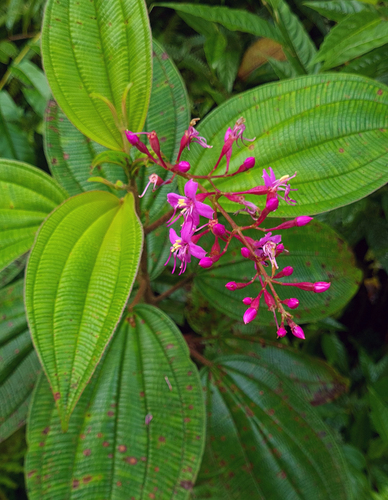
iNaturalist· cc-by-nc
(c) Steve Maldonado Silvestrini, some rights reserved (CC BY-NC)
iNaturalist· cc-by-nc
(c) rafizan, some rights reserved (CC BY-NC)
iNaturalist· cc-by-nc
(c) Nunia Thomas-Moko, some rights reserved (CC BY-NC)
Description
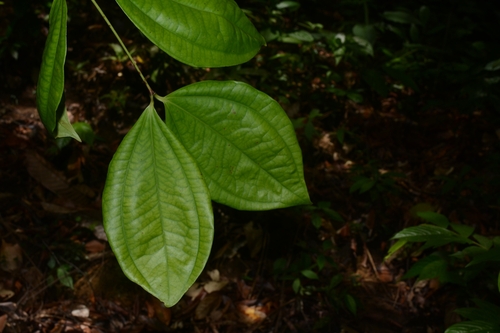
A slightly woody herb or shrub. It grows up to 1 m high. The stem is hairy. The flowers are small. The leaves have pleated surfaces. It can produce 5,000 seeds each year. One fruit can have 100 seeds. The fruit are purple. The fruit are edible.
Edible Uses
The purple fruit are eaten raw, especially by children, and the seeds are also consumed.
Traditional Uses
The fruit are eaten raw. The seeds are also eaten.
This uses section is brief — help expand it
Medicinal Uses
The leaves are astringent and antispasmodic. A decoction of the leafy branches is taken to reduce excessive menstrual flow. An infusion is used to treat stomachache, and is also taken as an enema. A decoction of the leaves is used to cicatrize old wounds. Macerated in cold water, the leaves are used to make a woman's antiseptic genital bath to remedy haemorrhaging.
Distribution
A tropical plant. It grows in the humid lowlands. It can grow in shady places. In Argentina it grows below 500 m above sea level.
Where It Grows
Africa, Amazon, American Samoa, Argentina, Asia, Belize, Bolivia, Brazil, Caribbean, Central America*, Colombia, Costa Rica, Cuba*, Dominican Republic, East Africa, Ecuador, El Salvador, Fiji, Guatemala, Guiana, Guianas, Guyana, Haiti, Hawaii, Honduras, India, Indonesia, Jamaica*, Lesser Antilles*, Madagascar, Malaysia, Melanesia, Mexico, Nicaragua, North America, Pacific, Panama, Paraguay, Peru, Puerto Rico, Rotuma, SE Asia, Singapore, South America, Suriname, Venezuela, Virgin Islands, USA, West Indies*,
Cultivation
A plant of the moist tropics, it grows in areas that are usually characterized by very high humidity for most of the year with a dry period of about two to three months. In Hawaii it can be found from sea level to around 900 metres, it has become widespread in areas that receive more than 12,700mm of rain annually, though it can also be found in areas of annual rainfall in excess of 760mm with no dry season. Succeeds in deep shade as well as in open, sunny areas. Prefers a moist but well-drained soil. The plant has often escaped from cultivation and is considered an invasive plant in many areas. It is an aggressive invader which shades out all vegetation below it. The seeds are principally dispersed by alien frugivorous birds, but any organism moving through the thickets will carry seeds away with it. It is probably not resistant to fire, an unlikely event in its habitat, but it rapidly colonizes burned areas. Plants flower and fruit prolifically throughout the year.
Other Uses
The plant is a natural pioneer species within its native range, where it can rapidly invade disturbed areas[305. This can be beneficial within the plant's native range, where it can help to create the conditions necessary for restoring native woodland, but the plant also readily invades areas outside its native range, where it can displace native species.
Production
Fruit occur in both the dry and the rainy season.
Other Information
The fruit are especially eaten by children.
Notes
It can be invasive.
Synonyms
Also Known As
Antumu, Caiuia, Camasey, Camesey peludo, Chinchak, Chinllakim Choroticos, Draunisiga, Folha-do-fogo, Haramunting, Harendong bulu, Karamunting, Kelymazana, Mazambody, Meleca-de-cachorro, Mora, Mucura, Mullaca, Mullaca morada, Nigua, Obogimo, Pixirica, Pixirica-de-cachorro, Senduduk bulu, Senduduk paksa, Sombatra, Vao fulu
References (26)
- Alimenticias - FloraSBS
- Brack, P., et al, 2020, Frutas nativas do Rio Grande do Sul, Brasil: riqueza e potencial alimentício. Native fruits of Rio Grande do Sul, Brazil: richness and potential as food. Rodriguésia 71: e03102018.
- Burkill, I.H., 1966, A Dictionary of the Economic Products of the Malay Peninsula. Ministry of Agriculture and Cooperatives, Kuala Lumpur, Malaysia. Vol 1 (A-H) p 595
- Don, G., A General History of the Dichlamydeus Plants: Calyciflorae
- Fouqué, A., 1972, Espèces fruitières d'Amérique tropicale. Institut français de recherches fruitierès outre-mer
Show all 26 references Hide references
- Franklin, J., Keppel, G., & Whistler, W., 2008, The vegetation and flora of Lakeba, Nayau and Aiwa Islands, Central Lau Group, Fiji. Micronesica 40(1/2): 169–225, 2008
- Kermath, B. M., et al, 2014, Food Plants in the Americas: A survey of the domesticated, cultivated and wild plants used for Human food in North, Central and South America and the Caribbean. On line draft. p 244
- Kinupp, V. F., 2007, Plantas alimenticias nao-convencionais da regiao metropolitana de Porto Alegre, RS, Brazil p 83
- Kunkel, G. 1984. Plants for human consumption.
- Lopez-Diago, D. & Garcia, N., 2021, Wild edible fruits of Colombia. Biota ColomBiana 22 (2) p 42
- Marinelli, J. (Ed), 2004, Plant. DK. p 450
- Martin, F.W., C.W. Campbell and R.M. Ruberté, 1987, Perennial edible fruits of the tropics - An inventory. United States Department of Agriculture, Agricultural Research Service, Agriculture Handbook No. 642. Washington, D.C., USA
- Mem. Wern. Nat. Hist. Soc. 4:309. 1823
- Milow, P., et al, 2013, Malaysian species of plants with edible fruits or seeds and their evaluation. International Journal of Fruit Science. 14:1, 1-27
- NYBG herbarium "edible"
- Pawera, L., et al, 2020, Wild Food Plants and Trends in Their Use: From Knowledge and Perceptions to Drivers of Change in West Sumatra, Indonesia, Foods. 2020, 9, 1240
- Plants of Haiti Smithsonian Institute http://botany.si.edu/antilles/West Indies
- Priyadi, H., et al, 2010, Five hundred plant species in Gunung Halimun Salak National Park West Java. A checklist including Sundanese names, distribution and use. CIFOR, FFPRI, SLU p 41
- Reis, S. V. and Lipp, F. L., 1982, New Plant Sources for Drugs and Foods from the New York Botanical Garden herbarium. Harvard. p 213
- Roa, J. A. G. & Boada, D. S. G., 2018, Fundación para el Fortalecimiento de la Fruticultura y Plantas Alimenticias no Convencionales en Colombia.
- Segura, S., et al, 2018, The edible fruit species in Mexico. Genet Resour Crop Evol (2018) 65:1767–1793
- Smith, N., et al, 2007, Amazon River Fruits. Flavors for Conservation. Missouri Botanical Gardens Press. p 170
- Styger, E., et al, 1999, Indigenous fruit trees of Madagascar: potential components of agroforestry systems to improve human nutrition and restore biological diversity. Agroforestry Systems 46: 289-310
- Torre, de la, L., et al, 2008, Enciclopedia de las Plantas Útiles del Ecuador. Herbario QCA. Pontificia Universidad Católica del Ecuador. p 424
- Van den Eynden, V., et al, 2003, Wild Foods from South Ecuador. Economic Botany 57(4): 576-603
- Vasquez, R. and Gentry, A. H., 1989, Use and Misuse of Forest-harvested Fruits in the Iquitos Area. Conservation Biology 3(4): 350f