Medinilla mirabilis
(Gilg.) Jacq.-Fel.
gbif· cc-by-nc-nd
Ehoarn Bidault
gbif· cc-by-nc-nd
Ehoarn Bidault
gbif· cc-by-nc-nd
Ehoarn Bidault
Description
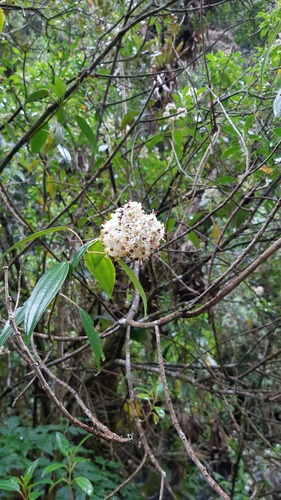
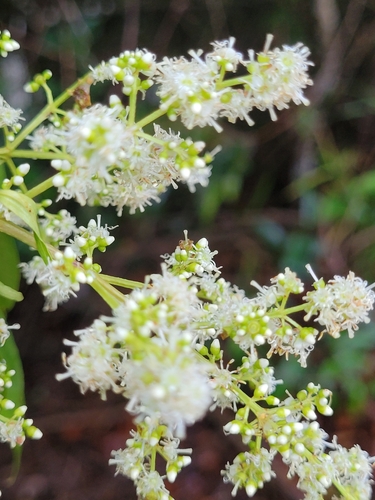
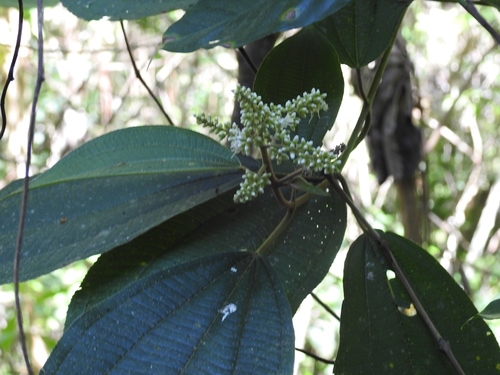
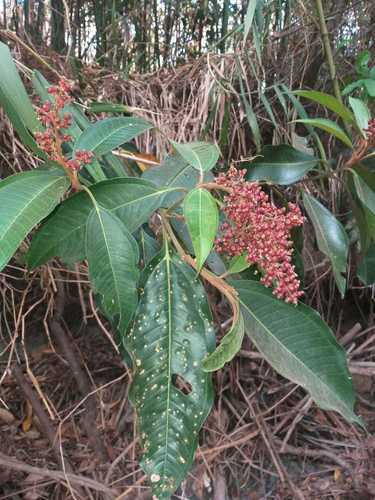
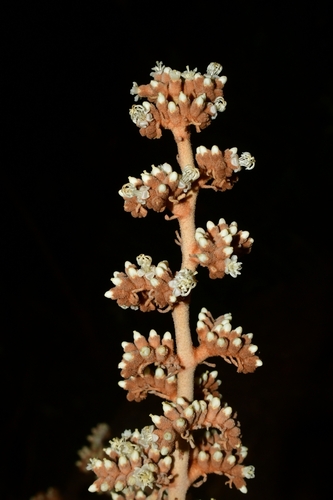
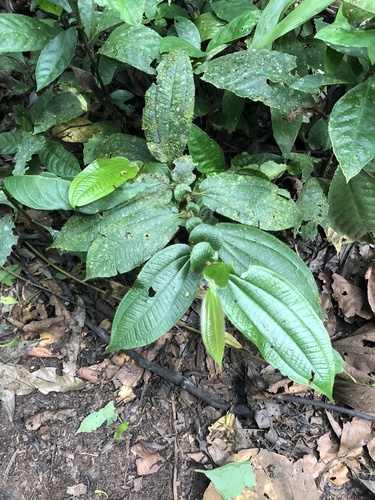
A climbing shrub or creeper. The stems can be 10 m long. The leaves are simple and usually arranged in rings of 4. They are leathery and young leaves are red. The leaf stalk is 2 cm long. The leaf blade is oval and 15-30 cm long by 5-15 cm wide. The base is rounded and it often tapers to the tip. The flowers are in groups at the nodes along the stem. They are near ground level. The flowers have both sexes. The fruit is an urn shaped false berry. It is 1.5 cm long. It is dark purple and has many seeds. The seeds are wedge shaped and 1 mm long.
Edible Uses
The young leaves are cooked and eaten as a vegetable, often prepared with meat or fish to provide an acid taste. It is recognized as a minor wild vegetable.
Traditional Uses
The young leaves are cooked and eaten as a vegetable. They are often cooked with meat of fish to give an acid taste.
This uses section is brief — help expand it
Medicinal Uses
The leaves, combined with melegueta pepper (Aframomum melegueta), are used as a cough medicine. Heated leaves are applied to cicatrize wounds.
Distribution
It is a tropical plant. It grows in the forest zone in West Africa. It grows from sea level up to 700 m above sea level.
Where It Grows
Africa, Cameroon, Central Africa, Gabon, Nigeria, West Africa,
Other Information
It is a minor wild vegetable.
Notes
There are about 400 Medinilla species. They are mostly in tropical Asia.
Synonyms
References (4)
- Burkill, H. M., 1985, The useful plants of west tropical Africa, Vol. 5. Kew.
- Flora of West Tropical Africa. Vol. 1 Part 1.
- Grubben, G. J. H. and Denton, O. A. (eds), 2004, Plant Resources of Tropical Africa 2. Vegetables. PROTA, Wageningen, Netherlands. p 381
- World Checklist of Useful Plant Species 2020. Royal Botanic Gardens, Kew