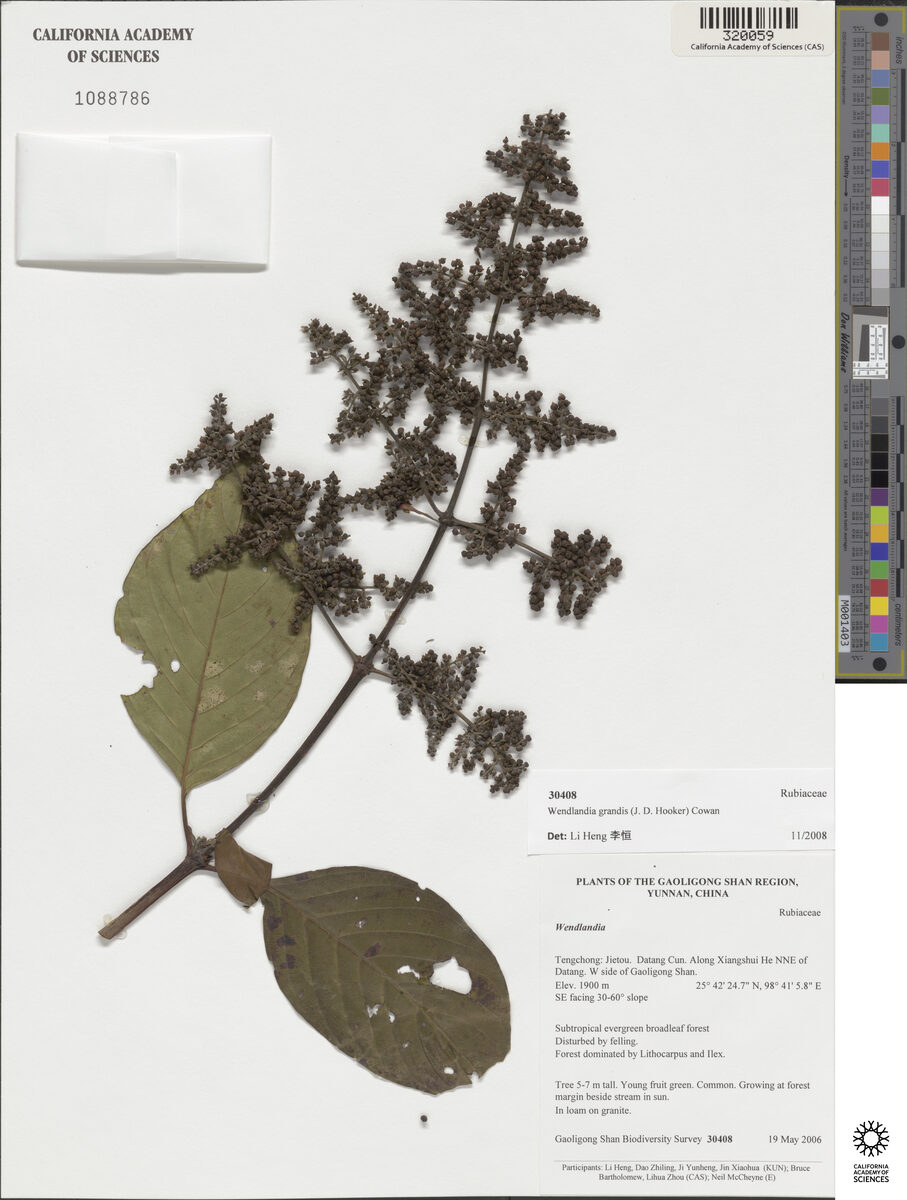
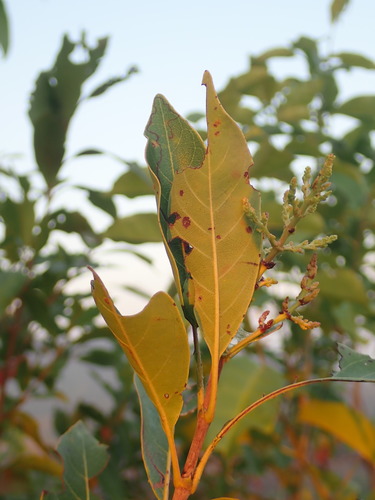
Canthium horridum
Blume
Thorny bramble
wikimedia· cc0
Wikimedia Commons - Francisco Manuel Blanco (O.S.A.)
wikimedia· cc0
Wikimedia Commons - Francisco Manuel Blanco (O.S.A.)
Description
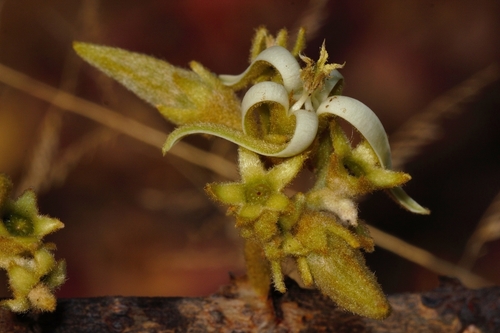
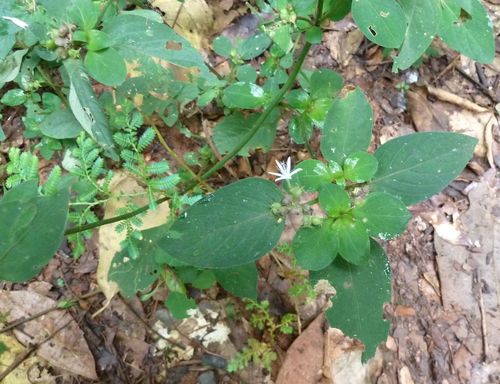
A spiny shrub. It grows 2-3 m high. It can be a small tree. The young branches are slender. The leaves are opposite and narrowly oval. They are 2-3 cm long by 1-3 cm wide. They taper to the tip and are rounded at the base. The flowers are small and white. They occur singly or as 2 together in the axils of leaves. The fruit are fleshy and 2-3 cm across. They turn yellow as they ripen.
Edible Uses
The leaves are pounded into water to produce a mucilage used as a sweet jelly, eaten cold. The yellow acid berries are used to make sweets.
Traditional Uses
The leaves (along with Cyclea barbata) are pounded into water to give a mucilage which is used as a sweet jelly, eaten cold. Sweets are made from the yellow acid berries.
Distribution
A tropical plant. In southern China it grows at low elevations from sea level to 500 m above sea level. In Yunnan.
Where It Grows
Asia, Bangladesh, China, India, Indochina, Indonesia, Laos, Malaysia, Myanmar, Philippines, SE Asia, Singapore, Thailand, Vietnam,
Notes
There are about 200 Canthium species.
Synonyms
Also Known As
Bestru, Bulang, Bulangan, Bulang kechil, Bulang tikus, Dayap-dayap, Kait-kait, Kaliyage, Khlet nuu, Kuliak-daga, Lep rawk, Ma kao nei, Mimisan, Naam leprok, Nam lep rawk, Ning zhou jian, Selungkit, Ya dai si
References (9)
- Bircher, A. G. & Bircher, W. H., 2000, Encyclopedia of Fruit Trees and Edible Flowering Plants in Egypt and the Subtropics. AUC Press. p 81
- Burkill, I.H., 1966, A Dictionary of the Economic Products of the Malay Peninsula. Ministry of Agriculture and Cooperatives, Kuala Lumpur, Malaysia. Vol 1 (A-H) p 448
- Cao, Y., et al, 2020, Ethnobotanical study on wild edible plants used by three trans-boundary ethnic groups in Jiangcheng County, Pu’er, Southwest China. Journal of Ethnobiology and Ethnomedicine (2020) 16:66
- Heyne, K., 1927 ed.,
- Hu, Shiu-ying, 2005, Food Plants of China. The Chinese University Press. p 676
Show all 9 references Hide references
- Luo, B., et al, 2019, Wild edible plants collected by Hani from terraced rice paddy agroecosystem in Honghe Prefecture, Yunnan, China. Journal of Ethnobiology and Ethnomedicine 15:56
- Priyadi, H., et al, 2010, Five hundred plant species in Gunung Halimun Salak National Park West Java. A checklist including Sundanese names, distribution and use. CIFOR, FFPRI, SLU p 60
- Slik, F., www.asianplant.net
- World Checklist of Useful Plant Species 2020. Royal Botanic Gardens, Kew