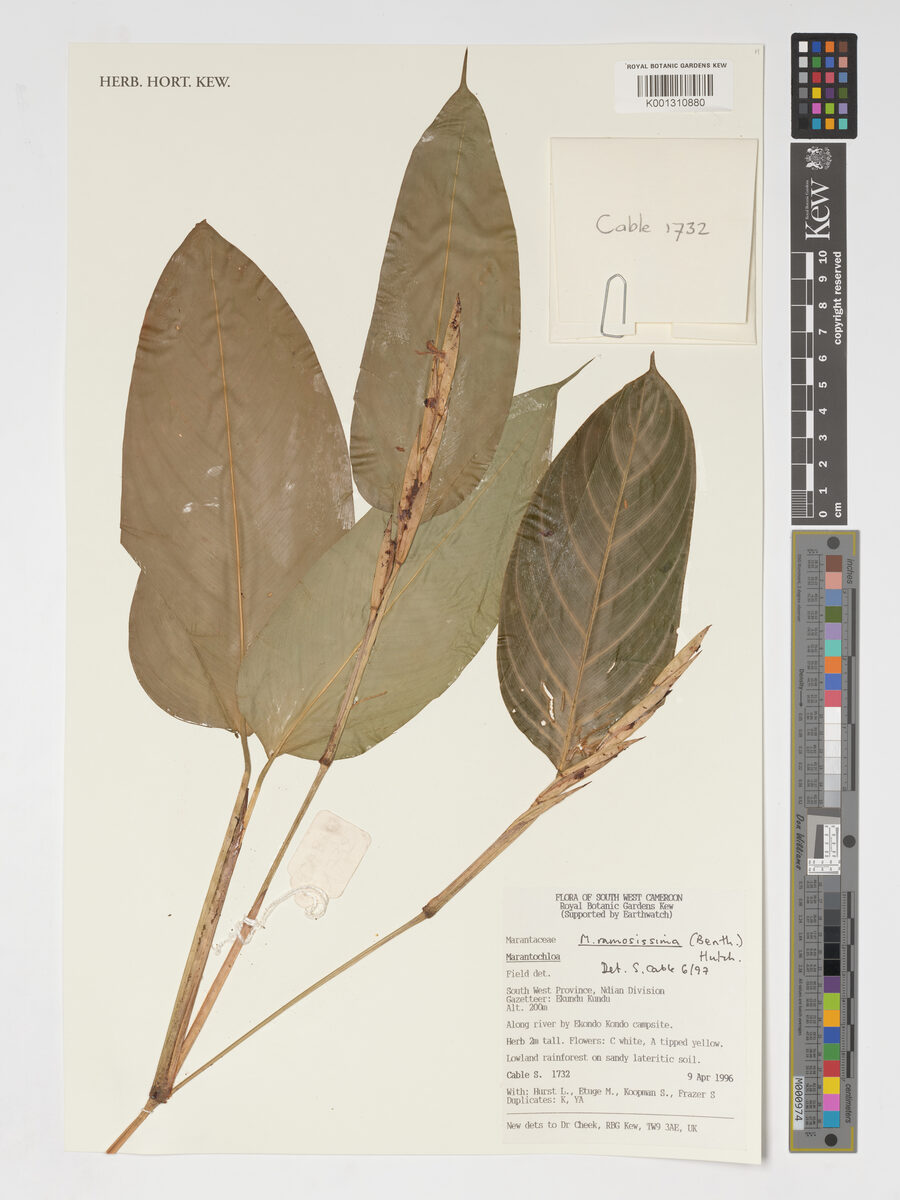
Phrynium pubinerve
Blume
Arrow root
iNaturalist· cc-by-nc
(c) Ganjar Cahyadi, some rights reserved (CC BY-NC), uploaded by Ganjar Cahyadi
iNaturalist· cc-by-nc
(c) Ganjar Cahyadi, some rights reserved (CC BY-NC), uploaded by Ganjar Cahyadi
iNaturalist· cc-by-nc
(c) Jonathan M, some rights reserved (CC BY-NC), uploaded by Jonathan M
Summary
Source: WikipediaPhrynium pubinerve is the type species of the plant genus Phrynium, in the family Marantaceae. It is widespread throughout Asia, with records from India, China, and Indo-China through to New Guinea; no subspecies are listed in the Catalogue of Life.
Description
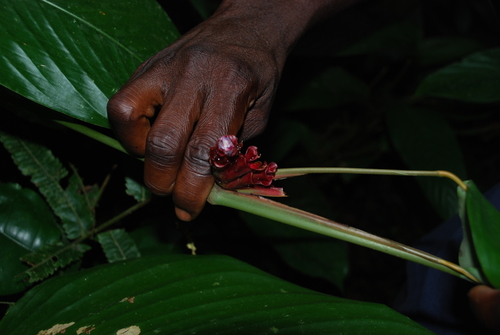
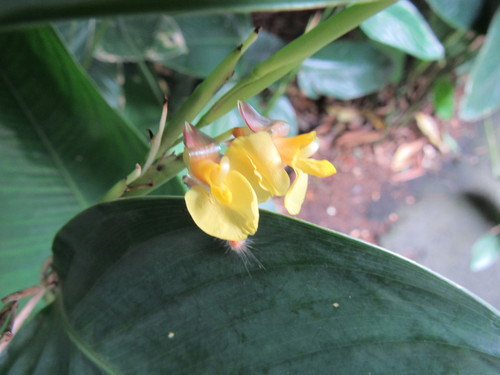
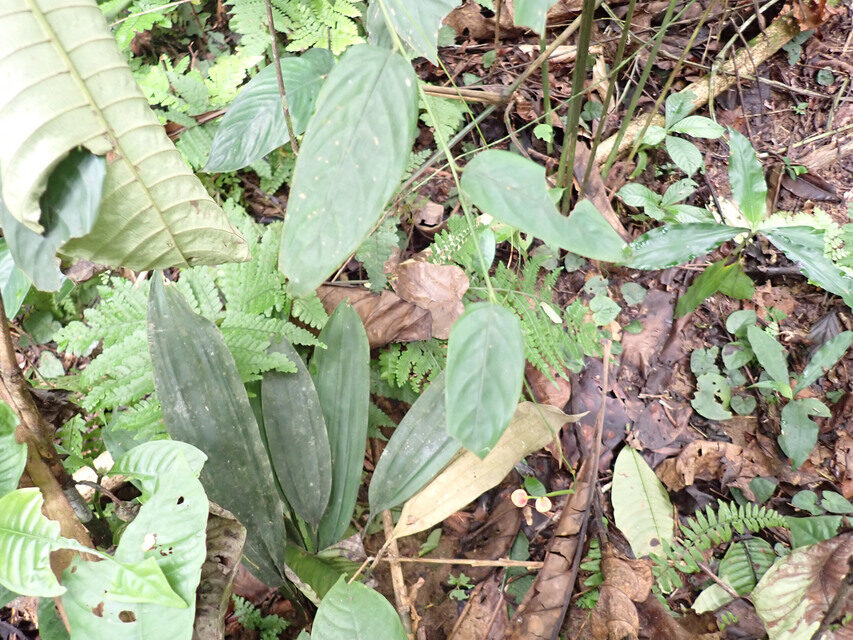
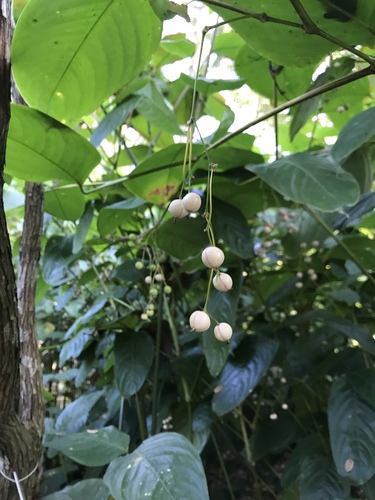
A herb. It can grow from 1-3.5 m high. It forms dense clusters. These can be several metres across. The roots are fattened tubers. The leaves are large. There are 2-3 leaves per shoot. The leaf sheath is 20-100 cm long. The leaf stalk is up to 180 cm long. The leaf blade is green and can be 80 cm long by 30 cm wide. The flowering stalks are between the leaves. The flower stalks can be up to 170 cm long. The flowers are purple. The fruit are round and brown. They are 1-1.2 cm long. Each fruit has 2 or 3 segments and 2 or 3 seeds.
Edible Uses
The underground tubers are used as a masticatory. The roots are cooked as a vegetable. The leaves are used to wrap cooked rice to add flavour, to wrap food during cooking, and are added to vinegar during manufacturing to add colour and flavour. The fruit and seeds are also eaten.
Traditional Uses
The underground tuber is used as a masticatory. Food is boiled in the leaves to add colour and flavour. The leaves are added to the liquid in the manufacturing of vinegar. The leaves are used to wrap cooked rice to add flavour. The roots are cooked as a vegetable.
Distribution
It is a tropical plant. It often grows in disturbed areas. It grows near streams and roadsides. It grows in valleys, dense forests and humid areas. In Yunnan.
Where It Grows
Andamans, Asia, China, Himalayas, India, Indochina, Indonesia, Laos, Malaysia, Myanmar, Northeastern India, Philippines, SE Asia, Thailand, Vietnam,
Notes
The leaves are used for wrapping food.
Synonyms
Also Known As
Balgato, Beepavq, Cay la dong, Ekkam, Hnah-thial, Khokam, Kobu, Packing leaf
References (13)
- Anderson, E. F., 1993, Plants and people of the Golden Triangle. Dioscorides Press. p 217 (As Phrynium capitatum)
- Arora, K., Indigenous Forest Management in the Andaman and Nicobar Islands, India.
- Clausager, K. & Bochsenius, F., 2003, The Marantaceae of Sabah, Northern Borneo. Kew Bulletin, Vol. 58, No. 3 (2003), pp. 647-678
- Facciola, S., 1998, Cornucopia 2: a Source Book of Edible Plants. Kampong Publications, p 149 (As Phrynium capitatum)
- Hani Medicine of Xishuangbanna, 1999, p 151 (As Phrynium capitatum)
Show all 13 references Hide references
- Hedrick, U.P., 1919, (Ed.), Sturtevant's edible plants of the world. p 489 (As Phrynium capitatum)
- Kar, A., et al, 2013, Wild Edible Plant Resources used by the Mizos of Mizoram, India. Kathmandu University Journal of Science, Engineering and Technology. Vol. 9, No. 1, July, 2013, 106-126 (As Phrynium capitatum)
- Kumar, Y J. et al, 1987, Further Contribution to the Ethnobotany of Meghalaya: Plants used by "War jaintia" of Jaintia Hill District. Econ. Tax. Bot. Vol 11 No. 1 pp 65-
- Lim, T. K., 2015, Edible Medicinal and Non Medicinal Plants. Volume 9, Modified Stems, Roots, Bulbs. Springer p 65
- Maikhuri, R, K, and Gangwar, A. K., 1993, Ethnobiological Notes on the Khasi and Garo Tribes of Meghalaya, Northeast India, Economic Botany, Vol. 47, No. 4, pp. 345-357 (As Phrynium capitatum)
- Murtem, G. & Chaudhrey, P., 2016, An ethnobotanical note on wild edible plants of Upper Eastern Himalaya, India. Brazilian Journal of Biological Sciences, 2016, v. 3, no. 5, p. 63-81 (As Phrynium capitatum)
- Sawian, J. T., et al, 2007, Wild edible plants of Meghalaya, North-east India. Natural Product Radiance Vol. 6(5): p 420 (As Phrynium capitatum)
- Taram, M., et al, 2018, Wild Food Plant Resources of Komkar Adi Tribe of Upper Siang District in Arunachal Pradesh, India. Bulletin of Arunachal Forest Research, Vol. 33(2), 27-35