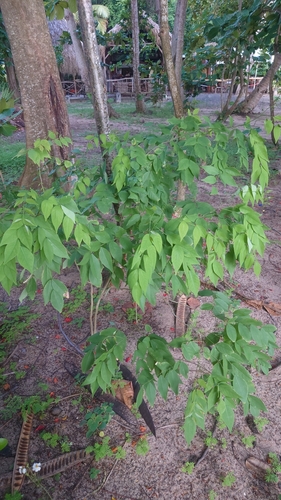
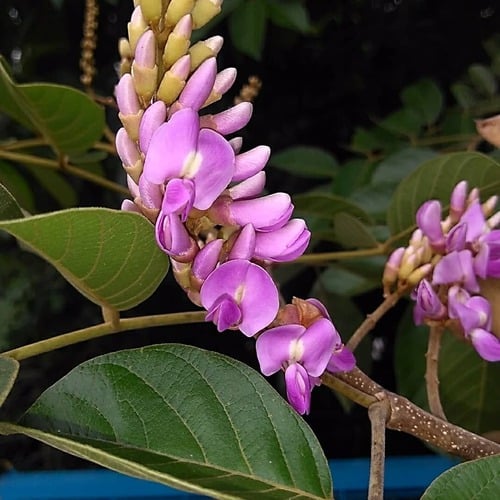
Bauhinia racemosa
(L.) Lam.
Burmese silk orchid
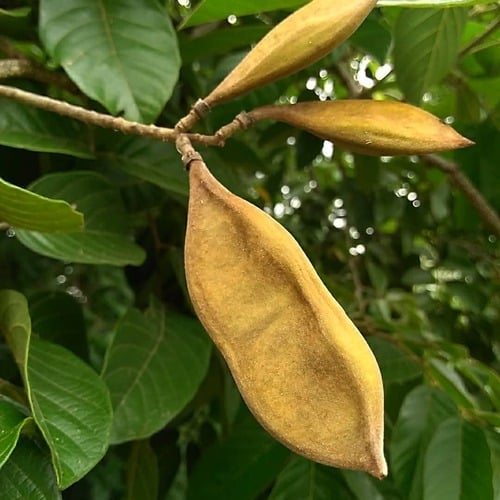
iNaturalist· cc-by-nc
(c) Rujuta Vinod, some rights reserved (CC BY-NC), uploaded by Rujuta Vinod
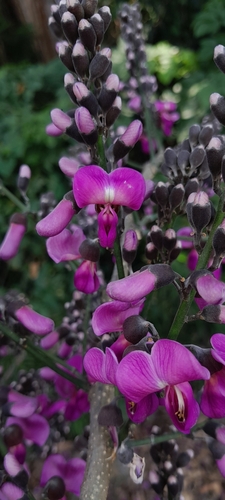
iNaturalist· cc-by-nc
(c) Shiwalee Samant, some rights reserved (CC BY-NC), uploaded by Shiwalee Samant
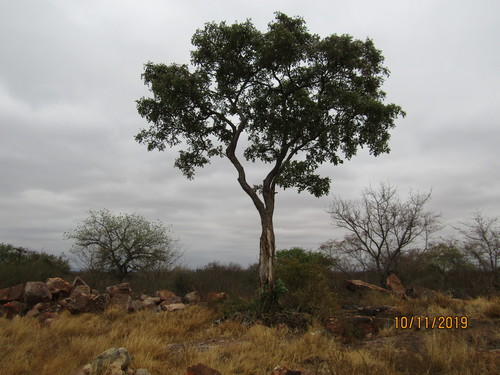
iNaturalist· cc-by-nc
(c) Shiwalee Samant, some rights reserved (CC BY-NC), uploaded by Shiwalee Samant
Summary
Source: WikipediaBauhinia racemosa, commonly known as the bidi leaf tree, is a rare medicinal species of flowering shrub with religious significance. It is a small crooked tree with drooping branches that grows 3–5 metres (10–16 ft) tall and flowers between February and May. It is native to Southeast Asia, the Indian subcontinent and China.
Description
A small deciduous tree. It can be up to 15 m high. It has a crooked trunk and spreading crown. The bark is very dark and rough and deeply cracked. The leaves have 2 lobes. They are broader than they are long. The flowers are greenish-yellow. There are 10 stamens. The pods are 15-20 cm long. They are thick and woody and slightly curved. They contain 10-20 seeds.
Edible Uses
The seeds are dried and ground into flour for bread-making or roasted and eaten. The flower buds are eaten cooked, while young leaves and flowers are stir-fried. The leaves are also pickled. The fruit pods are sold in markets.
Traditional Uses
The seeds are dried and ground into flour for making bread. They are also roasted and eaten. The flower buds are eaten cooked. The young leaves and flowers are stir-fried. The leaves are pickled.
Medicinal Uses
The plant has anticancer properties.
Distribution
A tropical plant. It grows in deciduous forest. It can tolerate a wide range of soils. It is reasonably tolerant of drought and high rainfall. In Yunnan.
Where It Grows
Asia, Cambodia, China, Himalayas, India, Indochina, Indonesia, Laos, Malaysia, Myanmar, Northeastern India, Pakistan, SE Asia, Sri Lanka, Thailand, Vietnam,
Cultivation
Plants can be grown by seeds, air-layering or grafting.
Propagation
Seed - pre-soak for24 hours in warm water then sow in situ or in a nursery seedbed. Germination rates of 1 year old seed can be from 58 - 95%. Young plants grow rapidly and quickly produce a taproot that can be 60cm long within 2 months of germination. Plants are not very tolerant of transplanting unless moved whilst still quite small. Cuttings of half-ripe wood, with the leaves removed, placed in moist sand.
Other Uses
The inner bark yields a bast fibre that can be made into rude cordage, but which soon rots in water. It is reddish in colour, very tough and strong, and has been used in the construction of bridges. The stems are usually cut in July or August, the outer bark being stripped off and thrown away, while the inner layers are used for rope as wanted, being previously soaked in water, and are twisted wet. The report from is quite likely here by mistake. I believe that the entry is more likely to be for Bauhinia vahlii (syn Bauhinia racemosa Vahl). The brown wood has irregular dark patches near the centre. It is hard. The wood is not much used, though it makes a good fuel.
Production
The fruit are available in May to July in Rajasthan in India. In southern China plants flower in April to May and fruit in June to August.
Other Information
The fruit are sold in markets.
Notes
There are about 250-350 Bauhinia species. Most are in the tropics. Also as Caesalpinaceae. It has anticancer properties.
Also Known As
Aachitro, Amata, Apta, Arai, Ari, Ashta, Asintro, Asitra, Asundro, Banne, Banraj, Bhosa, Ghila, Gurial, Gwiral, Hinglo, Jhanjhara, Jhinja, Jhinjheri, Jhiza, Kachnal, Kachnar, Kondal, Katmauli, Kosundra, Kotal, Mahulvel, Makuna, Maula, Mong-bo chum, Pohon bohinia anggrek-sutra myanmar, Seta, Shid, Svetkanchagna, Thaur
References (28)
- Ambasta S.P. (Ed.), 2000, The Useful Plants of India. CSIR India. p 69
- Bhogaonkar, P. Y. & Devarkar, V. D., 2018. Inventory for ethnovegetable knowledge of the tribals of Satpura hill area-Melghat, Dist. Amravati (India), Plantae Scientia, 2018; Vol. 01 Issue 01: 01-08
- Chauhan, S. H., et al, 2018, Consumption patterns of wild edibles by the Vasavas: a case study from Gujarat, India. Journal of Ethnobiology and Ethnomedicine (2018) 14:57
- Ekka, N. S. & Ekka, A., 2016, Wild Edible plants Used by Tribals of North-east Chhattisgarh (Part-I), India. Research Journal of Recent Sciences. Vol. 5(ISC-2015), 127-131 (2016)
- Encycl. 1:390. 1785
Show all 28 references Hide references
- Facciola, S., 1998, Cornucopia 2: a Source Book of Edible Plants. Kampong Publications, p 66
- GAMMIE,
- Gardner, S., et al, 2000, A Field Guide to Forest Trees of Northern Thailand, Kobfai Publishing Project. p 169
- Gunjatkar, N., & Vartak, V.D., 1982, Enumeration of wild edible legumes from Pune District, Maharashtra State. J.Econ. Tax. Bot. Vol 3 pp 1-9
- Jadhav, R., et al, 2015, Forest Foods of Northern Western Ghats: Mode of Consumption, Nutrition and Availability. Asian Agri-History Vol. 19, No. 4: 293-317
- Kahlon, L. K. & Singh, R., 2019, Traditional knowledge & Dynamics of edible plants of primitive tribal group ‘Paudi Bhuyan’ with changing demography migration patterns in Northern Odisha. Indian Journal of Traditional Knowledge Vol 18(1), pp 7-15
- Khyade, M. S., et al, 2009, Wild Edible Plants Used By the Tribes of Akole Tahasil of Ahmednagar District (Ms), India. Ethnobotanical Leaflets 13: 1328-36, 2009
- Kintzios, S. E., 2006, Terrestrial Plant-Derived Anticancer Agents and Plant Species Used in Anticancer research. Critical Reviews in Plant Sciences. 25: pp 79-113
- Kiran, K. C., et al, 2019, Diversity and Seasonal Availability of Potential Wild Edible Plants from Vidarbha Region of Maharashtra State, India. Int.J.Curr.Microbiol.App.Sci (2019) 8(2): 1434-1446
- Krishen P., 2006, Trees of Delhi, A Field Guide. DK Books. p 190
- Kunkel,
- Mahadkar, S., Valvi, S. & Rathod, V., 2012, Nutritional assessment of some selected wild edible plants as a good source of mineral. Asian Journal of Plant Science and Research 2(4):468-472
- Masoodi, H. U. R. & Sundriyal, R. C., 2020, Richness of non-timber forest products in Himalayan communities—diversity, distribution, use pattern and conservation status. Journal of Ethnobiology and Ethnomedicine 16:56
- Nakahara, K. et al, 2002, Antimutagenicity of Some Edible Thai Plants, and a Biocative Carbazole Alkaloid, Mahanine, Isolated from Micromelum minutum. Journal of Agricultural and Food Chemistry. 50: 4796-4892
- Pham-Hoang Ho, 1999, An Illustrated Flora of Vietnam. Nha Xuat Ban Tre. p 855
- Phangchopi, U., et al, 2015, Diversity of wild edible plants in Marat Longri Wildlife Sanctuary, Assam. Indian Journal of Natural Products and Resources Vol. 6(4), December 2015 pp. 305-313
- Radha, B., et al, 2013, Wild Edible Plant Resources of the Lohba Range of Kedarnath Forest Division (KFD), Garhwal Himalaya, India. Int. Res J. Biological Sci. Vol. 2 (11), 65-73
- Reddy, B. M., 2012, Wild edible plants of Chandrapur district, Maharashtra, India. Indian Journal of Natural Products and Resources. 3(1) pp 110-117
- Singh, H.B., Arora R.K.,1978, Wild edible Plants of India. Indian Council of Agricultural Research, New Delhi. p 84
- Singh, V. and Singh, P., 1981, Edible Wild Plants of Eastern Rajasthan. J. Econ. Tax. Bot. Vol 2 pp 197-207
- Sukarya, D. G., (Ed.) 2013, 3,500 Plant Species of the Botanic Gardens of Indonesia. LIPI p 153
- WATT
- Wild edible plants of Himachal Pradesh