Solanum violaceum
Ortega
Puthrisunda, Turkey berry
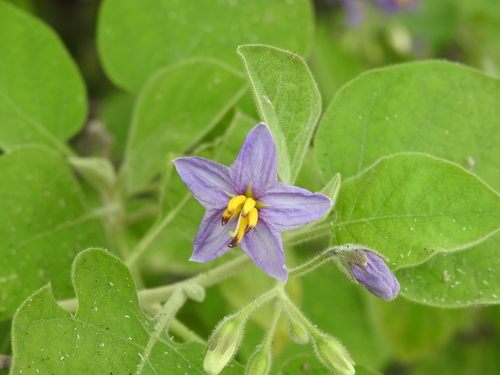
iNaturalist· cc0
no rights reserved, uploaded by 葉子
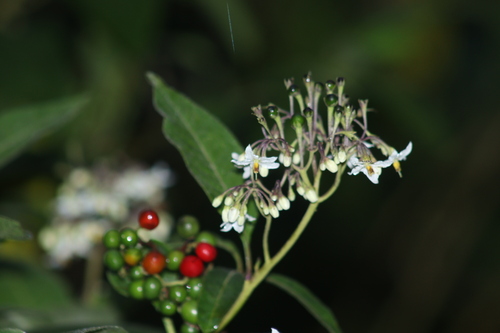
iNaturalist· cc-by-nc
(c) suchihfen, some rights reserved (CC BY-NC)
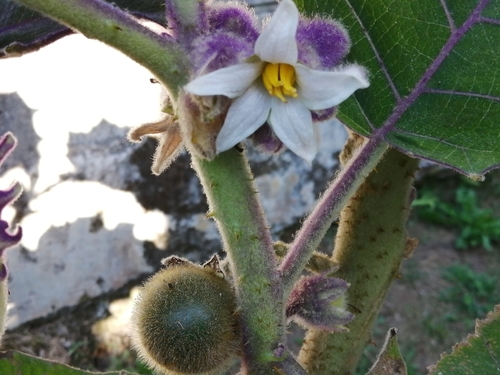
iNaturalist· cc-by-nc
(c) Han-Ting Liu, some rights reserved (CC BY-NC), uploaded by Han-Ting Liu
Summary
Source: WikipediaSolanum violaceum is a flowering plant in the family Solanaceae that is found in China at elevations of 100 to 2700 meters.
Description
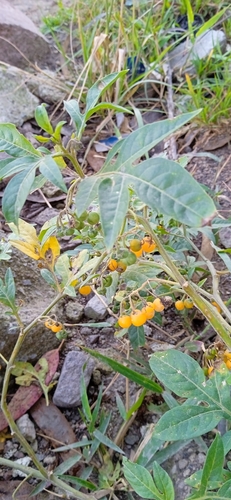
A herb or small shrub. It can grow 2 m tall. It has many branches. It is softly hairy. It has pale yellow prickles that curve backwards. The leaves are in unequal pairs. The leaves are 5-8 cm long by 4-7 cm wide. The leaf stalk can be 3 cm long. The leaf blades are divided into round lobes. The fruit are shiny orange berries. They can be 1.3 cm across.
Edible Uses
The unripe fruit are cooked and used as a vegetable. It is commercially cultivated.
Traditional Uses
The unripe fruit are cooked and used as a vegetable.
This uses section is brief — help expand it
Medicinal Uses
The fruits are diuretic and expectorant. They are an effective treatment against diabetes, and even seem to be capable of curing it. They are also used for relieving cough and alleviating toothache. Applied externally, they are used for treating skin diseases.
Known Hazards
Although providing many well-known foods for people, including the potato, tomato, pepper and aubergine, most species in this genus also contain toxic alkaloids. Whilst these alkaloids can make the plant useful in treaing a range of medical conditions, they can also cause problems such as nausea, vomiting, salivation, drowsiness, abdominal pain, diarrhoea, weakness and respiratory depression. Unless there are specific entries with information on edible uses, it would be unwise to ingest any part of this plant.
Distribution
A tropical plant. In southern China it grows between 100-2,700 m above sea level. In Sichuan and Yunnan.
Where It Grows
Asia, China, India, Indochina, Laos, Malaysia, Northeastern India, SE Asia, Sri Lanka, Taiwan, Vietnam,
Cultivation
The plant flowers and produces fruit all year round.
Propagation
Seed - sow in trays in a nursery. Prick out the seedlings into individual pots when they are large enough to handle and grow them on fast. Plant them out when 10cm or more tall. Cuttings of half-ripe wood. Very easy, the cuttings root within a couple of weeks.
Production
It flowers and fruits throughout the year.
Other Information
It is a commercially cultivated vegetable.
Nutrition
| Part | Moisture | kJ | kcal | Protein | Vit A | Vit C | Iron | Zinc |
|---|---|---|---|---|---|---|---|---|
| Fruit | 80 | — | — | 2.3 | — | 22.8 | 1.9 | 1 |
Also Known As
Kan, Khasa, Lan di, Lian huo, Si kuo kao yao, Thibbatu
References (9)
- Arora, R. K., 2014, Diversity in Underutilized Plant Species - An Asia-Pacific Perspective. Bioversity International. p 51
- Cao, Y., et al, 2020, Ethnobotanical study on wild edible plants used by three trans-boundary ethnic groups in Jiangcheng County, Pu’er, Southwest China. Journal of Ethnobiology and Ethnomedicine (2020) 16:66
- Ghorbani, A., et al, 2012, A comparison of the wild food plant use knowledge of ethnic minorities in Naban River Watershed Nature Reserve, Yunnan, SW China. Journal of Ethnobiology and Ethnomedicine; 8:17
- Kays, S. J., and Dias, J. C. S., 1995, Common Names of Commercially Cultivated Vegetables of the World in 15 languages. Economic Botany, Vol. 49, No. 2, pp. 115-152
- Milow, P., et al, 2013, Malaysian species of plants with edible fruits or seeds and their evaluation. International Journal of Fruit Science. 14:1, 1-2
Show all 9 references Hide references
- Pradheep, K., et al, 2016, Wild edible plants used by Konyak tribe in Mon district of Nagaland: Survey and inventorisation. Indian Journal of Natural Products and Resources. Vol 7(1) pp 74-81
- Ramachandran, V.S. and Nair, V.J., 1981, Ethnobotanical studies in Cannanore District, Kerala State (India). J Econ. Tax. Bot. Vol 2 pp 65-72
- Tanaka, Y. & Van Ke, N., 2007, Edible Wild Plants of Vietnam. Orchid Press. p 136
- World Checklist of Useful Plant Species 2020. Royal Botanic Gardens, Kew