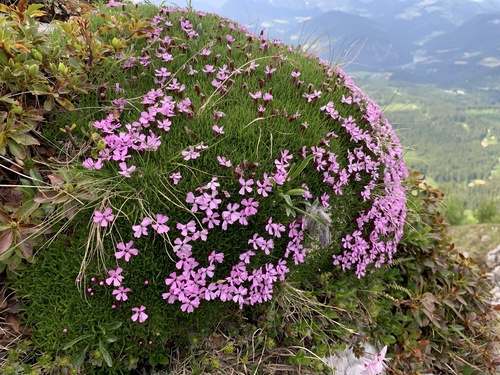
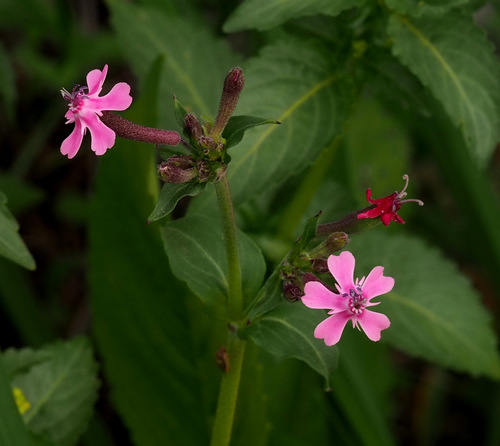
Dianthus chinensis
L.
Chinese pink
iNaturalist· cc-by-nc
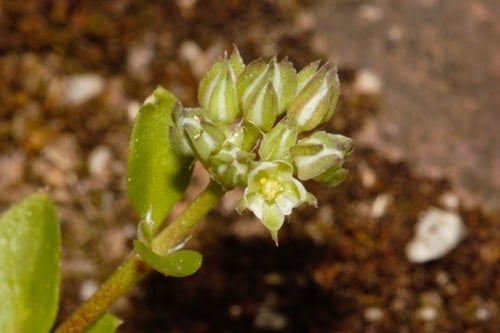
(c) maxpauel, some rights reserved (CC BY-NC), uploaded by maxpauel
iNaturalist· cc-by
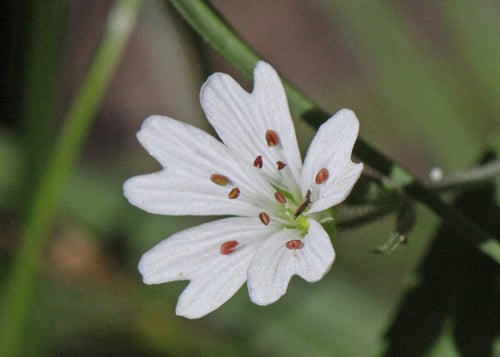
(c) Yves Bas, some rights reserved (CC BY), uploaded by Yves Bas
iNaturalist· cc-by-nc
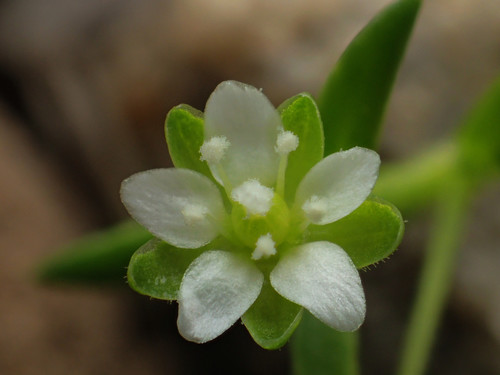
(c) Tim Edelsten, some rights reserved (CC BY-NC), uploaded by Tim Edelsten
Summary
Source: WikipediaDianthus chinensis, commonly known as rainbow pink or China pink is a species of Dianthus native to northern China, Korea, Mongolia, and southeastern Russia. It is a herbaceous perennial plant growing to 30–50 cm tall.
Description
A short lived plant often grown as an annual. It grows 30-45 cm high and spreads 15-23 cm wide. It is a bushy plant. The stems have easy to see nodes. The leaves are slender. They are light green, pointed and 8 cm long. The flowers are red, pink or white. They are about 2.5 cm across.
Edible Uses
No edible uses are known for this plant.
Medicinal Uses
The Chinese pink has been used in Chinese herbal medicine for over 2,000 years. The whole plant is a bitter tonic herb that stimulates the digestive and urinary systems as well as the bowels. It is anthelmintic, antibacterial, antiphlogistic, diaphoretic, diuretic, emmenagogue, febrifuge, and haemostatic. Internally, it is used to treat acute urinary tract infections (especially cystitis), urinary stones, constipation, and failure to menstruate. Externally, it is applied to skin inflammations and swellings. Crushed old leaves are used for clearing the eyesight. Plants are harvested just before the flowers open and dried for later use.
Distribution
It is often planted amongst rocks. It is best in a light to medium, well-drained soil. It needs an open sunny position. It is resistant to drought and frost.
Where It Grows
Asia, Australia, Central Asia, China*, Hawaii, India, Kazakhstan, Korea, Mongolia, Myanmar, Pacific, Rotuma, Russia, SE Asia, Siberia, Tajikistan, USA,
Cultivation
Prefers a rich well-drained loamy neutral to alkaline soil in a sunny position, but succeeds in most soils including dry ones. A very ornamental plant, it is usually biennial in habit, but can be a short-lived perennial. There are many cultivars that are widely grown in gardens. Since these flower freely in their first year and then degenerate, they are usually treated as annuals. A very variable species in the wild, it has often been subdivided into up to eight different varieties.
Propagation
Seed: sow May/June in a cold frame; germination usually takes 2–3 weeks. Prick out seedlings into individual pots when large enough and plant out in summer or autumn. Alternatively, sow thinly in an outdoor seedbed in late spring and plant out in late spring or autumn. Cuttings of half-ripe shoots can be taken in July in a frame. Division in September — larger clumps can go directly into permanent positions, though it is better to pot up smaller clumps in a cold frame until rooting well, then plant out in spring.
Other Uses
No other uses are known for this plant. Attracts wildlife.
Notes
There are 320 Dianthus species. The plant is used in medicine.
Synonyms
Also Known As
Shizu, Stone bamboo, Zaw-hmwa-gale
References (7)
- Bodkin, F., 1991, Encyclopedia Botanica. Cornstalk publishing, p 337
- Brown, D., 2002, The Royal Horticultural Society encyclopedia of Herbs and their uses. DK Books. p 193
- Flora of China @ efloras.org Volume 6
- Seidemann J., 2005, World Spice Plants. Economic Usage, Botany, Taxonomy. Springer. p 135
- Sp. pl. 1:411. 1753
Show all 7 references Hide references
- Staples, G.W. and Herbst, D.R., 2005, A tropical Garden Flora. Bishop Museum Press, Honolulu, Hawaii. p 227
- Valder, P., 1999, The Garden Plants of China. Florilegium. p 357