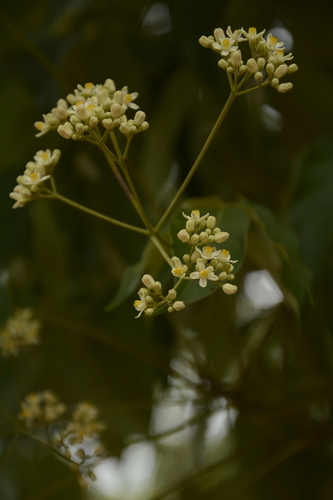
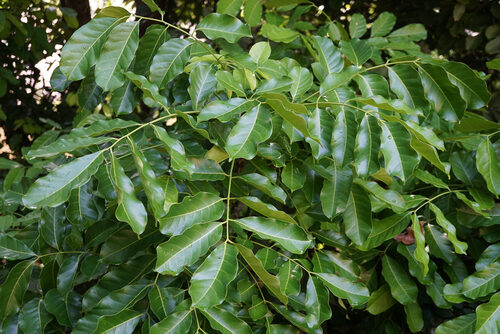
Aglaia odoratissima
Blume
Mock lime, Orchid tree
iNaturalist· cc-by-nc
(c) Aber TREC, some rights reserved (CC BY-NC)
gbif· cc0
President and Fellows of Harvard College
Summary
Source: WikipediaAglaia odoratissima is a species of plant in the family Meliaceae. It is a tree native to parts of mainland Southeast Asia (Myanmar, Thailand, and Vietnam), the Nicobar Islands, and Malesia (Borneo, Java, the Lesser Sunda Islands, Peninsular Malaysia, Philippines, Sulawesi, and Sumatra).
Description
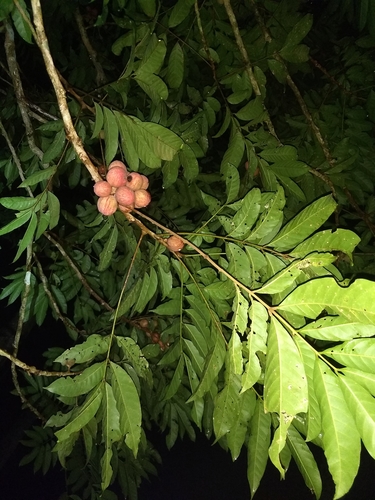
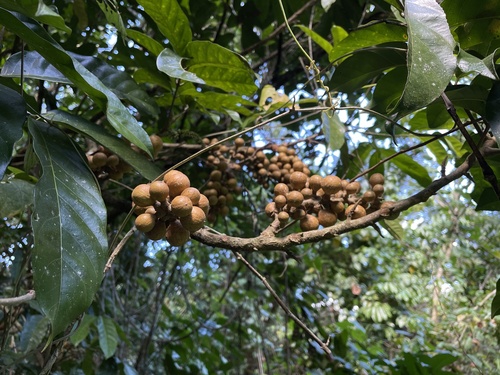
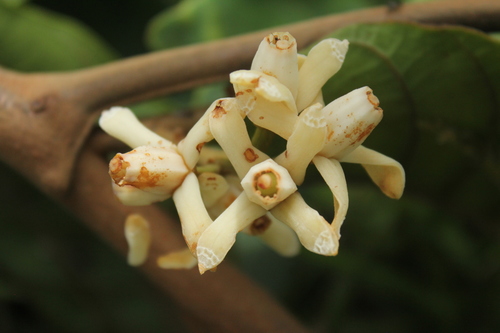
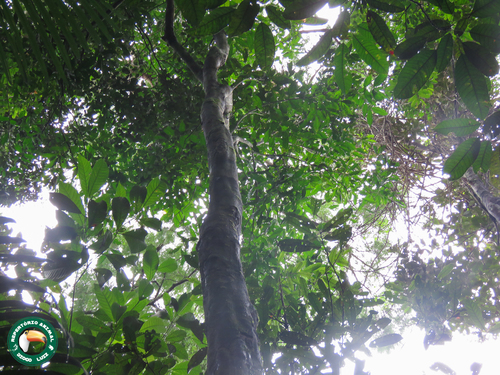
A small tree. It grows 12-20 m tall. The trunk is 30 cm across. The bark is smooth and greenish-grey. There are a few long, divided branches. The twigs are slender and covered with scales. The leaves have leaflets along the stalk and one at the end. There are 1-3 pairs of leaflets. The leaves are 10-30 cm long and 5-30 cm wide. There are 3-5 leaflets are that are 5-18 cm long by 1-6 cm wide. They are pale brown underneath. The male flowers are 1.5 mm wide and the flowering cluster is 7-35 cm long by 2-25 cm wide. The female flowering group are narrow and spike like. The fruit are 2 cm long by 1-1.5 cm wide. They are oval and rounded at the tip and taper to the base. They are orange to red and covered with scales.
Edible Uses
The flowers are used to flavour tea. The fruit aril and outer fruit layer are eaten, and the fruit are often consumed by children.
Traditional Uses
The flowers are used to flavour tea.
This uses section is brief — help expand it
Medicinal Uses
The flowers are used traditionally to flavour tea.
Distribution
A tropical plant. It grows in the forest from sea level to 1,900 m altitude. It often grows along rivers.
Where It Grows
Asia, Brunei, China, India, Indochina, Indonesia, Malaysia, Myanmar, Nicobar, Philippines, SE Asia, Singapore, Thailand,
Cultivation
Plants can be grown from seeds.
Other Uses
The genus 'Aglaia' is the only source of the group of about 50 known representatives of compounds that bear a unique cyclopenta[b]tetrahydrobenzofuran skeleton. These compounds are more commonly called rocaglate or rocaglamide derivatives, or flavaglines, and most have been found to have potent insecticidal properties, antifungal, antiviral, antibacterial or anthelmintic bioactivity. Several of them exhibit pronounced cytotoxic activity against a range of human cancers. Since the first representative in this group was only discovered in 1982, this is one of the few recent examples of a completely new class of plant secondary metabolites of biological promise (see B. G. Wang et al., Biochem. Syst. Ecol. 32: 1223-1226. 2004; L.W. Chaidir et al., J. Nat. Prod. 64: 1216-1220. 2001). The very fragrant flowers are used in perfumery. An essential oil is distilled from the seed. The sapwood is pale pink or pale yellowish-brown or dark red-brown. The wood is strong, hard and fairly durable but only available in small sizes. A decorative wood, it is used for making furniture.
Production
In Thailand it flowers all year round and mostly fruits January to June.
Other Information
The fruit are often eaten by children. It is sometimes cultivated in gardens.
Notes
There are about 104 Aglaia species. They occur in Asia and the Pacific.
Synonyms
Also Known As
Fika labo, Kasai, Khi hen, Lantupak, Lembunau, Lenzat hutan, Mata lawid, Ma ti, Me-ke, Nuan paeng, Pancal kidang, Pokok telur belangkas hutan, Prayong paa, Sangkhriat, Sang khriat lueat, Tangiran manok, Tanglu, Thanatka-wa
References (13)
- Ambasta S.P. (Ed.), 2000, The Useful Plants of India. CSIR India. p 21
- Bijdr. 171. 1825
- Bircher, A. G. & Bircher, W. H., 2000, Encyclopedia of Fruit Trees and Edible Flowering Plants in Egypt and the Subtropics. AUC Press. p 14
- Burkill, I.H., 1966, A Dictionary of the Economic Products of the Malay Peninsula. Ministry of Agriculture and Cooperatives, Kuala Lumpur, Malaysia. Vol 1 (A-H) p 75 (As Aglaia diepenhorstii)
- Hariyadi, B., 2008, The Entwined Tree: Traditional Natural Resource Management of Serampas, Jambi, Indonesia. Ph. D thesis. Univ. or Hawaii. p 427
Show all 13 references Hide references
- Hoare, A., 2003, Food use of the Lundayeh SW Sabah. Borneo Research Council.
- Palakit, K., et al, 2015, Effects of Climate Variability on Monthly Growth of Aglaia odoratissima and Hydnocarpus ilicifolia at the Sakaerat Envinronmental Research Station, Northeastern Thailand. Environment and Natural Resources J. Vol. 13, No.1:1-12
- PROSEA handbook Volume 13 Spices. p 273
- Seidemann J., 2005, World Spice Plants. Economic Usage, Botany, Taxonomy. Springer. p 12
- Slik, F., www.asianplant.net
- Sukarya, D. G., (Ed.) 2013, 3,500 Plant Species of the Botanic Gardens of Indonesia. LIPI p 113
- Trimanto, & Hapsari L., 2016, Botanical survey in thirteen montane forests of Bawean Island Nature Reserve, East Java Indonesia: Conservation status, bioprospecting and potential tourism. Biodiversitas 17: 832-846.
- Wongprasert, T. et al, 2011, A Synoptic Account of the Meliaceae of Thailand. Thai For. Bull. 39:210-266