Globba marantina
L.
Yellow dancing girl ginger
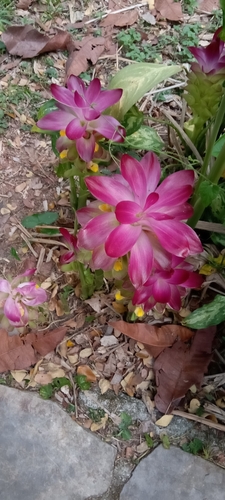
iNaturalist· cc-by-sa
(c) J.M.Garg, some rights reserved (CC BY-SA)
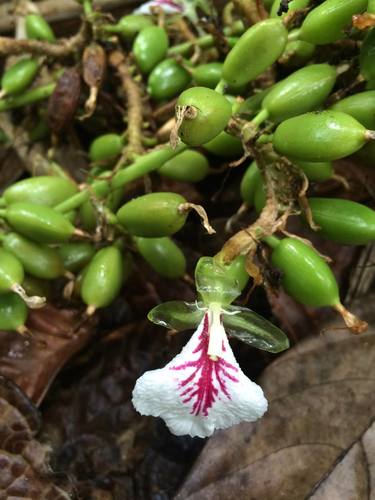
iNaturalist· cc-by-nc
(c) lenisutcliffe, some rights reserved (CC BY-NC)
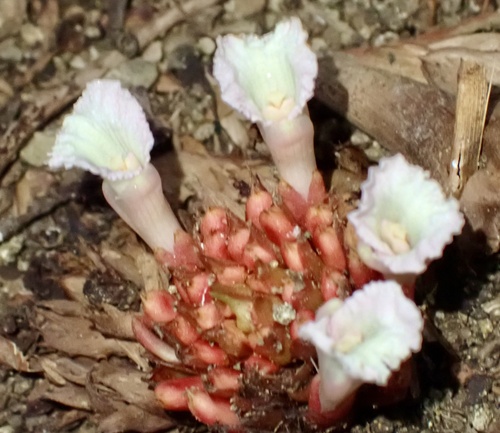
iNaturalist· cc-by-nc
(c) lenisutcliffe, some rights reserved (CC BY-NC)
Description
A ginger family herb. It keeps growing from year to year. It grows 50 cm tall. It has tuberous roots. It has leafy shoots with 8-15 leaves. The leafy growth or ligule is 2 mm long and is fringed with hairs. The leaf stalk of the upper leaves is distinct and is 5 mm long. The leaf blade is sword shaped and 15 cm long by 4-5 cm wide. It has short hairs underneath. The flowers are compact and 1-4 cm long. The flower stalk is 1-3 cm long. There are 8-15 sterile bracts. They overlap. The lower ones are large and are 1.5-2.5 cm long by 2 cm wide. The upper ones are smaller. Each one usually carries a small bulb. These are narrowly oval or cone shaped and 1 cm long. The flowers are yellow.
Edible Uses
The slightly spicy bulbils are eaten fresh or dried as a seasoning and can be used similarly to cardamom. The rhizome and bulb are also edible portions.
Traditional Uses
The slightly spicy bulbils are eaten fresh or dried as a seasoning. It can be used like cardamoms.
This uses section is brief — help expand it
Medicinal Uses
The small bulbils are used to stimulate the appetite.
Distribution
A tropical plant. It grows in dry forested areas. It also grows on sand banks. It can grow in sago plantations.
Where It Grows
Andamans, Asia, Australia, Bangladesh, Cambodia, Carribbean, China, Himalayas, India, Indochina, Indonesia, Laos, Leeward Is., Malaysia, Myanmar, Nepal, Pacific, Papua New Guinea, PNG, Philippines, SE Asia, Slovenia, Solomon Islands, Sri Lanka, Thailand, Vietnam,
Cultivation
Plants can be grown from the bulbils. When the plant dies back, these bulbils become dormant for 5 months then they germinate.
Propagation
Seed - the plant rarely flowers and so seed is not often produced. Bulbils - these are often formed in profusion and are the easiest method of propagation. They can withstand long periods of adverse conditions and so are easily stored for several months before planting them out directly into their permanent positions.
Notes
There are about 50-70 Globba species. In Slovenia probably in a hot house.
Synonyms
Also Known As
Kapulaga ambon, Halia utan, Bonelau, Barak, Bangliu, Chhota rasna, Luyan-luyaan, L(oo) ba l(uf)n, Phalar-gale, Sarhep kura, Waso-pan
References (10)
- Ambasta, S.P. (Ed.), 2000, The Useful Plants of India. CSIR India. p 237
- Burkill, I.H., 1966, A Dictionary of the Economic Products of the Malay Peninsula. Ministry of Agriculture and Cooperatives, Kuala Lumpur, Malaysia. Vol 1 (A-H) p 1091
- Facciola, S., 1998, Cornucopia 2: a Source Book of Edible Plants. Kampong Publications, p 248
- French, B.R., 2010, Food Plants of Solomon Islands. A Compendium. Food Plants International Inc. p 334
- Misra, S., 2020, Survey of edible plants for human consumption in south Odisha, India. Journal of Emerging Technologies and Innovative Research (JETIR) Vol. 7, Issue 12 p 278
Show all 10 references Hide references
- PROSEA handbook Volume 13 Spices. p 256
- Rajkalkshmi, P. et al, 2001, Total carotenoid and beta-carotene contents of forest green leafy vegetables consumed by tribals of south India. Plant Foods for Human Nutrition 56:225-238 (As Alobba) Globba bulbifera)
- Seidemann J., 2005, World Spice Plants. Economic Usage, Botany, Taxonomy. Springer. p 167
- Tanaka,
- World Checklist of Useful Plant Species 2020. Royal Botanic Gardens, Kew