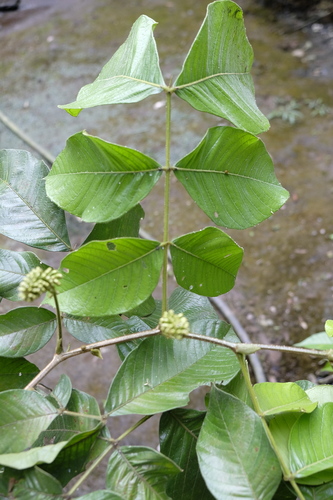
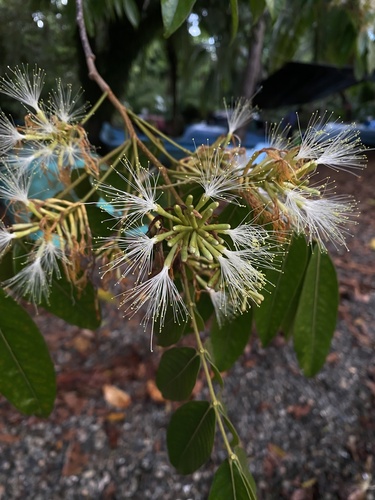
Acacia stipuligera
F. Muell.
Tjilpirinja, Kulaiaan
iNaturalist· cc-by-nc
(c) Ian McMaster, some rights reserved (CC BY-NC), uploaded by Ian McMaster
iNaturalist· cc-by-nc-sa
(c) Arthur Chapman, some rights reserved (CC BY-NC-SA)
iNaturalist· cc-by-nc-sa
(c) Arthur Chapman, some rights reserved (CC BY-NC-SA)
Summary
Source: WikipediaAcacia stipuligera is a tree or shrub belonging to the genus Acacia and the subgenus Juliflorae. It is native to arid and tropical parts of northern Australia.
Description
A shrub or small tree. It grows 5 m tall. There are prickles along the stem. The leaves are twice divided and there are 8-18 pairs of pinnae. There are up to 50 pairs of pinnules on each pinnae. The flowers are yellow. They are in large clusters at the ends of branches. The pods are flattened.
Edible Uses
Seed - cooked. It can be eaten in the same ways as other small legume seeds and is also ground into a powder then used as a flavouring in desserts or as a nutritious supplement to pastries and breads. The seeds are relatively soft-coated; they are produced in profusion in good seasons; and are easily harvested, A traditional food of the native Australians, it has potential as a famine or subsistence food for humans. The seedpods are 55 - 135mm long and 3 - 4 mm wide, with dark brown, narrowly oblong seed 4.5 - 5.5mm long. Acacia seeds are highly nutritious and contain around 26% protein, 26% available carbohydrate, 32% fibre and 9% fat. The fat content is higher than most legumes with the aril providing the bulk of fatty acids present. These fatty acids are largely unsaturated. The energy content is high in all species tested, averaging 1480 ±270 kJ per 100g. The seeds are low glycaemic index foods - the starch is digested and absorbed very slowly, producing a small, but sustained rise in blood glucose and so delaying the onset of exhaustion in prolonged exercise. The ground seed can be used to produce a high quality, caffeine-free coffee-like beverage.
Traditional Uses
The seed are eaten. They are pounded into flour before eating. The gum is eaten.
This uses section is brief — help expand it
Medicinal Uses
The bark of all Acacia species contains greater or lesser quantities of tannins and are astringent. Astringents are often used medicinally - taken internally, for example. they are used in the treatment of diarrhoea and dysentery, and can also be helpful in cases of internal bleeding. Applied externally, often as a wash, they are used to treat wounds and other skin problems, haemorrhoids, perspiring feet, some eye problems, as a mouth wash etc. Many Acacia trees also yield greater or lesser quantities of a gum from the trunk and stems. This is sometimes taken internally in the treatment of diarrhoea and haemorrhoids.
Known Hazards
The seed of many Acacia species, including this one, is edible and highly nutritious, and can be eaten safely as a fairly major part of the diet. Not all species are edible, however, and some can contain moderate levels of toxins. Especially when harvesting from the wild, especial care should be taken to ensure correct identification of any plants harvested for food. Especially in times of drought, many Acacia species can concentrate high levels of the toxin Hydrogen cyanide in their foliage, making them dangerous for herbivores to eat.
Distribution
It grows in the northern part of Australia. It gets killed by summer fires. It can grow in arid places.
Where It Grows
Australia*,
Cultivation
Acacia stipuligera is a plant of the hot, semi-arid and arid zones of tropical northern Australia, where it can be found at elevations up to 525 metres. The summers are very hot, with a mean maximum temperature for the hottest month of 34 - 41°c and a mean minimum temperature for the coolest month of 9 - 12°c. The area is largley frost-free, though very occasional frosts are recorded from higher elevations in the south of its range, with the lowest ever recorded temperature being −4°c. Mean annual rainfall is generally within the range 125 - 700, with the majority falling during the hotter part of the year. Requires a sunny position. Grows in the wild mainly on well-drained, predominately deep red sands and sandy loams, mainly of an acid to neutral pH, though also occasionally found on sandy soils over limestones. A moderately fast-growing tree, though short-lived, usually dieing when around 10 years old. The seeds of most acacia species can be quickly and efficiently harvested at full maturity without the need for any specialised equipment. Small seed-bearing branches can be cut and beaten on sheets, or bushes can be beaten or shaken directly onto large sheets. This species has a symbiotic relationship with certain soil bacteria; these bacteria form nodules on the roots and fix atmospheric nitrogen. Some of this nitrogen is utilized by the growing plant but some can also be used by other plants growing nearby.
Propagation
The seed of most, if not all, members of this genus has a hard seedcoat and may benefit from scarification before sowing to speed up germination. This can usually be done by pouring a small amount of nearly boiling water on the seeds (being careful not to cook them!) and then soaking them for 12 - 24 hours in warm water. By this time they should have imbibed moisture and swollen - if they have not, then carefully make a nick in the seedcoat (being careful not to damage the embryo) and soak for a further 12 hours before sowing. Acacia seeds that have matured fully on the bush and have been properly dried have a hard seed coat and can be stored in closed containers without deterioration for 5 - 10 years or more in dry conditions at ambient temperatures. It is best to remove the aril, which attracts weevils and can lead to moulds forming. The arils are easilyremoved by placing the seeds in water and rubbing them between the hands, then drying the seeds and winnowing them.
Other Uses
A gum obtained from the stems and branches has similar features to the gums from Acacia torulosa, Acacia tumida and Acacia difficilis. It has a low rhamnose content, negative rotations and high values for nitrogen, methoxyl and uronic acid groups. It is unique for an Acacia in the formation of a loose gel during dialysis. The heartwood is dark brown; it is demarcated from the broad band of pale yellowish sapwood. It has a basic density of 810 kg/m3. The wood is usually available only in small dimensions and so has little application. The wood should be suitable for fuel. The species has potential for sand stabilisation and should make an outstanding ornamental under cultivation (although rather short-lived).
Production
A quick growing but relatively short lived shrub.
Notes
There are about 1,350 Acacia species. Over 1,000 occur in Australia. Also as Mimosaceae.
Nutrition
| Part | Moisture | kJ | kcal | Protein | Vit A | Vit C | Iron | Zinc |
|---|---|---|---|---|---|---|---|---|
| Seed | 3.3 | 1240 | 297 | 23.1 | — | — | 6.9 | 2.9 |
| Gum | — | — | — | — | — | — | — | — |
Also Known As
Jirrpirinypa, Mpwiya
References (11)
- Bircher, A. G. & Bircher, W. H., 2000, Encyclopedia of Fruit Trees and Edible Flowering Plants in Egypt and the Subtropics. AUC Press. p 5
- Cherikoff V. & Isaacs, J., The Bush Food Handbook. How to gather, grow, process and cook Australian Wild Foods. Ti Tree Press, Australia p 42, 188
- Doran, J.C., & Turnbull, J.W. (Eds), 1997, Australian Trees and Shrubs: species for land rehabilitation and farm plantings in the tropics. ACIAR Monograph No 24. p 225
- Elliot, W.R., & Jones, D.L., 1982, Encyclopedia of Australian Plants suitable for cultivation. Vol 2. Lothian. p 118
- Latz, P., 1996, Bushfires and Bushtucker. IAD. p 117
Show all 11 references Hide references
- Lister, P.R., P. Holford, T. Haigh, and D.A. Morrison, 1996, Acacia in Australia: Ethnobotany and potential food crop. p. 228-236. In: J. Janick (ed.), Progress in new crops. ASHS Press, Alexandria, VA.
- Paczkowska, G . & Chapman, A.R., 2000, The Western Australian Flora. A Descriptive Catalogue. Western Australian Herbarium. p 326
- Pennock, A., et al, Australian Dry-zone Acacias for Human Food: Proceedings of a Workshop.
- Townsend, K., 1994, Across the Top. Gardening with Australian Plants in the tropics. Society for Growing Australian Plants, Townsville Branch Inc. p 65
- Wheeler, J.R.(ed.), 1992, Flora of the Kimberley Region. CALM, Western Australian Herbarium, p 327
- World Checklist of Useful Plant Species 2020. Royal Botanic Gardens, Kew