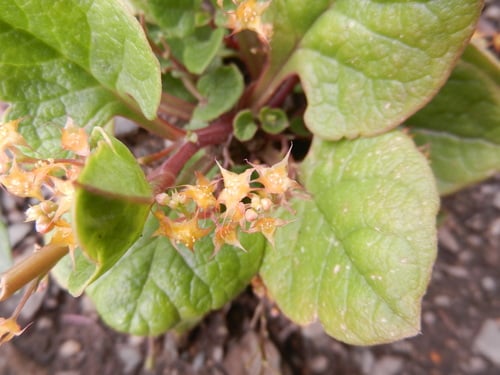
Anredera cordifolia
(Tenore) Steenis
Madeira vine, Potato vine
iNaturalist· cc-by-nc
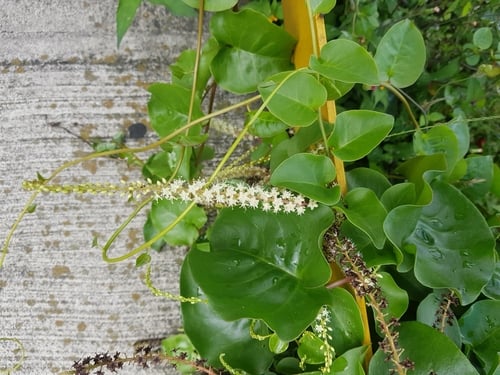
(c) Jenny Guo (小白鷺), some rights reserved (CC BY-NC), uploaded by Jenny Guo (小白鷺)
iNaturalist· cc-by-nc
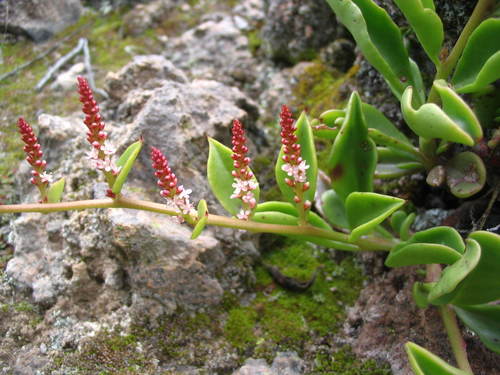
(c) Sandra Falanga, some rights reserved (CC BY-NC), uploaded by Sandra Falanga
iNaturalist· cc-by-nc
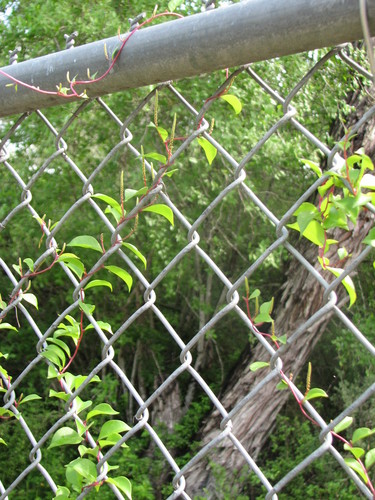
(c) Young Chan, some rights reserved (CC BY-NC), uploaded by Young Chan
Summary
Source: WikipediaAnredera cordifolia, commonly known as the Madeira vine or mignonette vine, is a South American species of ornamental succulent vine of the family Basellaceae. The combination of fleshy leaves and thick aerial tubers makes this a very heavy vine. It smothers trees and other vegetation it grows on and can easily break branches and bring down entire trees on its own. Other names include lamb's tail and potato vine.
Description
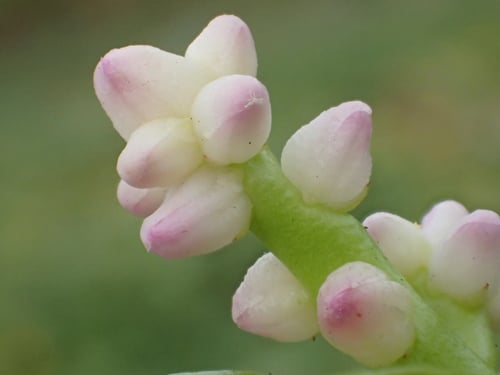
A climber or vine. The stems are 3-7 m long. It has aerial potato like tubers along the stem. They are 1-3 cm long. The leaves are small, fleshy and closely arranged. They are simple and 3-15 cm long by 2-10 cm wide. The leaf stalks are 5-15 cm long. The flowers are small, white and fragrant. The are in racemes in the axils of leaves. The flowers are about 6 mm across. They are white with green or white bracts. They have a scent. The fruit is a nut about 1 mm across.
Edible Uses
Edible Parts: Leaves Root Edible Uses: Root - cooked. We were supplied this plant by a friend who said that the root is edible. We have not seen any reports on its edibility. The raw root is crisp and pleasant when first put in the mouth, but soon degenerates into a mucilaginous mass described by some people as 'like eating catarrh' and in rather less flattering terms by others!. When well baked, the root loses this quality and is quite pleasant to eat. Leaves cooked. Used as a spinach.
Traditional Uses
The leaves can be eaten raw in salads or used as a potherb or prepared with sesame oil and soy sauce. The tubers are boiled and eaten.
This uses section is brief — help expand it
Medicinal Uses
Antiinflammatory Hepatic The plant has been shown to have anti-inflammatory, anti-ulcer, and liver-protective effects.
Known Hazards
Eating the leaves can cause temporary diarrhea in pigs and sheep. Its effects on other livestock are not well researched.
Distribution
It is a tropical plant. It grows in South China. It becomes invasive in warm, moist climates. It needs light well-drained soil. In tropical Queensland it grows from sea level to 720 m altitude. In Argentina it grows from sea level to 2,000 m above sea level. It is damaged by drought and frost. Tasmania Herbarium. It grows in Sichuan.
Where It Grows
Africa, Andes, Argentina, Asia, Australia, Brazil, Central America, Chile, China, Easter Island, Eswatini, Europe, France, Hawaii, India, Indonesia, Malta, Mediterranean, Mexico, New Zealand, North America, Pacific, Paraguay, Portugal, Puerto Rico, SE Asia, South Africa, Southern Africa, South America*, Spain, Sri Lanka, St Helena, Swaziland, Taiwan, Tasmania, Uruguay, USA, West Indies,
Cultivation
It can reproduce from small tubers along the stems. It can be grown from cuttings.
Propagation
Seed - we have no information on this plant, but, if seed can be obtained, suggest sowing it in a greenhouse in the spring. Prick out the seedlings into individual pots when they are large enough to handle and grow them on in the greenhouse for at least their first winter. Plant out in spring after the last expected frosts. Softwood cuttings. Division. Dig up the tubers at any time from late autumn to early spring. Store them in a cool but frost-free place and either pot them up in the greenhouse in early spring or plant them directly outside in late spring.
Other Uses
An ornamental succulent vine. For landscaping purposes. Fast growing possessing fragrant white flowers, easily trained to twine up trellises, fences, or rock walls for decoration or for screening. Special Uses Scented Plants
Other Information
It is cultivated. It is sold in local markets.
Notes
There are 5-10 Anredera species. It can become invasive.
Synonyms
Also Known As
Ala-niviti, Bartelha-coracao, Binahong, Bridal wreath, Cascade creeper, Jalap, Lamb's tail, Mei dang sha, Mignonette vine, Pa bang
References (33)
- Ambasta S.P. (Ed.), 2000, The Useful Plants of India. CSIR India. p 43 (As Anredera baselloides)
- Bircher, A. G. & Bircher, W. H., 2000, Encyclopedia of Fruit Trees and Edible Flowering Plants in Egypt and the Subtropics. AUC Press. p 62 (As Boussingaultia baselloides)
- Bodkin, F., 1991, Encyclopedia Botanica. Cornstalk publishing, p 87
- Cao, Y., et al, 2020, Ethnobotanical study on wild edible plants used by three trans-boundary ethnic groups in Jiangcheng County, Pu’er, Southwest China. Journal of Ethnobiology and Ethnomedicine (2020) 16:66
- Chao, Pi-Yu, et al, 2014, Antioxidant Activity in Extracts of 27 Indigenous Taiwanese Vegetables. Nutrients 2014, 6, 2115-2130
Show all 33 references Hide references
- "Chinese Nutrition Journal", 2002, Vol 23(11) p 121
- Cooper, W. and Cooper, W., 2004, Fruits of the Australian Tropical Rainforest. Nokomis Editions, Victoria, Australia. p 87
- Facciola, S., 1998, Cornucopia 2: a Source Book of Edible Plants. Kampong Publications, p 47
- Fl. Males. ser. 1, 5:303. 1957
- Heywood, V.H., Brummitt, R.K., Culham, A., and Seberg, O. 2007, Flowering Plant Families of the World. Royal Botanical Gardens, Kew. p 55
- Hu, Shiu-ying, 2005, Food Plants of China. The Chinese University Press. p 384 (As Anredera baselloides)
- Kinupp, V. F., 2007, Plantas alimenticias nao-convencionais da regiao metropolitana de Porto Alegre, RS, Brazil p 68
- Lim, T. K., 2015, Edible Medicinal and Non Medicinal Plants. Volume 9, Modified Stems, Roots, Bulbs. Springer p 9
- Long, C., 2005, Swaziland's Flora - siSwati names and Uses http://www.sntc.org.sz/flora/
- Macmillan, H.F. (Revised Barlow, H.S., et al) 1991, Tropical Planting and Gardening. Sixth edition. Malayan Nature Society. Kuala Lumpur. p 344 (As Boussaingaultia baselloides)
- Marinelli, J. (Ed), 2004, Plant. DK. p 444
- Martin, F.W. & Ruberte, R.M., 1979, Edible Leaves of the Tropics. Antillian College Press, Mayaguez, Puerto Rico. p 182 (As Boussaingaultia baselloides)
- Melzer, R. & Plumb, J., 2011, Plants of Capricornia. Belgamba, Rockhampton. p 539
- NYBG herbarium "edible"
- Paczkowska, G. & Chapman, A.R., 2000, The Western Australian Flora. A Descriptive Catalogue. Western Australian Herbarium. p 180
- Sasi, R. et al, 2011, Wild edible plant Diversity of Kotagiri Hills - a Part of Nilgiri Biosphere Reserve, Southern India. Journal of Research in Biology. Vol. 1 No. 2, pp 80-87
- Seidemann J., 2005, World Spice Plants. Economic Usage, Botany, Taxonomy. Springer. p 44
- Steenbeeke, Greg as part of the Plants Directory project. List of plant species from northern NSW that may be used as food plants p 7
- Sukarya, D. G., (Ed.) 2013, 3,500 Plant Species of the Botanic Gardens of Indonesia. LIPI p 896
- Swaziland's Flora Database http://www.sntc.org.sz/flora
- Tanaka,
- Tasmanian Herbarium Vascular Plants list p 15
- Uphof,
- Wang, J. et al, 2013, A Study on the Utilization of Wild Plants for Food in Liangshan Yi Autonomous Prefecture. Plant Diversity and Resources. 35(4): 416-471
- Wiersema, J. H. & Leon, B., 2013, World Economic Plants. A Standard Reference CRC Press. 2nd Ed. p 56
- World Checklist of Useful Plant Species 2020. Royal Botanic Gardens, Kew
- www.eFloras.org Flora of China
- Zizka, G., 1991, Flowering Plants of Easter Island. Palmarum Hortus Francofurtensis