Acacia longifolia subsp. sophorae
(Labill.) Court
Coastal wattle, Boobyalla
gbif· cc-by
Arnim Littek
gbif· cc-by
Arnim Littek
gbif· cc-by
Arnim Littek
Summary
Source: WikipediaAcacia longifolia is a species of Acacia native to southeastern Australia, from the extreme southeast of Queensland, eastern New South Wales, eastern and southern Victoria, southeastern South Australia, and Tasmania. Common names for it include long-leaved wattle, acacia trinervis, aroma doble, golden wattle, coast wattle, sallow wattle and Sydney golden wattle. It is not listed as being a threatened species, and is considered invasive in Portugal, New Zealand and South Africa. In the southern region of Western Australia, it has become naturalised and has been classed as a weed due to its out-competing indigenous species. It can grow very quickly, reaching 7–10 m in five to six years.
Description
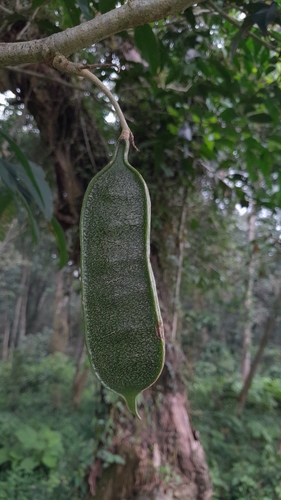
A shrub or small tree. It grows 5 m tall. There are prickles along the stem. The leaves are twice divided and there are 8-18 pairs of pinnae. There are up to 50 pairs of pinnules on each pinnae. The flowers are yellow. They are in large clusters at the ends of branches. The pods are flattened.
Edible Uses
Acacia longifolia is widely cultivated in subtropical regions of the world. Its uses include prevention of soil erosion, food (flowers, seeds and seed pods), yellow dye (from the flowers), green dye (pods) and wood. The flower colour derives from the organic compound kaempferol. The tree's bark has limited use in tanning, primarily for sheepskin. It is useful for securing uninhabited sand in coastal areas, primarily where there are not too many hard frosts. In Tasmania the ripening pods were roasted and the seeds removed and eaten.
Traditional Uses
The pods are roasted and the seeds picked out and eaten. (The pods are not eaten.) The roasted seeds are ground into flour and sprinkled on salads and sandwiches.
Medicinal Uses
Kaempferol (3,4′,5,7-tetrahydroxyflavone) N-(2-imidazol-4-yl-ethyl)-trans-cinnamamide N-(2-imidazol-4-yl-ethyl)-deca-trans-2, cis-4-dienamide Dimethyltryptamine 0.2–0.3% & Histamine
Distribution
It is a warm temperate and subtropical plant. It occurs naturally in cooler parts of eastern Australia. It prefers light sandy soil but can tolerate most kinds of soil conditions. It needs well drained soil. It requires an open sunny position. It is drought, wind and frost resistant. It is salt tolerant. It often grows along coastal sand dunes. It suits hardiness zones 9-11. Tasmania Herbarium. Arboretum Tasmania.
Where It Grows
Australia*, New Zealand, Tasmania*,
Cultivation
It is grown from seed. The seed need treatment to break the hard seed coat. Normally this is by putting the seeds in very hot water and letting the water cool down overnight then planting the seeds immediately.
Production
Plants flower August to September.
Notes
There are about 1,350 Acacia species. Over 1,000 occur in Australia. Also as Mimosaceae.
Synonyms
References (38)
- W. T. Aiton, Hortus kew. ed. 2, 5:462. 1813
- Barker, R., 1991, A Checklist of Native Plants Reportedly Edible. Australian Food Plant Study Group. Society for Growing Australian Plants. (As Acacia sophorae)
- Bodkin, F., 1991, Encyclopedia Botanica. Cornstalk publishing, p 33
- Bonney, N., 1997, Economic Native Trees and Shrubs for South Australia. Greening Australia (SA) inc. Campbelltown SA 5074 p 9 (As Acacia longifolia var. sophorae)
- Bonney, N., 2012, Edible Wild Native Plants for Southern Australia. p 14
Show all 38 references Hide references
- Breidahl H., 1997, Australian Southern Shores. Lothian. p 120
- Cameron, M., (Ed.) 1981, A Guide to Flowers & Plants of Tasmania. Reed p 102
- Cherikoff V. & Isaacs, J., The Bush Food Handbook. How to gather, grow, process and cook Australian Wild Foods. Ti Tree Press, Australia p 194
- Clarke, P. A., 2013, The Aboriginal Ethnobotany of the Adelaide Region, South Australia. Transactions of the Royal Society of South Australia. (2013), 137(1): 97-126
- Caton, J.M. & Hardwick, R. J., 2016, Field Guide to Useful Native Plants from Temperate Australia. Harbour Publishing House. p 52 (As Acacia sophorae)
- Cribb, A.B. & J.W., 1976, Wild Food in Australia, Fontana. p 78 (As Acacia longifolia var. sophorae)
- Curtis, W.M., 1956, The Students Flora of Tasmania Vol 1 p 124
- Edible and Useful Native Plants (off internet) (As Acacia sophorae)
- Elliot, W.R., & Jones, D.L., 1982, Encyclopedia of Australian Plants suitable for cultivation. Vol 2. Lothian. p 115
- Etherington, K., & Imwold, D., (Eds), 2001, Botanica's Trees & Shrubs. The illustrated A-Z of over 8500 trees and shrubs. Random House, Australia. p 56
- Facciola, S., 1998, Cornucopia 2: a Source Book of Edible Plants. Kampong Publications, p 151
- Gott, B & Conran, J., 1991, Victorian Koorie Plants. PO Box 666 Hamilton, Victoria 3300, Australia. p 28
- Greig, D., 1996, Flowering Natives for Home Gardens. Angus & Robertson. p 39
- Grieg, D., 2002, A photographic guide to Wildflowers of South-eastern Australia. New Holland. p 62
- Hardwick, R.J., 2000, Nature's Larder. A Field Guide to the Native Food Plants of the NSW South Coast. Homosapien Books. p 48
- Harris, S., Buchanan, A., Connolly, A., 2001, One Hundred Islands: The Flora of the Outer Furneaux. Tas Govt. p 97
- Haslam, S., 2004, Noosa's Native Plants. Noosa Integrated Catchment Assn. Inc. p 15
- Hastings Advance Community College, 2017, Uses for Native Plants of the Mornington Peninsula. 86pp.
- Hemphill, I, 2002, Spice Notes. Macmillan. p 413
- Holliday, I., 1979, A Field Guide to Australian Native Shrubs. Rigby. p 12
- Howells, C & Gulline, H., 2003, Coastal Plants of Tasmania. Plant Identikit. Australian Plant Society, Tasmania. p 25
- ILDIS Legumes of the World http:www;ildis.org/Legume/Web
- Lazarides, M. & Hince, B., 1993, Handbook of Economic Plants of Australia, CSIRO. p 6
- Low, T., 1991, Wild Food Plants of Australia. Australian Nature FieldGuide, Angus & Robertson. p 41
- Low, T., 1992, Bush Tucker. Australia’s Wild Food Harvest. Angus & Robertson. p 86
- Maiden, J. H., 1889, The Useful Native Plants of Australia (including Tasmania). The Technology Museum of NSW, Sydney. p 4
- Paczkowska, G . & Chapman, A.R., 2000, The Western Australian Flora. A Descriptive Catalogue. Western Australian Herbarium. p 314 (As Acacia longifolia subsp. sophorae)
- Plants for a Future database, The Field, Penpol, Lostwithiel, Cornwall, PL22 0NG, UK. http://www.scs.leeds.ac.uk/pfaf/
- Robins, J., 1996, Wild Lime. Cooking from the Bush food garden. Allen & Unwin p 166
- Smith, K & I., 1999, Grow your own bushfoods. New Holland. Australia. p 98 (As Acacia longifolia var. sophorae)
- Tasmanian Herbarium Vascular Plants list p 39
- Woolmore, E et al, 2002, King Island Flora: A Field Guide. p 57 (As Acacia longifolia subsp sophorae)
- www.fsd.monash.edu.au/files/bethgottpamphley_po.pdf