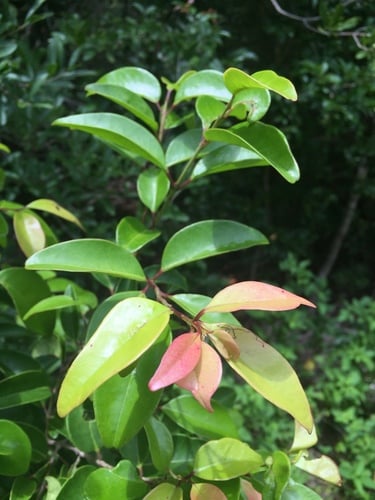
Backhousia myrtifolia
Hook. & Harvey
Nutmeg myrtle, Grey Myrtle, Ironwood, Cinnamon myrtle
iNaturalist· cc-by-nc
(c) Craig Robbins, some rights reserved (CC BY-NC), uploaded by Craig Robbins
iNaturalist· cc-by
(c) ronavery, some rights reserved (CC BY), uploaded by ronavery
iNaturalist· cc-by-nc
(c) Richie Southerton, some rights reserved (CC BY-NC), uploaded by Richie Southerton
Summary
Source: WikipediaBackhousia myrtifolia (commonly referred to as carrol, neverbreak, iron wood, grey myrtle or cinnamon myrtle) is a small rainforest tree species which grows in subtropical rainforests of Eastern Australia. First discovered and subsequently used by the indigenous communities of Australia, this plant produces oils that have a cinnamon-like aroma, and display both anti-bacterial and anti-fungal properties. Therefore, it has potential applications as not only a spice in food preparation, but also in the medical field as a treatment option for microbial infection. Backhousia myrtifolia can grow up to 30 metres. The leaves are ovate or elliptic, 4–7 cm long, and the flowers star-shaped in appearance. Backhousia myrtifolia is renowned for the snow-white colour of its flowers, a characteristic that makes it suitable not only as a domestic/commercial crop but also as an internationally exported product. However, the susceptibility of this plant to "post-harvest browning syndrome" (a disease resulting in leaf discolouration and wilting), threatens its potential as a crop plant.
Description
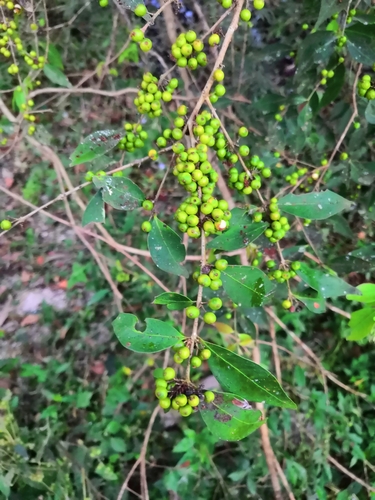
A tall shrub or small tree. It grows 7-8 m tall. It has a slender trunk. It spreads to 1.5-3 m across. The leaves are egg-shaped and pointed. They are dark green and shiny above and paler underneath. The leaves are 2.5-7 cm long by 1-2.5 cm wide. New growth is hairy and often pink. The flowers are white and fluffy. They are 1.5-2 cm across. They are produced in clusters near the ends of branches. The fruit is a capsule enclosed by fleshy sepals. These are yellowish-green.
Edible Uses
None known
Traditional Uses
The leaves are used for seasoning. They have a cinnamon scent and are used for teas and flavouring sweet dishes. The leaves can be used fresh or dried and ground.
Medicinal Uses
None known
Distribution
It is a warm temperate plant. It grows best in part shade. It responds to fertilising. It needs abundant water. It needs moist well drained soil. It can grow from tropical to temperate climates. It is only slightly damaged by frost when young. It suits hardiness zones 9-10. In Melbourne Botanical Gardens. Mt Cootha Botanical Gardens. Arboretum Tasmania.
Where It Grows
Australia*, North America, Tasmania, USA,
Cultivation
Prefers a position in full sun in a fertile moisture retentive well-drained soil. A very ornamental plant, in Britain it is only reliably hardy in the Scilly Isles. Plants in Australian gardens tolerate temperatures down to at least -7°c, but this cannot be translated directly to British gardens due to our cooler summers and longer, colder and wetter winters. Seed can remain viable on the plant for 3 - 4 years.
Propagation
Seed - surface sow in spring or autumn in a greenhouse and keep the compost moist until germination takes place. When they are large enough to handle, prick the seedlings out into individual pots and grow them on in the greenhouse for at least their first winter. Plant them out into their permanent positions in late spring or early summer, after the last expected frosts. Cuttings of half-ripe wood with a heel, July/August in a frame.
Other Uses
Essential Wood An essential oil is obtained from the leaves. The uses are not specified. Wood - hard, tough, strong, close grained. Used for tool handles, wheels, construction etc. Special Uses Scented Plants
Notes
There are 7-13 Backhousia species. They occur in Australia.
References (20)
- Alice, L. & O'Quinn, T., Australian Bush Superfoods. Explore Australia p 38
- Blomberry, A.M., 1979, Australian Native Plants. Angus and Robertson p 139
- Bodkin, F., 1991, Encyclopedia Botanica. Cornstalk publishing, p 124
- Bonney, N., 2012, Edible Wild Native Plants for Southern Australia. p 110
- Bot. Mag. 71: t. 4133. 1845
Show all 20 references Hide references
- Caton, J.M. & Hardwick, R. J., 2016, Field Guide to Useful Native Plants from Temperate Australia. Harbour Publishing House. p 204
- Cronin, L., 1989, The Concise Australian Flora. Reed. p 143
- Cundall, P., (ed.), 2004, Gardening Australia: flora: the gardener's bible. ABC Books. p 215
- Elliot, W.R., & Jones, D.L., 1982, Encyclopedia of Australian Plants suitable for cultivation. Vol 2. Lothian. p 268
- Etherington, K., & Imwold, D., (Eds), 2001, Botanica's Trees & Shrubs. The illustrated A-Z of over 8500 trees and shrubs. Random House, Australia. p 112
- Facciola, S., 1998, Cornucopia 2: a Source Book of Edible Plants. Kampong Publications, p 140
- Hibbert, M., 2002, The Aussie Plant Finder 2002, Florilegium. p 37
- Jones D, L, 1986, Ornamental Rainforest Plants in Australia, Reed Books, p 67
- Lord, E.E., & Willis, J.H., 1999, Shrubs and Trees for Australian gardens. Lothian. p 12
- Molyneux, B & Forrester, S., 1997, The Austraflora A-Z of Australian Plants. Reed. p 47
- Nicholson, N & H., 1996, Australian Rainforest Plants, Terania Rainforest Publishing. NSW. p 15
- Robins, J., 1996, Wild Lime. Cooking from the Bush food garden. Allen & Unwin p 137
- Townsend, K., 1994, Across the Top. Gardening with Australian Plants in the tropics. Society for Growing Australian Plants, Townsville Branch Inc. p 93
- Williams, J.B., Harden, G.J., and McDonald, W.J.F., 1984, Trees and shrubs in rainforests of New South Wales and Southern Queensland. Univ. of New England, Armidale. p 110
- www.ceres.org/au/bushfood catalogue