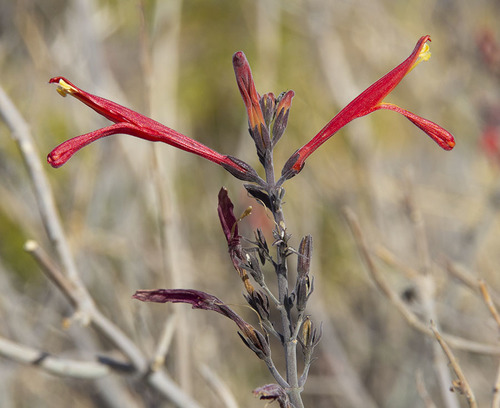
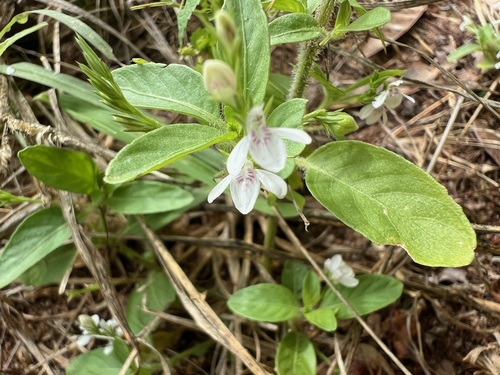
Avicennia marina
(Forsskal) Vierhapper
White mangrove, Grey Mangrove
iNaturalist· cc-by-nc
(c) drmattnimbs, some rights reserved (CC BY-NC), uploaded by drmattnimbs
iNaturalist· cc-by-nc
(c) spiderk, some rights reserved (CC BY-NC)
iNaturalist· cc-by-nc
(c) shanes, some rights reserved (CC BY-NC), uploaded by shanes
Summary
Source: WikipediaAvicennia marina, commonly known as grey mangrove or white mangrove, is a species of mangrove tree classified in the plant family Acanthaceae (formerly in the Verbenaceae or Avicenniaceae). As with other mangroves, it occurs in the intertidal zones of estuarine areas.
Description
A small tree up to 3-8 m high. It spreads to 2-5 m wide. It often has several stems. It has many slender aerating roots. These are pencil thin and arise from the radiating roots under the surface. The bark is smooth and grey to white. The leaves are 3-8 cm long by 2-3 cm wide. They are oval to sword shaped and shiny grey-green. They are leathery, and whitish underneath. The leaves occur opposite one another. The leaves have a short stalk. The flowers are 0.5 cm across. They are yellowish and have a sweet scent. The occur in the axils of leaves. The fruit capsule is flattened and has 2 large seed leaves. The fruit is edible. There is one seed inside. The seed germinates on the bush before it drops. This species varies a lot. There are some named subspecies.
Edible Uses
The fruit is edible and is traditionally eaten after extensive soaking and cooking. Seeds are also eaten.
Traditional Uses
The fruit are eaten after roasting. They are extensively soaked and then cooked. CAUTION: The bitter juice is used to produced abortions in India.
Medicinal Uses
The bitter juice has been used to produce abortions in India.
Known Hazards
The bitter juice is used to produce abortions in India.
Distribution
A tropical plant. It grows in the tropics but also extends into cooler regions. They are most commonly on the seaward edge of the mangroves. It grows in muddy soil with a pH of 6.5-8. It cannot tolerate shade. It can grow in salty soils. It can grow in arid places. It suits hardiness zones 10-12.
Where It Grows
Africa, America, Andamans & Nicobar, Arabia, Asia, Australia, Bahrain, Bangladesh, China, Comoros, East Africa, East Timor, Egypt, India, Indochina, Indonesia, Iran, Japan, Kenya, Madagascar, Maldives, Middle East, Mozambique, Myanmar, New Caledonia, New Zealand, North Africa, Oman, Pacific, Pakistan, Papua New Guinea, PNG, Philippines, Qatar, Saudi Arabia, SE Asia, Singapore, Solomon Islands, South Africa, Southern Africa, Sri Lanka, Sudan, Taiwan, Tanzania, Thailand, Timor-Leste, United Arab Emirates, UAE, Vietnam, Yemen,
Cultivation
Plants are often self sown. Seedlings can be transplanted.
Propagation
Seed - best sown as soon as ripe. The seeds are very susceptible to desiccation. There is also progressive deterioration of the internal tissues of the seeds associated with fungal infection during hydrated storage. Young seedlings grow best when they are in contact with fresh water, but growth diminishes soon under these conditions and is best in water with 10 - 50% of full seawater salinity for older seedlings. Natural regeneration is often abundant, and wildlings can be collected to serve as planting stock. Propagation by air layering and root suckers has been successful.
Other Uses
The bark contains tannins. The source of a reddish and brown dyes. The bark has been utilized commercially for tanning, but the tannin content is rather low. The smoke of burning wood is considered very efficient as a mosquito repellent. The greyish to yellowish wood is heavy and durable with a fine and even texture. It is used for poles in house building, for boat construction, especially for the ribs, for furniture and handles, and to make beehives. The branches serve as stakes for fences. The wood is also used as firewood and for charcoal production; it is especially used for lime burning. The tree is useful for preventing coastal erosion and as a windbreak. The tree is often a pioneer in sandy habitats, but may also invade mud flats. The tree tolerates heavy metals in the soil very well. The roots may be employed as a biological indicator of environmental exposure to copper, lead and zinc.
Production
Trees in Australia flower from October to January and fruit January to February.
Notes
There are about 6-8 Avicennia species. They are tropical. It was in the Avicenniaceae and Verbenaceae families.
Synonyms
Also Known As
Afiafy, Artama, Baru, Dwarf mangrove, Gurm, Hafiafy, Hai lan, Honkofotsy, Manawa, Manyarr, Mchu, Mirirrwiny, Mosotro, Mtu, Ngurngulu, Smooth-barked Grey mangrove, Gurm, Thinbir, Witseebasboom
References (56)
- Ambasta S.P. (Ed.), 2000, The Useful Plants of India. CSIR India. p 63
- Bindon, P., 1996, Useful Bush Plants. Western Australian Museum. p 47
- Boomsma, C.D., 1972, Native Tree of South Australia. Woods & Forests Department South Australia, Bulletin No.19. p 53
- Brock, J., 1993, Native Plants of Northern Australia, Reed. p 93
- Cancilla, D., 2018, Ethnobotanical and Ethnozoological Values Desktop Assessment - Eliwana Project. p 37
Show all 56 references Hide references
- Cherikoff V. & Isaacs, J., The Bush Food Handbook. How to gather, grow, process and cook Australian Wild Foods. Ti Tree Press, Australia p 198
- Clarke, P. A., 2013, The Aboriginal Ethnobotany of the Adelaide Region, South Australia. Transactions of the Royal Society of South Australia. (2013), 137(1): 97-126
- Cooper, W. and Cooper, W., 2004, Fruits of the Australian Tropical Rainforest. Nokomis Editions, Victoria, Australia. p 86
- Cronin, L., 1989, The Concise Australian Flora. Reed. p 148
- Cundall, P., (ed.), 2004, Gardening Australia: flora: the gardener's bible. ABC Books. p 210
- Dashorst, G.R.M., and Jessop, J.P., 1998, Plants of the Adelaide Plains & Hills. Botanic Gardens of Adelaide and State Herbarium. p 122
- Denkschr. Kaiserl. Akad. Wiss. Wien, Math.-Naturwiss. Kl. 71:435. 1907
- Dharani, N., 2002, Field Guide to common Trees & Shrubs of East Africa. Struik. p 299
- Elliot, W.R., & Jones, D.L., 1982, Encyclopedia of Australian Plants suitable for cultivation. Vol 2. Lothian. p 264
- Etherington, K., & Imwold, D., (Eds), 2001, Botanica's Trees & Shrubs. The illustrated A-Z of over 8500 trees and shrubs. Random House, Australia. p 109
- Flora of Pakistan.
- Floyd, A.G., 1977, Ecology of the Tidal Forests in the Kikori-Romilly Sound Area Gulf of Papua. Ecology Report No 4 Division of Botany, Lae, Papua New Guinea. p 26
- French, B.R., 1986, Food Plants of Papua New Guinea, Asia Pacific Science Foundation p 314
- French, B.R., 2010, Food Plants of Solomon Islands. A Compendium. Food Plants International Inc. p 299
- Frodin, D.G. & Leach, G.L., 1982, Mangroves of the Port Moresby Region. Biology Department Occasional Paper No 3 Revised edition. Papua New Guinea, p 18 (Avicennia eucalyptifolia - part)
- Havel, J.J., 1975, Forest Botany, Volume 3 Part 2 Botanical taxonomy. Papua New Guinea Department of Forests, p 283
- Hiddins, L., 1999, Explore Wild Australia with the Bush Tucker Man. Penguin Books/ABC Books. p 144
- Holliday, I., 1989, A Field Guide to Australian Trees. Hamlyn. p 68
- http://iscmumbai.maharashtra.gov.in/floristic%20survey.html
- Hu, Shiu-ying, 2005, Food Plants of China. The Chinese University Press. p 642
- Isaacs, J., 1987, Bush Food, Aboriginal Food and Herbal Medicine. Weldons. p 129
- Karim, F. M. & Dakheel, A, J., 2006, Salt-tolerant plants of the United Arab Emirates. 2006. International Center for Biosaline Agriculture, Dubai, UAE. p 153
- Kenneally, K.E., Edinger, D. C., and Willing T., 1996, Broome and Beyond, Plants and People of the Dampier Peninsula, Kimberley, Western Australia. Department of Conservation and Land Management. p 70
- Lands, M., 1987, Mayi: Some Bush fruits of Dampierland. Magabala Books, Broome West Australia. p 24
- Lazarides, M. & Hince, B., 1993, Handbook of Economic Plants of Australia, CSIRO. p 30
- Levitt, D., 1981, Plants and people. Aboriginal uses of plants on Groote Eylandt, Australian Institute of Aboriginal Studies, Canberra. p 84
- Lovelock, C., & Clarke, S., 1999, Field Guide to the Mangroves of Queensland. Australian Institute of Marine Science. p 50
- Low, T., 1991, Wild Food Plants of Australia. Australian Nature FieldGuide, Angus & Robertson. p 45
- Low, T., 1992, Bush Tucker. Australia’s Wild Food Harvest. Angus & Robertson. p 83
- Paczkowska, G. & Chapman, A.R., 2000, The Western Australian Flora. A Descriptive Catalogue. Western Australian Herbarium. p 180
- Palgrave, K.C., 1996, Trees of Southern Africa. Struik Publishers. p 816
- Percival, M & Womersley, J.S., 1975, Floristics and ecology of the mangrove Vegetation of Papua New Guinea. Botany Bulletin No 8 Division of Botany, Lae, Papua New Guinea. p 40
- Phillips, D.C., 1988, Wild Flowers of Bahrain. A Field Guide to Herbs, Shrubs, and Trees. Privately published. p 29
- Price, S.H. & J.L., Wild Food, Medicine and useful plants of the Wet tropics. Kwik Kopy, Cairns. p 6
- Roy, S. D., et al, 2009, Mangroves of Andaman and Nicobar Islands. ICAR p 11
- Royal Botanic Gardens, Kew (1999). Survey of Economic Plants for Arid and Semi-Arid Lands (SEPASAL) database. Published on the Internet; http://www.rbgkew.org.uk/ceb/sepasal/internet [Accessed 4th April 2011]
- Ruiters-Welcome, A. K., 2019, Food plants of southern Africa. Ph.D. thesis. Univ. of Johannesburg p 5
- Scarth-Johnson, V., 2000, National Treasures. Flowering Plants of Cooktown and Northern Australia. Vera Scarth-Johnson Gallery Association. Cooktown, Australia. p 20
- Schatz, G.E., 2001, Generic Tree Flora of Madagascar. Royal Botanical Gardens, Kew and Missouri Botanical Garden. p 37
- Selvam, V., 2007, Trees and shrubs of the Maldives. RAP Publication No. 2007/180
- Smith, M & Kalotas, A. C., 1985, Bardi Plants: An Annotated List of Plants and Their Use by the Bardi Aborigines of Dampierland, in North-western Australia. Rec. West Aust. Mus. 1985, 12(3): 317-359
- Smith, N and Wightman, G.M., 1990, Ethnobotanical Notes from Belyuen Northern Territory Australia. Northern Territory Botanical Bulletin No 10. Parks and Wildlife Commission of the Northern Territory. p 5, 6.
- Smith, N. M., 1991, Ethnobotanical Field Notes from the Northern Territory, Australia, J. Adelaide Bot. Gard. 14(1): 1-65
- Sujanapal, P., & Sankaran, K. V., 2016, Common Plants of Maldives. FAO & Kerala FRI, p 48
- Tiwi Plants and Animals. 2001, Aboriginal flora and fauna knowledge from Bathurst and Melville Islands, northern Australia. Northern Territory Botanical Bulletin; No. 24 p 26
- van Wyk, B, van Wyk, P, and van Wyk B., 2000, Photographic guide to Trees of Southern Africa. Briza. p 57
- Vigilante, T., et al, 2013, Island country: Aboriginal connections, values and knowledge of the Western Kimberley islands in the context of an island biological survey. Records of the Western Australian Museum Supplement 81: 145-182
- Welcome, A. K. & Van Wyk, B.-E., 2019, An inventory and analysis of the food plants of southern Africa. South African Journal of Botany 122 (2019) 136–179
- Wheeler, J.R.(ed.), 1992, Flora of the Kimberley Region. CALM, Western Australian Herbarium, p 800
- World Checklist of Useful Plant Species 2020. Royal Botanic Gardens, Kew
- Young, J., (Ed.), 2001, Botanica's Pocket Trees and Shrubs. Random House. p 119