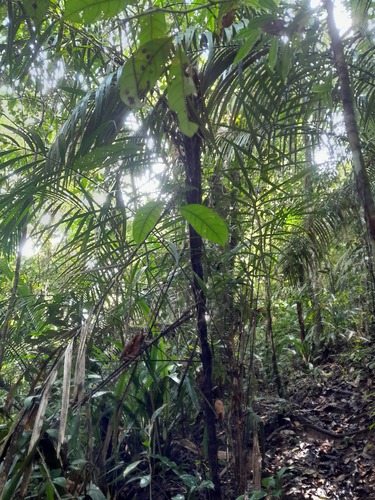
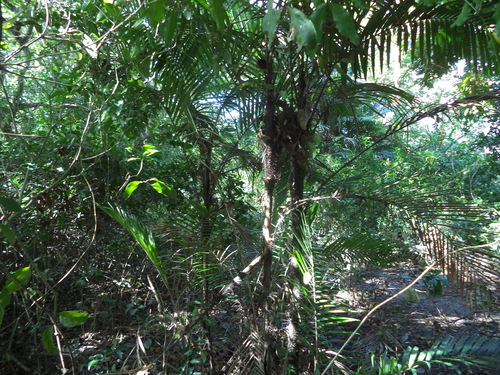
Attalea speciosa
Mart. ex Spreng.
Babasu oil palm
iNaturalist· cc-by-nc
(c) Luciana Chiyo, some rights reserved (CC BY-NC), uploaded by Luciana Chiyo
iNaturalist· cc-by-nc
(c) Jackson Góes, some rights reserved (CC BY-NC), uploaded by Jackson Góes
iNaturalist· cc-by-nc
(c) flavioubaid, some rights reserved (CC BY-NC)
Summary
Source: WikipediaAttalea speciosa, the babassu, babassu palm, babaçu, or cusi, is a palm native to the Amazon rainforest region in South America. The babassu palm is the predominant species in the Maranhão Babaçu forests of Maranhão and Piauí states. This plant has commercial value because its seeds produce an edible oil called babassu oil, which is also used in cleaners and skin-care products. The fruit is used to produce products such as medicines, beauty aids, and beverages. Traditional communities of the Maranhão region also produce a flour from the fruit, and this is commercialized as a nutritional supplement. The leaves are also used to provide thatch for houses and can be woven into mats for constructing house walls. The stems are used for timbers. The babassu palm is considered a weed in pasture areas of Cerrado vegetation in Brazil.
Description
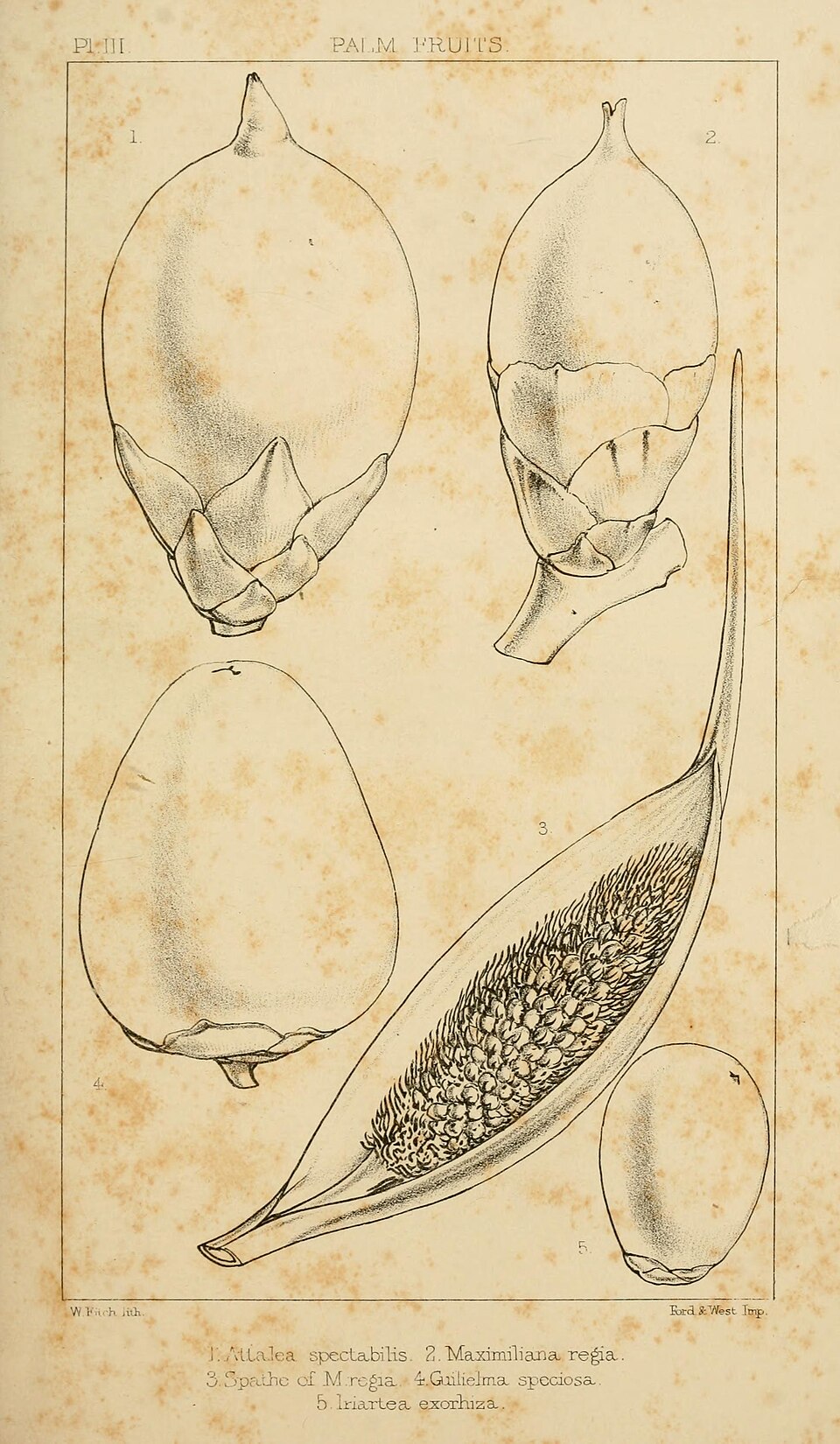
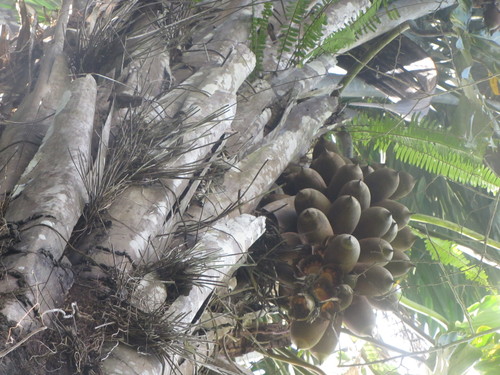
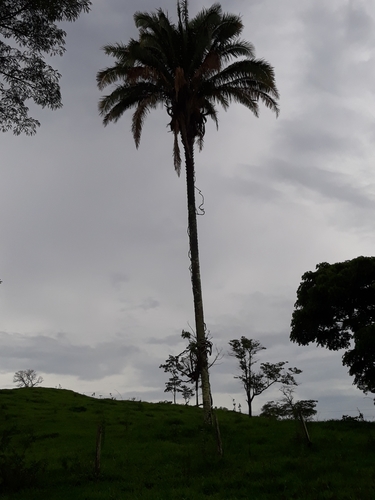
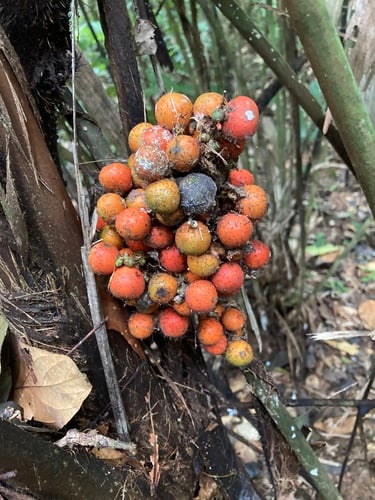
A palm. It grows 15-20 m high. The trunk is 40-50 cm across. The leaves are 7-10 m long. They are curved at the tip. The male flower sticks up among the leaves. It is 70-80 cm long. The female flower is larger. The fruit stalk is 1 m long. The fruit are oval and 8-10 cm long by 5-6 cm wide. They have a fibrous covering 1-4 mm thick.
Edible Uses
Edible Parts: Fruit Oil Sap Seed Edible Uses: Drink Milk Oil Salt Edible portion: Oil, Fruit, Nuts, Palm heart, Cabbage, Sap. A good quality cooking oil is extracted from the seeds . It can be used to make a butter. Seeds - raw or cooked. They can be eaten as a snack or made into a nut milk. The ellipsoid seeds are up to 6cm long by 1 - 2cm wide, there are usually 3 - 6 seeds in each fruit. The nuts are extremely hard and difficult to crack. The watery endosperm from immature seeds is consumed as a drink. Very nourishing. A sap obtained from the stem is fermented to make palm wine. The apical bud is used as a food. Harvesting this bud will effectively lead to the death of the trunk because it is unable to make side branches. Ashes from the burnt stem are used as a salt substitute. Babassu flour, mixed with milk and sugar, makes a chocolate-like drink.
Traditional Uses
The kernel of the nut is used to extract an edible oil. The kernels are eaten as a snack. The watery contents are used as a drink. Sap from the stem produces a palm wine. The palm heart is eaten. Ashes from the burnt stem are used as a salt substitute. The flour is mixed with milk and sugar to produce a chocolate like drink.
Medicinal Uses
Antirheumatic Febrifuge Plaster The leaves and liquid endosperm are used in local medicine. The seed kernel is used in liniments as a treatment for rheumatism. Ground into a powder and combined with sugar and water, it makes a refreshing and febrifuge emulsion.
Known Hazards
The fine silicate crystals falling off the fruit can cause serious eye damage to the collectors.
Distribution
It is a tropical plant. It grows in the lowlands in hot tropical monsoonal climates. It grows in forest and open areas. It grows in areas with 1200 mm of rain per year. In the Cairns Botanical Gardens. (As Orbigyna barbosiana). In Townsville palmetum.
Where It Grows
Amazon, Asia, Australia, Bolivia, Brazil*, Guiana, Guianas, Guyana, Indonesia, Mexico, Peru, SE Asia, South America, Suriname, USA,
Cultivation
It grows in areas where the annual rainfall is 1,200 - 2,500 mm with a 4 - 6 months dry season. Requires a sunny position. Soils range from well-drained upland soils to gallery forest, although in severely flooded areas it occurs in elevated, non-flooded areas. Prefers a deep well drained fertile soil. Plants can tolerate some drought. In a primary forest, seedlings require up to seven years to produce the first compound leaf and up to 42 years for other leaves. When cultivated without shade and in more favorable conditions, the plants can take just 10 years to mature.. The plant can regenerate very vigorously in open areas, so much so that it is considered to be an invasive weed in land that has been cleared for pasture. The palms begin to bear when 8 - 12 years old. The plant produces bunches of fruit that can be up to 1 metre long, weighing 14 - 90 kg. Each bunch contains from 100 - 600 fruits, with 200 fruits being the average. Wild groves can yield 1.5 - 2.5 tonnes per ha but, where the groves are thinned, yields range from 7 - 30 tonnes per ha with an average of 16 tonnes. Individual trees with 7 bunches, each bunch of 600 nuts and weighing up to 90 kg are known.
Propagation
Seed - when stored in the shell, the seed can have a long viability of several years. Fire or heat may be necessary to break dormancy. Separate kernels may germinate within a few months. Early growth is slow, concentrating initially on an extensive root system and consequently requiring large bags if grown in a nursery.
Other Uses
Basketry Charcoal Fuel Insecticide Lighting Mulch Oil Pioneer Plaster Soap making Thatching Wood Other uses rating: Very High (5/5). Agroforestry Uses: Although somewhat slow growing, the plant can regenerate very vigorously in open areas, to the extent that it is considered to be a weed of pastures. This makes it an excellent species for restoring native woodland and, with its wide range of uses, it is also a very good species to use when establishing a woodland garden[ 303 , 419 , K ]. Other Uses The leaves are commonly used for thatch and basketry. Young plants produce very large leaves before the stem is formed, and it is in this state that they are generally used for thatching. The unopened leaves from the centre are preferred since, though they require some preparation, they produce a more uniform thatch. The leaf is shaken until it falls partially open, and then each leaflet is torn at the base so as to remain hanging by its midrib only, which is, however, quite sufficient to secure it firmly. They thus hang all at right angles to the midrib of the leaf, which allows them to be laid in a very regular manner on the rafters. The leaf petioles are used for laths for windows and adobe walls. Decayed stems and leaves are used for mulch. The oil from the seed is excellent for soap production because of its high (45%) lauric acid content. It is also used for making candles. The epicarp (ca. 15% of the fruit) is a primary fuel source. The mesocarp (ca. 20% of the fruit) is a potential source of industrial starch, glucose or alcohol. The endocarp (ca. 59% of the fruit) is an important source of high grade charcoal for the steel industry as well as source of distillation by-products such as tar, acetic acid, methane, etc. It also has a potential use as a substrate for hydroponics. Nut waste is also used locally as a fuel for cooking and to repel insects. The wood is moderately heavy, soft and of low durability if exposed to the elements. It is used for construction purposes in rustic buildings. Special Uses Carbon Farming Food Forest
Production
The palms start to flower in the tenth year. They can live for 200 years. It produces 2-6 fruiting clusters each year. The kernel is 66% oil. In Bolivia there are an average of 182-211 trees per hectare. Fruit yields are 2456-2624 kg per hectare.
Other Information
It is a very important crop in Northern Brazil.
Notes
There are between (22) 30-71 Attalea species. Some authorities divide them among Attalea, Orbignya, Scheela and Maximiliana.
Nutrition
| Part | Moisture | kJ | kcal | Protein | Vit A | Vit C | Iron | Zinc |
|---|---|---|---|---|---|---|---|---|
| Fruit | 15.8 | 288 | — | 1.4 | — | — | — | — |
| Nuts | — | — | — | — | — | — | — | — |
| Palm heart | — | — | — | — | — | — | — | — |
| Sap | — | — | — | — | — | — | — | — |
Synonyms
Also Known As
Aguacu, Aguassu, American oil palm, Babacu palm, Babassu, Bauacu, Coco-de-macaco, Coco-naia, Coco-pindoba, Cusi, Cusino, Guaguaco, Guaguazu, Iba, Motacuchi, Palem minyak babasu, Uauacu, Xebinihua, Xeni
References (33)
- Balick, M.J. and Beck, H.T., (Ed.), 1990, Useful palms of the World. A Synoptic Bibliography. Colombia p 53 (As Orbignya martiana), 54, 63 (As Orbignya martiana), 64, 125 (As Orbignya oleifera), 143 (As Orbignya martiana), 157 (As Orbignya phalerata), 209 (As Orbignya martiana), 311 (As Orbignya phalerata), 390 (As Orbignya speciosa), 396 (As Orbignya martiana), 397, 399, 535, 555,
- Bortolotto, I. M., et al, 2018, Lista preliminar das plantas alimenticias nativas de Mato Grosso do Sul, Brasil. Iheringia, Serie Botanica, Porto Alegre, 73 (supl.):101-116
- Etkin, N.L. (Ed.), 1994, Eating on the Wild Side, Univ. of Arizona. p 121, 140 (As Orbignya phalerata)
- Facciola, S., 1998, Cornucopia 2: a Source Book of Edible Plants. Kampong Publications, p 30 (As Orbignya martiana)
- Glassman, A Taxonomic Treatment of the Palm Subtribe Attaleinae (Tribe Cocoeae). p 93 (As Orbignya phalerata)
Show all 33 references Hide references
- Grandtner, M. M. & Chevrette, J., 2013, Dictionary of Trees, Volume 2: South America: Nomenclature, Taxonomy and Ecology. Academic Press p 52
- Haynes, J., & McLaughlin, J., 2000, Edible palms and Their Uses. University of Florida Fact sheet MCDE-00-50-1 p 3
- Henderson, A., Galeano, G and Bernal, R., 1995, Field Guide to the Palms of the Americas. Princeton. p 164
- Hunter, D., et al, 2019, The potential of neglected and underutilized species for improving diets and nutrition. Planta (2019) 250:709-729
- Janick, J. & Paul, R. E. (Eds.), 2008, The Encyclopedia of Fruit & Nuts. CABI p 92
- Johnson, D.V., 1998, Tropical palms. Non-wood Forest products 10. FAO Rome. p 116
- Kermath, B. M., et al, 2014, Food Plants in the Americas: A survey of the domesticated, cultivated and wild plants used for Human food in North, Central and South America and the Caribbean. On line draft. p 110
- Leticia, Z., et al, 2015, Do Socioeconomic characteristics explain the knowledge and use of native food plants in semiarid environments in Northeastern Brazil? Journal of Arid Environments 115:53-61
- Lorenzi, H., 2002, Brazilian Trees. A Guide to the Identification and Cultivation of Brazilian Native Trees. Vol. 01 Nova Odessa, SP, Instituto Plantarum p 300 (As Orbignya speciosa)
- Lorenzi, H., Bacher, L., Lacerda, M. & Sartori, S., 2006, Brazilian Fruits & Cultivated Exotics. Sao Paulo, Instituto Plantarum de Estuados da Flora Ltda. p 87 (As Orbignya speciosa)
- Marcia, M. J., et al, 2011, Palm Uses in Northwestern South America: A Quantitative Review. Bot. Rev. (2011) 77:462-570
- Martin, F. W., et al, 1987, Perennial Edible Fruits of the Tropics. USDA Handbook 642 p 49 (As Orbignya martiana)
- Martins, R. C., et al, 2014, Use and Diversity of Palm (Arecaceae) Resources in Central Western Brazil. The Scientific World Journal.. Volume 2014, Article ID 942043
- Menninger, E.A., 1977, Edible Nuts of the World. Horticultural Books. Florida p 139 (As Orbignya barbosiana)
- Paz, F. S., et al, 2021, Edible Fruit Plant Species in the Amazon Forest Rely Mostly on Bees and Beetles as Pollinators. Journal of Economic Entomology, XX(XX), 2021, 1–13 (As Orbignya phalerata)
- Riffle, R.L. & Craft, P., 2003, An Encyclopedia of Cultivated Palms. Timber Press. p 44, 266
- Sukarya, D. G., (Ed.) 2013, 3,500 Plant Species of the Botanic Gardens of Indonesia. LIPI p 758
- Syst. veg. 2:624. 1825
- Tobar-Vargas, A., et al, 2013, New records of plants for San Andrews and Old Providence islands [International Biosphere reserve Seaflower) Caribbean Colombia. Check List 9(6) 1361-1366
- Tomchinsky, B., et al, 2021, Food Composition Data: Edible Plants from the Amazon. in M. C. M. Jacob, U. P. Albuquerque (eds.), Local Food Plants of Brazil, Ethnobiology, Springer p 275
- USDA, ARS, National Genetic Resources Program. Germplasm Resources Information Network - (GRIN). [Online Database] National Germplasm Resources Laboratory, Beltsville, Maryland. Available: www.ars-grin.gov/cgi-bin/npgs/html/econ.pl (10 April 2000)
- van Roosmalen, M.G.M., 1985, Fruits of the Guianan Flora. Utrecht Univ. & Wageningen Univ. p 342
- Vasquez, Roberto Ch. & Coimbra, German S., 1996, Frutas Silvestres Comestibles de Santa Cruz. p 158
- Wickens, G.E., 1995, Edible Nuts. FAO Non-wood forest products. FAO, Rome. p 169 (Also as Orbignya oleifera and Orbignya martiana and Orbignya speciosa)
- Wiersema, J. H. & Leon, B., 2013, World Economic Plants. A Standard Reference CRC Press. 2nd Ed. p 85
- World Checklist of Useful Plant Species 2020. Royal Botanic Gardens, Kew
- www.worldagroforestrycentre.org/treedb/ (As Orbignya phalerata)
- Zambrana, P, et al, 2017, Traditional knowledge hiding in plain sight – twenty-first century ethnobotany of the Chácobo in Beni, Bolivia. Journal of Ethnobiology and Ethnomedicine (2017) 13:57