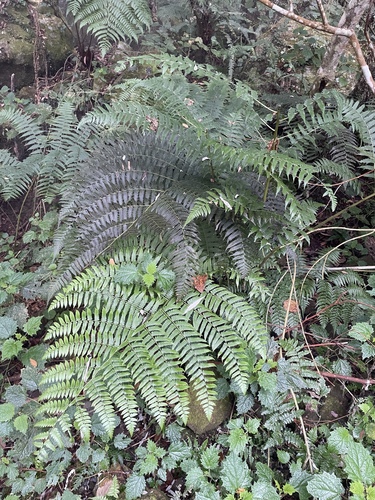
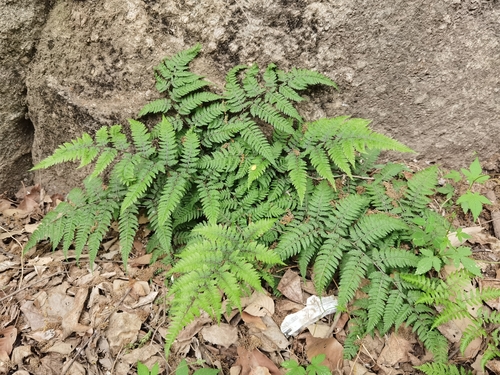
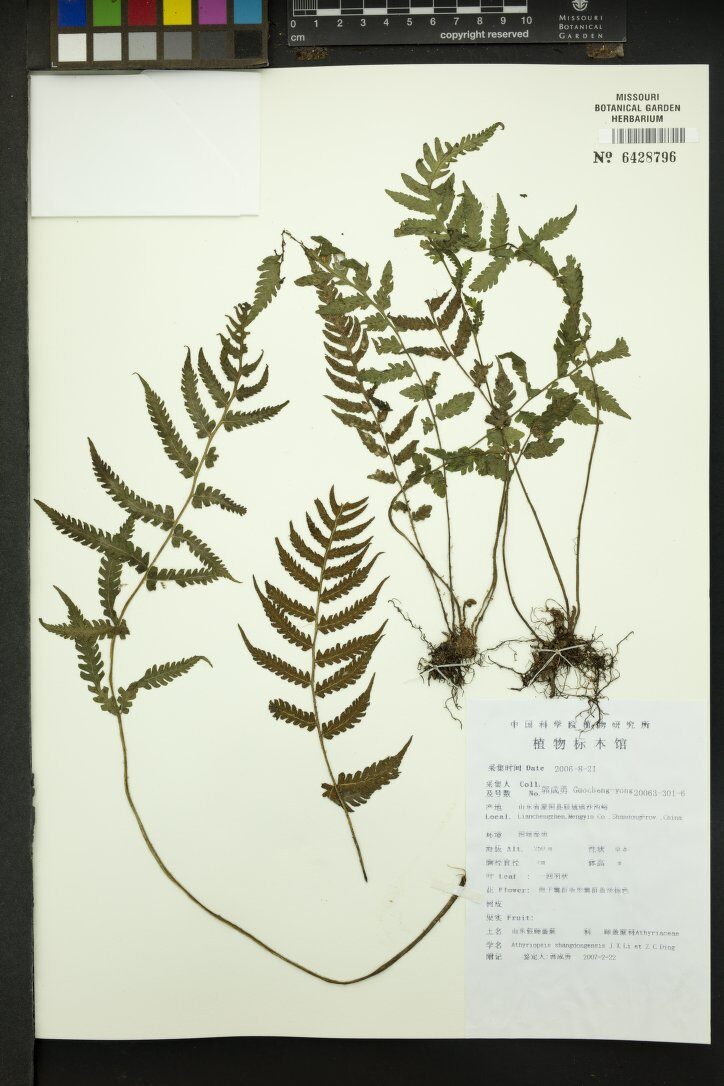
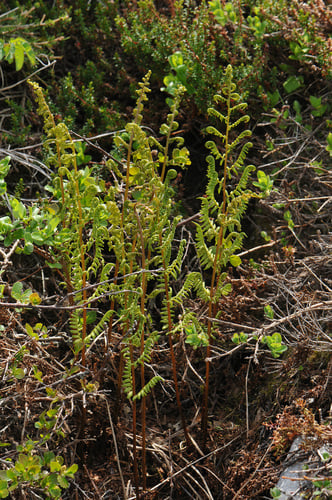
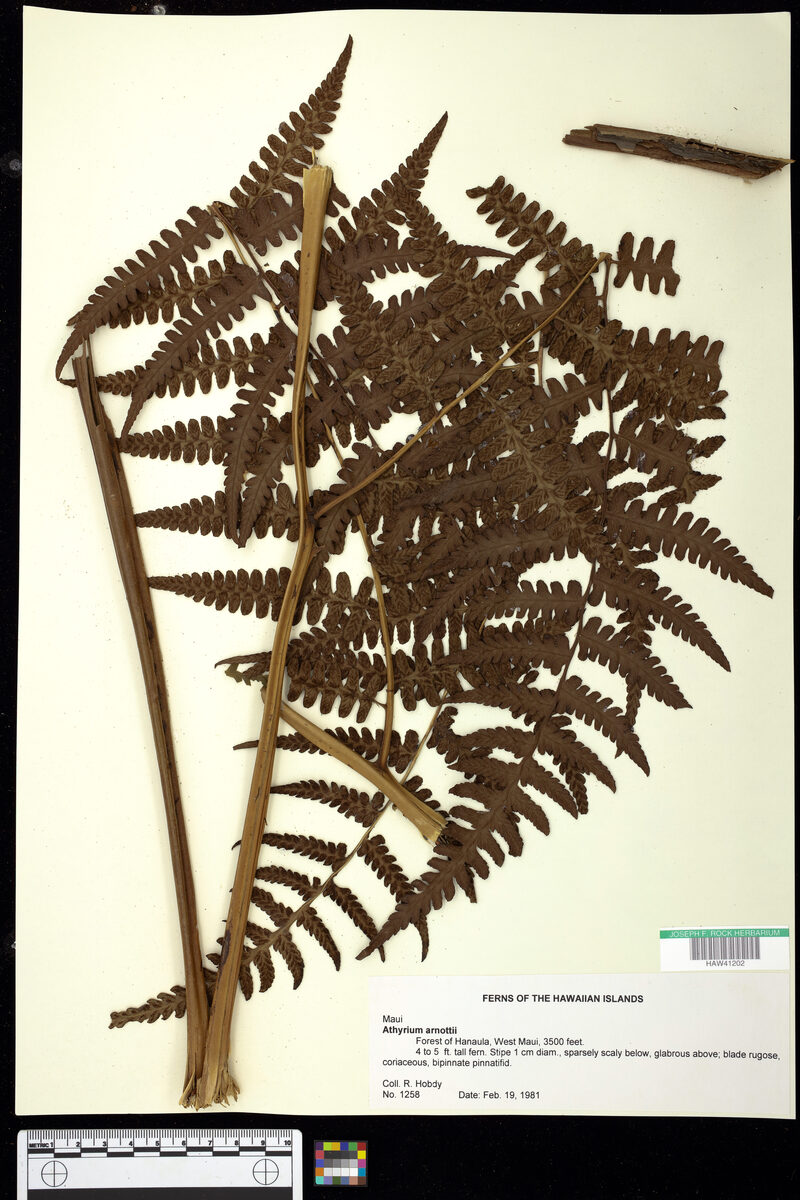
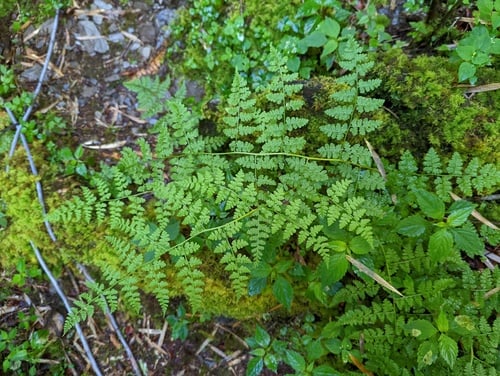
Athyrium filix-femina
(L.) Roth. ex Mert.
Lady fern, Female fern
iNaturalist· cc-by-nc
(c) jacquelinerose, some rights reserved (CC BY-NC), uploaded by jacquelinerose
iNaturalist· cc-by
(c) Ken-ichi Ueda, some rights reserved (CC BY)
iNaturalist· cc-by-nc
(c) Wendy Feltham, some rights reserved (CC BY-NC), uploaded by Wendy Feltham
Summary
Source: WikipediaAthyrium filix-femina, the lady fern or common lady-fern, is a large, feathery species of fern native to temperate Asia, Europe, and North Africa. It is often abundant (one of the more common ferns) in damp, shady woodland environments and is often grown for decoration. Its common names "lady fern" and "female fern" refer to how its reproductive structures (sori) are concealed in an inconspicuous – deemed "female" – manner on the frond. Alternatively, it is said to be feminine because of its elegant and graceful appearance.
Description
A clumping fern. It grows 45-90 cm high and wide. The fronds arise from erect rhizomes. They are usually divided into long pointed leaflets. They are finely divided and brittle. They break easily. It loses its fronds in winter months. There are many cultivated varieties.
Edible Uses
Edible Parts: Leaves Root Shoots Edible Uses: Young shoots, harvested before they have fully unfolded, can be eaten cooked. They must not be eaten raw - see the notes above on toxicity. Used in spring, they are a bitter emergency food. Rhizome - peeled and slow-baked. Reports that the root of this plant were eaten by native North American Indians are likely to be mistaken, it was probably Dryopteris expansa that was used.
Traditional Uses
The young fiddleheads are steamed and eaten. The underground rootstock and stem are peeled and roasted then eaten. The starch is also extracted.
This uses section is brief — help expand it
Medicinal Uses
Anthelmintic Diuretic Poultice Women's complaints A tea of the boiled stems has been used to relieve labour pains. The young unfurled fronds have been eaten to treat internal ailments such as cancer of the womb. The roots are anthelmintic and diuretic. A tea of the boiled roots has been used to treat general body pains, to stop breast pains caused by childbirth and to induce milk flow in caked breasts. The dried powdered root has been applied externally to heal sores. A liquid extract of the root is an effective anthelmintic, though it is less powerful than the male fern, Dryopteris felix-mas.
Distribution
A temperate plant. It is frost hardy. It suits shady, moist situations. It suits hardiness zones 4-9.
Where It Grows
Africa, Alaska, Albania, America, Armenia, Asia, Australia, Azerbaijan, Britain, Canada, Caucasus, Central Asia, China, Europe, Georgia, India, Ireland, Japan, Kazakhstan, Luxembourg, Mexico, Mongolia, Nepal, North Africa, North America, Peru, South America, Turkey, Türkiye, USA, Uzbekistan,
Propagation
Spores - surface sow in a pot of sterile compost in a shady part of the greenhouse and keep moist, this is most easily done by putting the pot in a plastic bag. Pot up small clumps of the plants when they are large enough to handle and keep them moist until they are established. Plant out in late spring of the following year. Division in spring as plants come into growth. Larger divisions can be planted straight into their permanent positions whilst smaller clumps are best potted up and kept in a cold frame until they are growing away well.
Other Uses
A good ground cover plant, forming a slowly spreading clump. The cultivar 'Minor' has a denser habit and spreads more freely, making a better cover. Special Uses Food Forest Ground cover
Notes
There are about 180 Athyrium species. Also put in the family Aspleniaceae and Woodsiaceae.
Synonyms
Also Known As
Unyiu
References (16)
- Ambasta S.P. (Ed.), 2000, The Useful Plants of India. CSIR India. p 61
- Arch. Bot. (Leipzig) 2(1):106. 1799
- Bowser, M. 2017, Handout on Edible Plants of the Kenai Peninsula. USFWS Kenai National Wildlife Refuge p 7
- Cundall, P., (ed.), 2004, Gardening Australia: flora: the gardener's bible. ABC Books. p 206
- Goudey, C.J., 1988, A Handbook of Ferns for Australia and New Zealand. Lothian. p 65
Show all 16 references Hide references
- Hibbert, M., 2002, The Aussie Plant Finder 2002, Florilegium. p 36
- Irving, M., 2009, The Forager Handbook, A Guide to the Edible Plants of Britain. Ebury Press p 351
- Jackes, D. A., Edible Forest Gardens
- Joyce, D., 1998, The Garden Plant Selector. Ryland, Peters and Small. p 333
- Kuhnlein, H. V. and Turner, N. J., 1991, Traditional Plant Foods of Canadian Indigenous Peoples. Food and Nutrition in History and Anthropology Volume 8. Gordon and Breach. p 31
- Lim, T. K., 2015, Edible Medicinal and Non Medicinal Plants. Volume 9, Modified Stems, Roots, Bulbs. Springer p 14
- MacKinnon, A., et al, 2009, Edible & Medicinal Plants of Canada. Lone Pine. p 383
- Plants for a Future database, The Field, Penpol, Lostwithiel, Cornwall, PL22 0NG, UK. http://www.scs.leeds.ac.uk/pfaf/
- Slocum, P.D. & Robinson, P., 1999, Water Gardening. Water Lilies and Lotuses. Timber Press. p 111
- Turner, N., 1995, Food Plants of Coastal First Peoples. Royal BC Museum Handbook p 25
- Urgamal, M., et al, 2014, Conspectus of the Vascular Plants of Mongolia. Mongolia Academy of Sciences Institute of Botany and National University of Mongolia Department of Biology. p 33