Humiria balsamifera
(Aubl.) A. St Hil.
Tauroniro
iNaturalist· cc-by
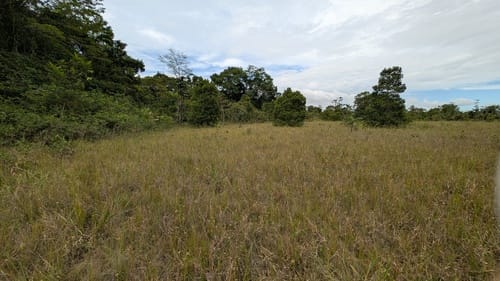
(c) Alex Popovkin, some rights reserved (CC BY), uploaded by Alex Popovkin
iNaturalist· cc-by
(c) João Medeiros, some rights reserved (CC BY)
iNaturalist· cc-by
(c) Alex Popovkin, some rights reserved (CC BY), uploaded by Alex Popovkin
Description
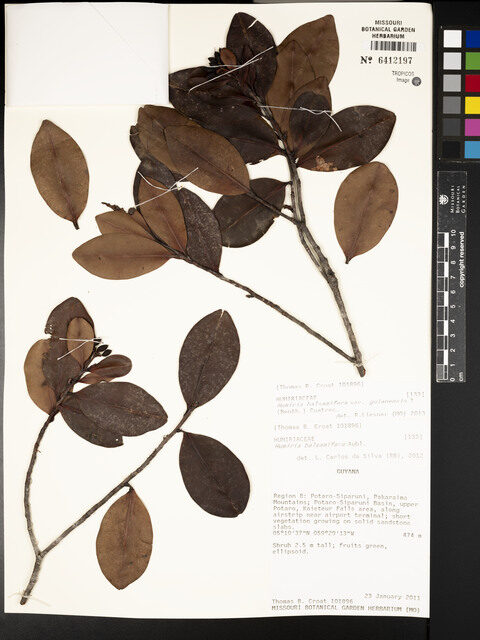
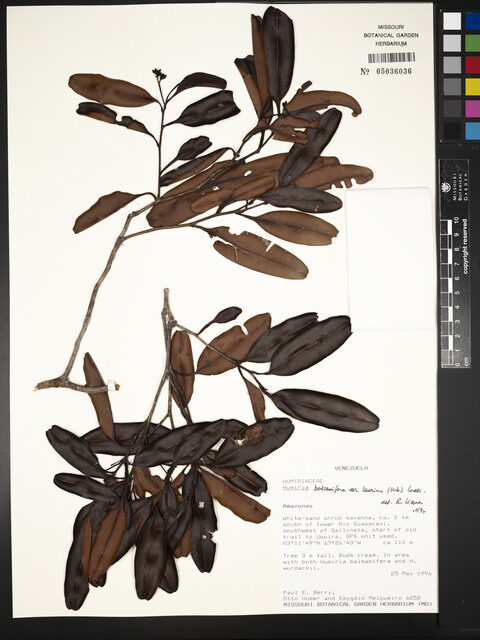
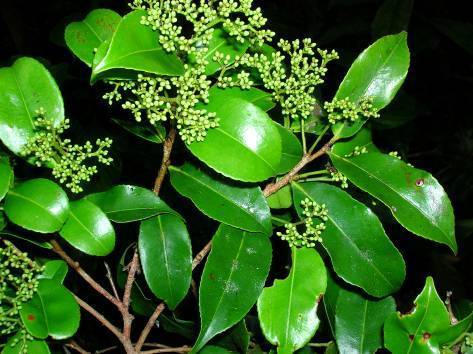
A tree. It grows 4-25 m high. It can be taller. The trunk can be 30-90 cm across. The crown is round and dense. It some locations it grows as a shrub. The trunk is short and 30-40 cm across. The leaves vary is size and shape. They are 6-15 cm long by 3-6 cm wide. The flowers are in groups at the ends of branches. They are white. The fruit is oval and fleshy with a stone inside. It is 10-11 mm long by 4-8 mm wide. It is dark purple and fleshy when ripe. There are 15 varieties.
Edible Uses
The fruit are eaten raw and are sold in local markets. Ripe fruit are softened in plastic bags to facilitate seed removal.
Traditional Uses
The fruit are eaten raw.
This uses section is brief — help expand it
Medicinal Uses
The tannin-rich bark is used in a decoction to reduce toothache, and is combined with species of Hymenaea and Maniklara to cure dysentery. An infusion of the bark is used to remedy amoebic dysentery, coughs and smallpox, whilst a decoction is used to treat throat disease and to heal chronic sores. The bark is macerated in water and applied onto erysipelas. A balsamic oleoresin obtained from the tree is used as a taenicide and to treat blennorrhagia. The warmed oil is applied as a liniment on inflamed joints. The active antidysenteric principle in the plant is the polyphenol bergenine.
Distribution
It is a tropical plant. It grows in dryland forest in the Amazon in Brazil.
Where It Grows
Amazon, Bolivia, Brazil, Colombia, French Guiana, Guianas, Guyana, Peru, South America, Suriname, Venezuela,
Cultivation
The plant is grown from seed. The ripe fruit are harvested and put in plastic bags to allow them to soften so it is easier to remove the seeds. Fresh seed are planted and germinate in 2-3 months.
Propagation
Seed - best sown as soon as it is ripe in a partially shaded position in a nursery seedbed. A low germination rate can usually be expected, with the seed sprouting within 60 - 90 days.
Other Uses
A red, balsamic oleoresin called 'baume-resine Houmouri' is obtained from the tree. The balsam is produced mainly by older trees, probably as a consequence of bacterial diseases. It has medicinal uses. The plant contains the substance isolongifolenone. Derivatives of this have been widely used as fragrances in cosmetics, perfumes, space sprays, detergents, deodorants, fabrics, fibres, and paper products. Modern research has shown that isolongifolenone is a very effective repellent of mosquitoes and ticks, work is currently taking place to make it commercially available When attacked by a certain fungus, the bark emits a pleasing perfume. It is used by local people as a scent for hair oil. The heartwood varies from light brown to reddish brown; it is poorly demarcated from the 4 - 5cm wide band of light brown sapwood. The texture is medium; grain straight to slightly interlocked; lustre medium; without distinctive odour or taste. The wood is heavy, hard, compact and very durable, even in adverse conditions. All species of Humiria have a reputation of being highly durable. Pure culture tests rate the wood very durable when exposed to white-rot fungus but durable to moderately durable in resistance to a brown-rot fungus. The wood is rated resistant to dry-wood termites, but has little resistance to marine borers. It is moderately difficult to work, considerable chipped grain develops in planing wood with interlocked grain. The wood is used for heavy construction, flooring, furniture, wheel spokes, and has been suggested as a possible decorative veneer.
Production
Plants grow at a moderate rate.
Other Information
The fruit are sold in markets.
Synonyms
Also Known As
Apacharama, Chamisia, Chanul, Loro shungo, Meri, Mureua, Oloroso, Quinilla negra, Tauaranru, Tauromiro, Umir, Umiri
References (17)
- Altschul, S.V.R., 1973, Drugs and Foods from Little-known Plants. Notes in Harvard University Herbaria. Harvard Univ. Press. Massachusetts. no. 1860
- Bendezu, Y. F., 2018, Arboles nativos de lad Region Ucayali. Instituto Nacional de Innovacion Agraria. p 153
- Cavalcante, P.B. 1991. Frutas comestíveis da Amazônia. Edições CEJUP.
- Etkin, N. L. (Ed.), 1994, Eating on the Wild Side, Univ. of Arizona. p 138
- Flores, Y., 2018, Arboles nativos de la Region Ucayili. Estacion Experimental Agragia Pucallpa. Pucallpa Peru, 375 p. p 153
Show all 17 references Hide references
- Grandtner, M. M. & Chevrette, J., 2013, Dictionary of Trees, Volume 2: South America: Nomenclature, Taxonomy and Ecology. Academic Press p 309
- Heywood, V.H., Brummitt, R.K., Culham, A., and Seberg, O. 2007, Flowering Plant Families of the World. Royal Botanical Gardens, Kew. p 169
- Kermath, B. M., et al, 2014, Food Plants in the Americas: A survey of the domesticated, cultivated and wild plants used for Human food in North, Central and South America and the Caribbean. On line draft. p 423
- Kew Plants of the World On line
- Lopez-Diago, D. & Garcia, N., 2021, Wild edible fruits of Colombia. Biota ColomBiana 22 (2) p 39
- Lorenzi, H., 2002, Brazilian Trees. A Guide to the Identification and Cultivation of Brazilian Native Trees. Vol. 02 Nova Odessa, SP, Instituto Plantarum p 126
- Martin, F. W., et al, 1987, Perennial Edible Fruits of the Tropics. USDA Handbook 642 p 96 (As Hourimiri balsamifera)
- Melnyk, M., Indigenous enterprise for the domestication of trees and the commercialization of their fruits. FAO
- Paz, F. S., et al, 2021, Edible Fruit Plant Species in the Amazon Forest Rely Mostly on Bees and Beetles as Pollinators. Journal of Economic Entomology, XX(XX), 2021, 1–13
- Polak, A. M., 1992, Major Timber Trees of Guyana. A Field Guide. Tropenbos Series 2. Wageningen. p 99
- Reis, S. V. and Lipp, F. L., 1982, New Plant Sources for Drugs and Foods from the New York Botanical Garden herbarium. Harvard. p 143
- World Checklist of Useful Plant Species 2020. Royal Botanic Gardens, Kew