Canavalia virosa
(Roxb.) Wight & Arn.
Karuthamma
wikimedia· cc-by-sa
Wikimedia Commons - Yercaud-elango
wikimedia· cc-by-sa
Wikimedia Commons - Yercaud-elango
Description
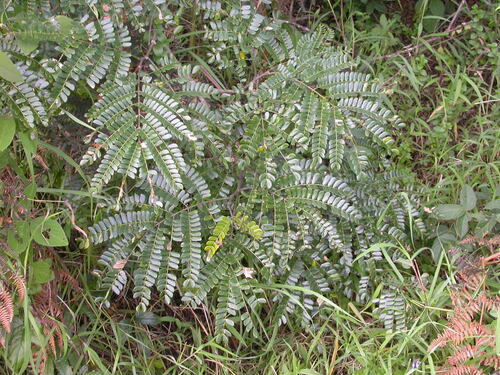
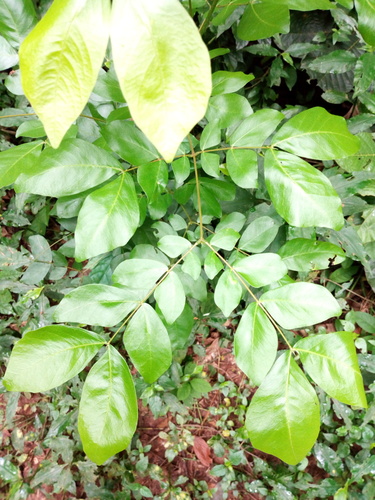
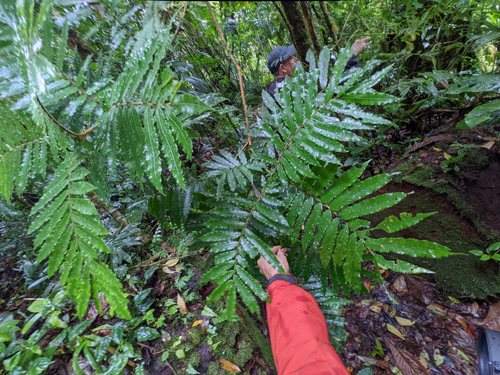
A climbing plant. It keeps growing from year to year. The stems are hairy when young. The leaves have 3 leaflets. These are 6-18 cm long by 4-15 cm wide. They are broadly oval and taper to the tip. They are hairy on both surfaces. The fruit are pods 10-17 cm long by about 3 cm wide. They are brown and hairy. The seeds are narrowly oval and reddish-brown with black markings.
Edible Uses
The pods and seeds are eaten, and the seeds are also used as a coffee substitute.
Medicinal Uses
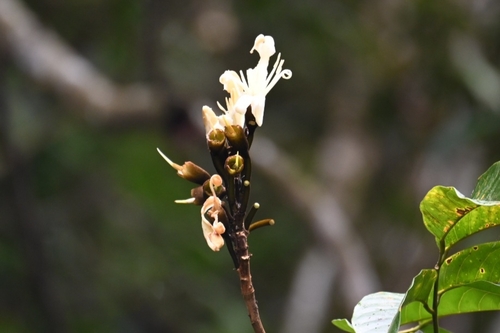
The seeds and pods are used as famine foods in coastal India. It is considered to be an underutilized wild plant with the potential to serve as a protein- and carbohydrate-rich food crop. It has more protein than several other edible legumes such as pigeon pea, chickpea, and cowpea. It grows rapidly, tolerates challenging habitat types such as dry, sandy, saline soils, and appears to be fairly pest-resistant. Like many legumes, C. cathartica contains antinutrients and requires some processing or preparation before it can be used for food. Antinutrients in the species include phenols, tannins, and lectins such as phytohaemagglutinin. Pressure cooking can reduce antinutrients. Roasting is somewhat less effective. In small-scale agriculture, farmers use this plant as green manure and mulch and host it in their fields for its nitrogen fixation. It grows easily on farmland in mangrove wetlands, it native habitat. It is used as cattle fodder. The stems with pods and leaves are fed to rabbits and hares. In numerous recent studies from India it is claimed that this species is the wild ancestor of Canavalia gladiata, referencing the 1974 third or paperback edition or the 1968 hardback edition of Tropical Crops: Dicotyledons by J. W. Purseglove, where it mentions that C. virosa may be the ancestor of C. gladiata, however this is likely in error, as with C. virosa in 1968 or 1974 one meant the modern C. africana using the then current taxonomy. Sauer himself proposed C. gladiolata as the ancestor of C. gladiata in the afore-mentioned article. The plant grows in Micronesia, where the island inhabitants use it as an herbal remedy for conditions such as cough. In Hawaii, where it is a non-native and invasive species, its showy flowers and large seeds are used in leis.
Distribution
A tropical plant.
Synonyms
Also Known As
Kalasima, Kalo-shim
References (14)
- Altschul, S.V.R., 1973, Drugs and Foods from Little-known Plants. Notes in Harvard University Herbaria. Harvard Univ. Press. Massachusetts. no. 1830
- Behera K. K., et al, 2008, Wild Edible Plants of Mayurbhanj District, Orissa, India. J. Econ. Taxon. Bot. Vol. 32 (Suppl.) pp 305-314
- Codjia, J. T. C., et al, 2003, Diversity and local valorisation of vegetal edible products in Benin. Cahiers Agricultures 12:1-12
- Davis, S.D., Heywood, V.H., & Hamilton, A.C. (eds), 1994, Centres of plant Diversity. WWF. Vol 1 or 2. p 140
- Flora of Pakistan. www.eFloras.org
Show all 14 references Hide references
- Fox, F. W. & Young, M. E. N., 1982, Food from the Veld. Delta Books. p 204
- Grivetti, L. E., 1980, Agricultural development: present and potential role of edible wild plants. Part 2: Sub-Saharan Africa, Report to the Department of State Agency for International Development. p 30
- Prodr. fl. Ind. orient. 253. 1834
- Rashid, H. E., 1977, Geography of Bangladesh. Westview p 261
- Reddy, K.R., 1989, Additional Notes on the Wild Edible Plants of India. J. Econ. Tax. Bot. Vol. 13 No. 1 pp 125-127
- Ruiters-Welcome, A. K., 2019, Food plants of southern Africa. Ph.D. thesis. Univ. of Johannesburg p 56
- Saidulu, P. et al, 2015, Ethnobotanical Knowledge Studied in Pocharam Wildlife Sanctuary, Telangana, India. Not Sci Biol, 2015, 7(2):164 -170
- van Wyk, Ben-Erik, 2019, The diversity and multiple uses of southern African legumes. Australian Systematic Botany, 2019, 32, 519–546
- Welcome, A. K. & Van Wyk, B.-E., 2019, An inventory and analysis of the food plants of southern Africa. South African Journal of Botany 122 (2019) 136–179