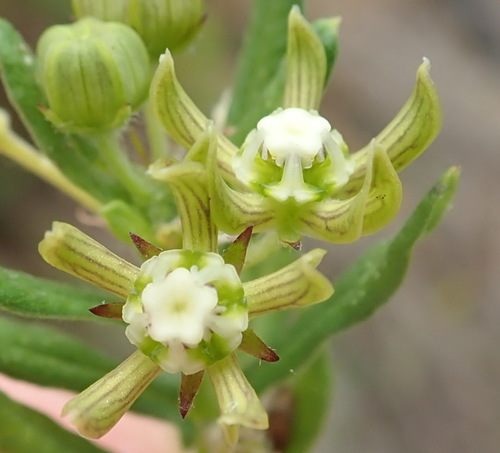
Holarrhena pubescens
Wall. ex A. DC.
Easter tree, Ivory tree, Conessi bark
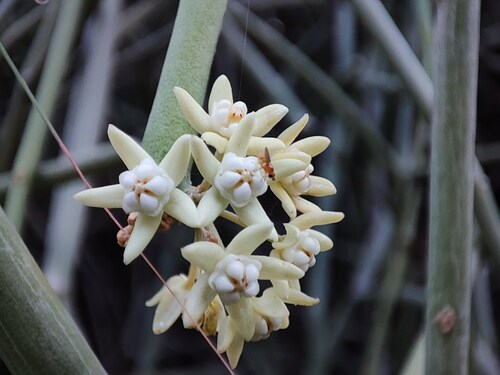
iNaturalist· cc-by-nc-sa
(c) Dinesh Valke, some rights reserved (CC BY-NC-SA)
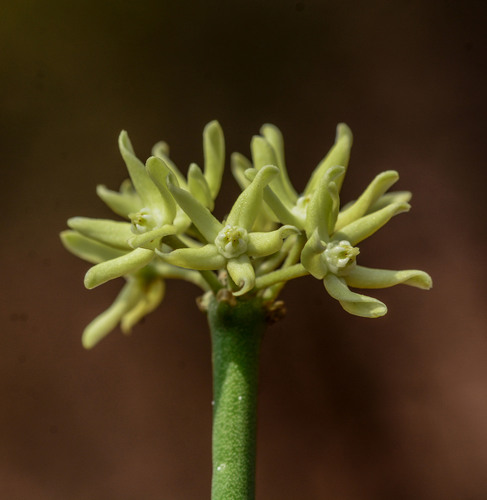
iNaturalist· cc-by-nc
(c) Aparna Watve, some rights reserved (CC BY-NC), uploaded by Aparna Watve
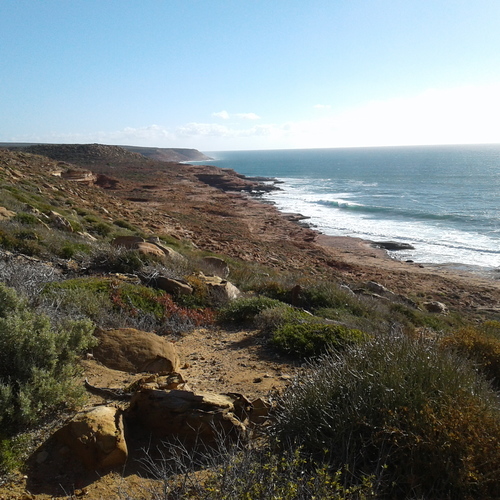
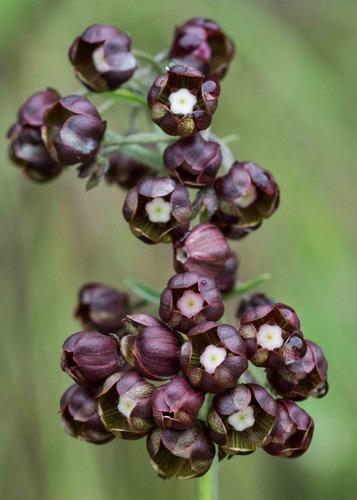
iNaturalist· cc-by-nc
(c) Heinrich Human, some rights reserved (CC BY-NC)
Summary
Source: WikipediaHolarrhena pubescens is a species of flowering plant in the family Apocynaceae. It is native to central and southern Africa, the Indian subcontinent, Indochina, and parts of China. Holarrhena pubescens is sometimes confused with the species Wrightia antidysenterica due to a second, taxonomically invalid publication of the name Holarrhena pubescens. In Cambodia, it is called /tɨk dɑh kʰlaː thɔm/ ទឹកដោះខ្លាធំ big tiger milk or /kʰlaɛɲ kŭəŋ/ ខ្លែងគង់ invulnerable kite. These seeds are sold as indraja (इनद्राजा) for Ayurvedic medicine in India.
Description
A small tree or tall shrub. It loses its leaves. It grows 10 m tall. The bark is rough and pale grey and cracked. It peels off in irregular flakes. The leaves are thin and opposite. They are pale green and broadly oval. They are wedge shaped at the base. The flowers are white or cream. They are 3-4 cm across. They are in loose clusters. They are at the ends of twigs. The fruit are a pair of follicles that are curved and slender. They are 20-48 cm long and 6-8 mm thick. It opens to reveal many seeds.
Edible Uses
The flowers are cooked and eaten as a vegetable, and young fruit and leaves are also eaten as vegetables. Flowers are sold in local markets.
Traditional Uses
The flowers are cooked and eaten as a vegetable. The young fruit are eaten as a vegetable. The leaves are eaten as a vegetable. CAUTION: There is a poisonous alkaloid in the seeds.
Medicinal Uses
The bark and seeds are used to control dysentery.
Known Hazards
The seeds contain a poisonous alkaloid.
Distribution
It is a subtropical plant. It is native to India. It grows up to 1,100 m altitude in the Himalayas. In Yunnan.
Where It Grows
Africa, Asia, Bangladesh, Cambodia, China, Himalayas, India, Indochina, Laos, Myanmar, Nepal, Northeastern India, Pakistan, SE Asia, Sikkim, South Africa, Taiwan, Thailand, Vietnam,
Cultivation
Though sensitive to frost, the plant recovers easily from damage. Succeeds on a wide range of soils. Plants can stand slight shade but develop best when growing in full light. Established plants are drought tolerant. The tree coppices well and can survive bush fires by producing sucker shoots from burned-down stumps. Juvenile plants are more susceptible to damage by fire than older ones. Natural reproduction is abundant owing to regular and copious seeding from an early age, comparative immunity of the plant to damage by animals and its power of recovery from injury. Seeds, that are dispersed by wind germinate during the early rains, and seedlings attain 10 - 15 cm by the end of the first year. In subsequent years, growth is more rapid, the mean annual diameter increment being 7 - 8 mm. In India, early height increment of Holarrhena pubescens is low, only 10 - 15 cm/year under natural conditions. Established plants are fast-growing. All parts of the plant contain a milky sap.
Propagation
Seed - direct sowing or raising seedlings in a nursery both work well. Fresh seeds have a high percentage of germination, but in seeds more than one year old the viability is low. The seed usually germinates in 2 - 3 weeks.
Other Uses
A dye similar to henna is extracted from the leaves. The wood ash is used as a mordant. The floss from the seeds is used for stuffing pillows. Conessine, an alkaloid found in the plant, was found to possess a wide range of disruptive activities against 4 insect species, and showed potential as a larval growth inhibitor, sterilant and antifeedant in laboratory tests. The wood is moderately soft and white, turning yellowish or pinkish with age. It has a straight grain and fine and even texture; there is no distinction between sapwood and heartwood. The wood is easy to saw and machine and fairly durable under cover. Popular for turning and carving, it is used to make small articles such as combs, picture frames, carved boxes, toys, spoons, knives, walking sticks and beads, and sometimes for furniture and ploughs. The pulp from the wood has been used to make paper. A pioneer species, it quickly invades open spaces. The plant may prove useful for the reforestation of deforested land in comparatively dry regions, especially because it is not readily browsed even by goats. In India the species is successfully intercropped with field crops.
Other Information
Flowers are sold in local markets.
Notes
The bark and seeds are used to control dysentery.
Synonyms
Also Known As
Conessia Holarrhena, Danghkyam-kaba, Dudhkhiri, Fajee rip, Indrajao, Indrajau, Khirra Kuda, Khirro, Koreya pump, Koreya phul, Koriya, Kudagappala, Kudva, Kunvad, Kurchi conessi, Lettok, Lettok-gyi, Mai-hkao-long, Mai-yang, Pandhara kuda
References (26)
- Ambasta, S.P. (Ed.), 2000, The Useful Plants of India. CSIR India. p 270 (As Holarrhena antidysenterica)
- Burkill, I.H., 1966, A Dictionary of the Economic Products of the Malay Peninsula. Ministry of Agriculture and Cooperatives, Kuala Lumpur, Malaysia. Vol 1 (A-H) p 1199 (As Holarrhena antidysenterica)
- Chandrakumar, P., et al, 2015, Ethnobotanical studies of wild edible plants of Gond, Halba and Kawar tribes of Salekasa Taluka, Gondia District, Maharashtra State, India. International Research Journal of Pharmacy 6(8)
- Chandrashekara, U. M., 2009, Tree species yielding edible fruit in the coffee-based homegardens of Kerala, India: their diversity, uses and management. Food Sec. 1:361-370 (As Holarrhena antidysenterica)
- Chauhan, S. H., et al, 2018, Consumption patterns of wild edibles by the Vasavas: a case study from Gujarat, India. Journal of Ethnobiology and Ethnomedicine (2018) 14:5 (As Holarrhena antidysenterica)
Show all 26 references Hide references
- Dangol, D. R. et al, 2017, Wild Edible Plants in Nepal. Proceedings of 2nd National Workshop on CUAOGR, 2017.
- Dobriyal, M. J. R. & Dobriyal, R., 2014, Non Wood Forest Produce an Option for Ethnic Food and Nutritional Security in India. Int. J. of Usuf. Mngt. 15(1):17-37 (As Holarrhena antidysenterica)
- Gautam, R. S., et al, 2022, Ethnobotanical Review of Wild Edible Plants of Nepal. Journal of Natural History Museum Volume 32, 2021-22 p 103
- Jadhav, R., et al, 2015, Forest Foods of Northern Western Ghats: Mode of Consumption, Nutrition and Availability. Asian Agri-History Vol. 19, No. 4: 293-317
- Joshi, N., et al, 2007, Traditional neglected vegetables of Nepal: Their sustainable utilization for meeting human needs. Tropentag 2007. Conference on International Agricultural Research for Development.
- Joshi, N. & Siwakoti, M., 2012, Wild Vegetables Used by Local Community of Makawanpur District and Their Contribution to Food Security and Income Generation. Nepal Journal of Science and Technology Vol. 13, No. 1 (2012) 59-66
- Kiran, K. C., et al, 2019, Diversity and Seasonal Availability of Potential Wild Edible Plants from Vidarbha Region of Maharashtra State, India. Int.J.Curr.Microbiol.App.Sci (2019) 8(2): 1434-1446
- Kumar, R. & Saikia, P., 2020, Wild edible plants of Jharkhand and their utilitarian perspectives. Indian Journal of Traditional Knowledge Vol 19 (2), April 2020, pp 237-250
- Kumar, S. A., Manus, D. & Mallika, M., 2018, Impact of non-timber forest products on Forest and in Livelihood Economy of the People of Adjoining Areas of Jalpaiguri Forest Division, West Bengal, India. Int. J. of Life Sciences, 2018; 6 (2):365-385
- Marandi, R. R. & Britto, S. J., 2015, Medicinal Properties of Edible Weeds of Crop Fields and Wild plants Eaten by Oraon Tribals of Latehar District, Jharkhand. International Journal of Life Science and Pharma Research. Vo. 5. (2) April 2015 (As Holarrhena antidysenterica)
- Panda, T., 2014, Traditional knowledge on wild edible plants as livelihood food in Odisha, India. Journal of Biology and Earth Sciences 2014; 4 (2): B144-B159 (As Holarrhena antidysenterica)
- Prafulla, S., 2017, Wild Food Diversity of Nawegaon-Nagzira Tiger Reserve in Gondia-Bhandara district of Maharashtra, India. Int. J. of Life Sciences, 2017, Vol. 5 (4): 620-626
- Prodr. 8:413. 1844 (As Holarrhena antidysenterica)
- Rahangdale, D.R. & Rahangdale, S.S., 2014, Potential Wild Edible Plant Resources from Maharashtra Future Prospects for their Conservation and Improvement. Life Science Leaflets. http://lifesciencesleaflets.ning.com
- Reddy, B. M., 2012, Wild edible plants of Chandrapur district, Maharashtra, India. Indian Journal of Natural Products and Resources. 3(1) pp 110-117
- Savita, et al, 2006, Studies on wild edible plants of ethnic people in east Sikkim. Asian J. of Bio Sci. (2006) Vol. 1 No. 2 : 117-125 (As Holarrhena antidysenterica)
- Sarma, H., et al, 2010, Updated Estimates of Wild Edible and Threatened Plants of Assam: A Meta-analysis. International Journal of Botany 6(4): 414-423 (As Holarrhena antidysenterica)
- Sharma, B.D., & Lakshminarasimhan, P., 1986, Ethnobotanical Studies on the Tribals of Nasik District (Maharashtra). J. Econ. Tax. Bot. Vol. 8 No. 2 pp 439-446 (As Holarrhena antidysenterica)
- Swaminathan, M.S., and Kochnar, S.L., 2007, An Atlas of Major Flowering Trees in India. Macmillan. p 200 (As Holarrhena antidysenterica)
- Tewari, D.N., 1994, Important Plants of India. International Book Distributors, India. p 64 (As Holarrhena antidysenterica)
- World Checklist of Useful Plant Species 2020. Royal Botanic Gardens, Kew