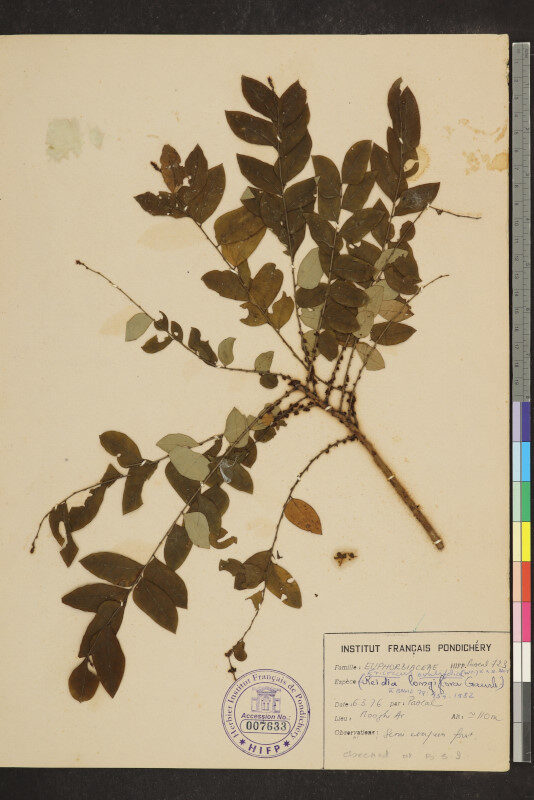
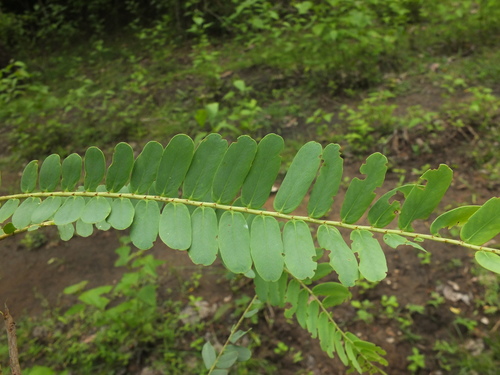
Antidesma acidum
Retz.
China laurel, Sour currant shrub
iNaturalist· cc-by-nc
(c) Aniruddha Singhamahapatra, some rights reserved (CC BY-NC), uploaded by Aniruddha Singhamahapatra
iNaturalist· cc-by-nc
(c) Aniruddha Singhamahapatra, some rights reserved (CC BY-NC)
Summary
Source: WikipediaAntidesma acidum is a shrub or small tree that is native to an area from Java to Southwestern China and Pakistan. It is a long-lived, shade-tolerant species that is usually found under closed-canopy. The fruit is eaten in many places, the leaves in some locations. In Luang Prabang (Laos) open-air markets, the leaves are only sold alongside Russula mushrooms, to give a sour flavour to soup made from the fungi.
Description
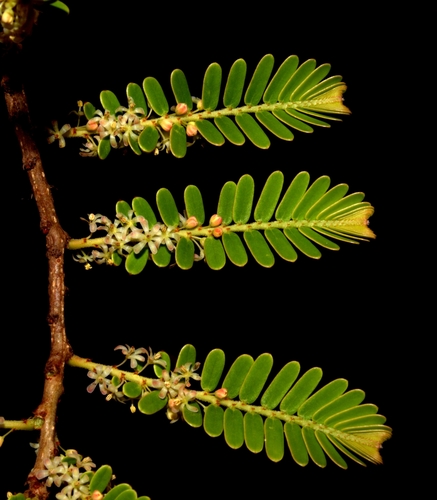
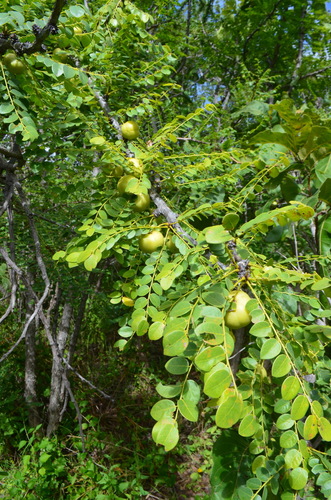
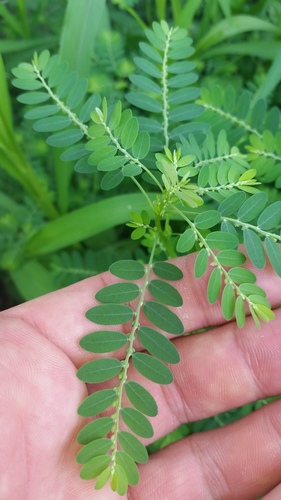
A shrub 2-3 m tall. It can be a tree 13 m high. The branches are round with fine hairs but become smooth and grey. The leaves are alternate. They are broadly oval and 3.5-9 cm long by 2-6 cm wide. The leaf stalk is hairy and 2-5 mm long. The flower arrangement is like a spike. It can be at the end of branches or in the axils of upper leaves. It is hairy and 3-10 cm long. Male and female flowers are on separate plants. Flowers are about 1.5 mm wide. The fruit is fleshy with a stone inside. It is flattened and hairy. It is 4 mm long. It turns blue when ripe. The stone has a netlike surface. It is 3.5 mm across.
Edible Uses
Ripe acidic fruits are eaten fresh or pickled, especially by children and sold in local markets. Young leaves are used in curries as a sour flavoring substitute for tamarind, and can be preserved for pickles, though fresh leaves store only 3-4 days.
Traditional Uses
The ripe fruit are eaten fresh or pickled. They are acidic. The young leaves are used in curries to give them a sour taste. They are a substitute for tamarind. The leaves can be preserved for later use. They are used for pickles. The fresh harvested leaves can only be stored for 3-4 days.
Medicinal Uses
The people who live in the Phu Khiao Wildlife Sanctuary, Chaiyaphum Province, northeast Thailand, in their folkloric medicine to treat fever, drink a water decoction of the root of this species. Further north, in the Bueng Khong Long Non-hunting Area, Bueng Kan Province, northeastern Thailand, people harvest and eat the ripe wild fruits from March to September. In Cambodia, the fleshy fruit is eaten, and in local medicine an infusion of the root is given to young mothers as a tonic. The Bunong people of Mondulkiri Province, northeastern Cambodia, collect the wild fruits daily for food, and occasionally use the plant in their ethnomedicine to treat cough. When establishing Wurfbainia villosa, "medical cardamom", plantations in Phongsaly Province, northern Laos, in an area where shifting cultivation is dominant, farmers avoid new fallow areas that have sun-loving fast-growing plants, as these affect the cardamom plants. In fallow that is over five years old these short-lived species are replaced by long-lived species such as A. acidum, Alstonia scholaris and Albizia chinensis, which provide shade for the cardamom. At the open air markets of Luang Prabang, north Laos, the leaves of this species are only sold alongside Russula mushrooms. They are regarded as a special herb to provide a sour element in the traditional soup made from the mushroom. The Russula mushrooms are usually sold as a mixture of species, including Russula alboareolata, Russula delica, Russula faustiana, Russula integra, Russula paludosa, Russula subfoetens, Russula virescens, and other species. The fruit are also sold, both sour (unripe) and sweet (ripe). A variety of trees grow in rice fields in Champasak Province, southern Laos. Fruit trees, including this species, are common in fields. This species provides fruit and medicine. The Boro of Assam relish the mild sour leaves of this plant and combine it with fish or meat to make curries. Amongst people who are known by the external designation of Loi in the Thoubal district of Manipur, northeast India, the plant is used in their traditional ethnomedicine to treat diabetes. In the Cooch Behar district of West Bengal, northeast India, the ripe fruit of the wild plant are eaten by children. The young tender leaves of the plant are gathered by "Tribal" and other rural people of Odisha, south India, to be eaten as vegetables, as are a large range of other wild plants. They are fried if oil is available, otherwise boiled with salt, and then served as a side-item with rice. The ripe fruit are eaten by the Tharu people living in Dudhwa National Park, Uttar Pradesh, northwest India (on the Nepal border). The plant is cited as an agricultural species in Nepal.
Distribution
A tropical plant. It grows in secondary forest. In Nepal it grows from 150-1300 m altitude. In Yunnan in China it grows between 200-1500 m above sea level. It grows in secondary forest. In Sichuan.
Where It Grows
Andamans, Asia, Bangladesh, Bhutan, Cambodia, China, Himalayas, India, Indochina, Indonesia, Laos, Myanmar, Nepal, Northeastern India, Pakistan, SE Asia, Sikkim, Thailand, Vietnam,
Cultivation
Plants are grown from seed.
Production
In NE Thailand fruit are available March to September.
Other Information
The fruit are especially eaten by children. They are sold in local markets.
Notes
There are about 100-170 Antidesma species. These were previously in the Euphorbiaceae.
Nutrition
| Part | Moisture | kJ | kcal | Protein | Vit A | Vit C | Iron | Zinc |
|---|---|---|---|---|---|---|---|---|
| Fruit | 76.2 | — | — | — | — | 20.2 | — | — |
| Leaves | — | — | — | — | — | — | — | — |
Synonyms
Also Known As
Aburok, Abutenga, Abutenga, Amali, Amari, Amli, Amrul, Amta, Amtu, Archal, Areepazham, Ariporian, Asarippuli, Chouding, Ching heiyen, Ching yensil, Ching yensin, Chutki, Dakhi, Dhakki, Dieng-japeu, Dieng-japen, Elna, Ghondurili, Guo hua, Huli soppu, Iheri, Ingchum, Ingsum, Ing-sum-arong, Jamula, Kali khatai, Kantjer, Karrihulipa, Katma, Khatua, Khotura, Kim-ma-lin, Kundui, Lapasaiko, Lapha saikho, Mak mao, Mao soi, Markmao, Marmuri, Matha arak, Mau, Migana kudi, Mutta, Nekhon tenga, Nekhon-tenga, Noolithali, Nunnunia, Pa che e si, Pellagumudu, Pulleru, Sabheli baji, Sannagooge, Saroti, Saru heloch, Sarwat, Sirupulli, Surpela, Thurte-an, Tramuech
References (68)
- Bajpai, O., et al, 2015, Tree species of the Himalayan Terai region of Uttar Pradesh, India: a checklist. Check List 11(4): 1718
- Bandyopadhyay, S. et al, 2009, Wild edible plants of Koch Bihar district, West Bengal. Natural Products Radiance 8(1) 64-72
- Baro, D., Baruah, S. and Borthukar, S. K. 2015, Documentation on wild vegetables of Baksa district, BTAD (Assam). Scholars Research Library. Archives of Applied Science Research, 2015, 7 (9):19-2
- Behera, K. K. et al, 2008, Wild Edible Plants of Mayurbhanj District, Orissa, India. J. Econ. Taxon. Bot. Vol. 32 (Suppl,) pp 305-314
- Bircher, A. G. & Bircher, W. H., 2000, Encyclopedia of Fruit Trees and Edible Flowering Plants in Egypt and the Subtropics. AUC Press. p 34 (As Antidesma diandrum)
Show all 68 references Hide references
- Bohra, N., et al, 2017, Ethnobotany of wild edible plants traditionally used by the local people in the Ramnagar regions from Nainital District, Uttarakhand, India. Biolife 5(1): 12-19 (As Antidesma diandrum)
- Cao, Y., et al, 2020, Ethnobotanical study on wild edible plants used by three trans-boundary ethnic groups in Jiangcheng County, Pu’er, Southwest China. Journal of Ethnobiology and Ethnomedicine (2020) 16:66
- Cengel, D. J. & Dany, C., (Eds), 2016, Integrating Forest Biodiversity Resource Management and Sustainable Community Livelihood Development in the Preah Vihear Protected Forest. International Tropical Timber Organization p 121
- Chakraborty, S. & Chaturbedi, H. P., 2014, Some Wild Edible Fruits of Tripura- A Survey. Indian Journal of Applied research. (4) 9
- Chandrashekara, U. M., 2009, Tree species yielding edible fruit in the coffee-based homegardens of Kerala, India: their diversity, uses and management. Food Sec. 1:361-370
- Devi, O.S., P. Komor & D. Das, 2010, A checklist of traditional edible bio-resources from Ima markets of Imphal Valley, Manipur, India. Journal of Threatened Taxa 2(11): 1291-1296 (As Antidesma diandrum)
- Dobriyal, M. J. R. & Dobriyal, R., 2014, Non Wood Forest Produce an Option for Ethnic Food and Nutritional Security in India. Int. J. of Usuf. Mngt. 15(1):17-37
- Dutta, U., 2012, Wild Vegetables collected by the local communities from the Churang reserve of BTD, Assam. International Journal of Science and Advanced Technology. Vol. 2(4) p 119
- Flora of Pakistan. www.eFloras.org
- Gautim, R. S., et al, 2020, Wild Edible Fruits of Nepal. Int. J. Appl. Sci. Biotechnol. Vol 8(3): 289-304
- Ghimeray, A. K., Lamsal, K., et al, 2010, Wild edible angiospermic plants of the Illam Hills (Eastern Nepal) and their mode of use by local community. Korean J. Pl. Taxon. 40(1)
- GUPTA (As Antidesma diandrum)
- Hedrick, U.P., 1919, (Ed.), Sturtevant's edible plants of the world. p 60 (As Antidesma diandrum)
- Jacquat, C., 1990, Plants from the Markets of Thailand. D.K. Book House p 78
- Jeeva, S., 2009, Horticultural potential of wild edible fruits used by the Khasi tribes of Meghalaya. Journal or Horticulture and Forestry Vol. 1(9) pp. 182-192 (As Antidesma diandrum)
- Jin, Chen et al, 1999, Ethnobotanical studies on Wild Edible Fruits in Southern Yunnan: Folk Names: Nutritional Value and Uses. Economic Botany 53(1) pp 2-14
- Jose, D. T. & Sasidharan, N., 2016, Checklist of wild edible plants of Aralam Wildlife sanctuary, Kerala, India. South Indian Journal Of Biological Sciences 2016; 2(1); 141‐144
- Kachenchart, B., et al, 2008, Phenology of Edible Plants at Sakaerat Forest. In Proceedings of the FORTROP II: Tropical Forestry Change in a Changing World. Bangkok, Thailand.
- Kala, C. P., 2009, Aboriginal uses and management of ethnobotanical species in deciduous forests of Chhattisgarh state in India. Journal of Ethnobiology and Ethnomedicine. 5:32 (As Antidesma diandrum)
- Kar, A., & Borthakur, S. K., 2008, Wild vegetables of Karbi - Anglong district, Assam, Natural Product Radiance, Vol. 7(5), pp 448-460
- Kar, A., & Borthakur, S. K., 2008, Wild edible fruits of Karbi's of Karbi Anglong district of Assam, India, Pleione 2(2): 175-181
- Kar, A., et al, 2013, Wild Edible Plant Resources used by the Mizos of Mizoram, India. Kathmandu University Journal of Science, Engineering and Technology. Vol. 9, No. 1, July, 2013, 106-126
- Konsam, S., et al, 2016, Assessment of wild leafy vegetables traditionally consumed by the ethnic communities of Manipur, northeast India. Journal of Ethnobiology and Ethnomedicine, 12:9 (As Antidesma diandrum)
- Luczaj, L., et al, 2021, Wild food plants and fungi sold in the markets of Luang Prabang, Lao PDR. Journal of Ethnobiology and Ethnomedicine (2021) 17:6
- Maikhuri, R, K, and Gangwar, A. K., 1993, Ethnobiological Notes on the Khasi and Garo Tribes of Meghalaya, Northeast India, Economic Botany, Vol. 47, No. 4, pp. 345-357 (As Antidesma diandrum)
- Majumdar, K., & Datta, B. K., 2009, Traditional wild edible fruits for the forest dwellers of Tripura, India. Pleione 3(2): 167 - 178
- Manandhar, N.P., 2002, Plants and People of Nepal. Timber Press. Portland, Oregon. p 92
- Marandi, R. R. & Britto, S. J., 2015, Medicinal Properties of Edible Weeds of Crop Fields and Wild plants Eaten by Oraon Tribals of Latehar District, Jharkhand. International Journal of Life Science and Pharma Research. Vo. 5. (2) April 2015 (As Antidesma diandrum)
- Martin, F.W. & Ruberte, R.M., 1979, Edible Leaves of the Tropics. Antillian College Press, Mayaguez, Puerto Rico. p 191 (As Antidesma diandrum)
- Martin, M.A., 1971, Introduction L'Ethnobotanique du Cambodge. Centre National de la Recherche Scientifique. Paris. (As Antidesma diandrum)
- Meitei, L. R., et al, 2022, An ethnobotanical study on the wild edible plants used by forest dwellers in Yangoupokpi Lokchao Wildlife Sanctuary, Manipur, India. Ethnobotany Research and Application 23:15
- Misra S. & Misra M., 2016, Ethnobotanical and Nutritional Evaluation of Some Edible Fruit Plants of Southern Odisha, India. International Journal of Advances in Agricultural Science and Technology, Vol.3 Issue.1, March- 2016, pg. 1-30
- Miya, M. S. & Gautum, D., 2021, Checklist of floral species at the Institute of Forestry, Pokhara Campus, Pokhara, Nepal. Journal of Institute of Forestry, Nepal 18 (2021) 133-177
- Narayanan Ratheesh, M. K. et al, 2011, Wild edible plants used by the Kattunaikka, Paniya and Kuruma tribes of Wayanad District, Kerala, India. Journal of Medicinal Plants Research Vol. 5(15), pp. 3520-3529
- Narzary, H., et al, 2013, Wild Edible Vegetables Consumed by Bodo tribe of Kokrajhar District (Assam), North-East India. Archives of Applied Science Research, 5(5): 182-190
- Natuhara, Y., et al, 2011, Uses of trees in paddy fields in Champasak Province, Southern Lao PDR. Landscape and Ecological Engineering. p 7
- Pasha, M. K. & Uddin, S. B., 2019, Minor Edible Fruits of Bangladesh. Bangladesh J. Plant Taxon. 26(2): 299–313
- Patiri, B. & Borah, A., 2007, Wild Edible Plants of Assam. Geethaki Publishers. p 123
- Pegu, R., et al, 2013, Ethnobotanical study of Wild Edible Plants in Poba Reserved Forest, Assam, India. Research Journal of Agriculture and Forestry Sciences 1(3):1-10
- Phangchopi, U., et al, 2015, Diversity of wild edible plants in Marat Longri Wildlife Sanctuary, Assam. Indian Journal of Natural Products and Resources Vol. 6(4), December 2015 pp. 305-313
- Phon, P., 2000, Plants used in Cambodia. © Pauline Dy Phon, Phnom Penh, Cambodia. p 42
- Rajkalkshmi, P. et al, 2001, Total carotenoid and beta-carotene contents of forest green leafy vegetables consumed by tribals of south India. Plant Foods for Human Nutrition 56:225-238
- Ramachandran, V.S. and Nair, V.J., 1981, Ethnobotanical studies in Cannanore District, Kerala State (India). J Econ. Tax. Bot. Vol 2 pp 65-72
- Reddy, K. N. et al, 2007, Traditional knowledge on wild food plants in Andhra Pradesh. Indian Journal of Traditional Knowledge. Vol. 6(1): 223-229
- Sarma, H., et al, 2010, Updated Estimates of Wild Edible and Threatened Plants of Assam: A Meta-analysis. International Journal of Botany 6(4): 414-423
- Savita, et al, 2006, Studies on wild edible plants of ethnic people in east Sikkim. Asian J. of Bio Sci. (2006) Vol. 1 No. 2 : 117-125 (As Antidesma diandrum)
- Sawian, J. T., et al, 2007, Wild edible plants of Meghalaya, North-east India. Natural Product Radiance Vol. 6(5): p 413 (As Antidesma diandrum)
- Setiya, A. V., et al, 2016, Exploration and documentation of some wild edible plants used by the aboriginals from Gadchiroli District (M.S.) India. International Advanced Research Journal in Science, Engineering and Technology. 3(7)
- Shin, T., et al, 2018, Traditional knowledge of wild edible plants with special emphasis on medicinal uses in Southern Shan State, Myanmar. Journal of Ethnobiology and Ethnomedicine (2018) 14:48
- Singh, H.B., Arora R.K.,1978, Wild edible Plants of India. Indian Council of Agricultural Research, New Delhi. p17, 49 (As Antidesma diandrum)
- Somnasang, P., Moreno, G and Chusil K., 1998, Indigenous knowledge of wild hunting and gathering in north-east Thailand. Food and Nutrition Bulletin 19(4) p 359f
- Somnasang, P., et al, 2000, Knowing gathering and eating: Knowledge and attitudes about wild food in an Isan Village in north eastern Thailand. Journal of Ethnobiology 20(2):197-216
- Suksri, S., et al, 2005, Ethnobotany in Bung Khong Long Non-Hunting Area, Northeast Thailand. Kasetsart J., (Nat. Sci) 39: 519-533
- Teron, R. & Borthakur, S. K., 2016, Edible Medicines: An Exploration of Medicinal Plants in Dietary Practices of Karbi Tribal Population of Assam, Northeast India. In Mondal, N. & Sen, J.(Ed.) Nutrition and Health among tribal populations of India. p 151
- Terra, G.J.A., 1973, Tropical Vegetables. Communication 54e Royal Tropical Institute, Amsterdam, p 25 (As Antidesma diandrum)
- Thitiprasert, W., et al, 2007, Country report on the State of Plant Genetic Resources for Food and Agriculture in Thailand (1997-2004). FAO p 95
- Uprety, Y., et al, 2010, Non-timber Forest Products in Bardiya District of Nepal: Indigenous use, Trade and Conservation. J. Hum. Ecol. 30(3): 143-158
- Uprety, Y., et al, 2012, Diversity of use and local knowledge of wild edible plant resources in Nepal. Journal of Ethnobotany and Ethnomedicine 8:16
- Uprety, Y., et al, 2016, Traditional use and management of NTFPs in Kangchenjunga Landscape: implications for conservation and livelihoods. Journal of Ethnobiology and Ethnomedicine (2016) 12:19
- Ravikrishna, S., 2011, Ethno-medico-botanical survey on Wild Edible fruits of Udupi Taluq, Udupi p 52
- Flora of Thailand. www.nationalherbarium.nl/thaueuph/
- Wild edible plants of Himachal Pradesh (As Antidesma diandrum)
- World Checklist of Useful Plant Species 2020. Royal Botanic Gardens, Kew