Syzygium antisepticum
(Blume) Merr. & L. M. Perry
iNaturalist· cc-by-nc
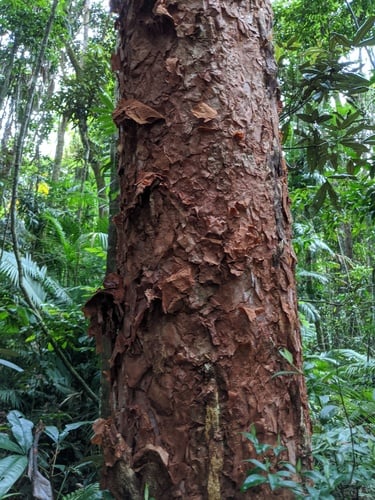
(c) Didier Levasseur, some rights reserved (CC BY-NC), uploaded by Didier Levasseur
iNaturalist· cc-by-nc
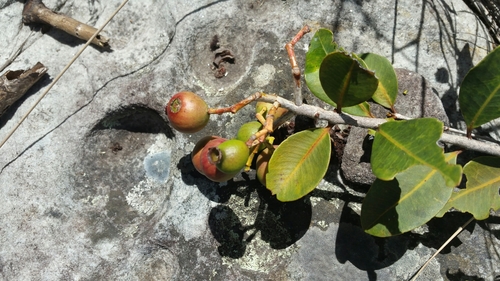
(c) jinghan, some rights reserved (CC BY-NC)
iNaturalist· cc-by-nc
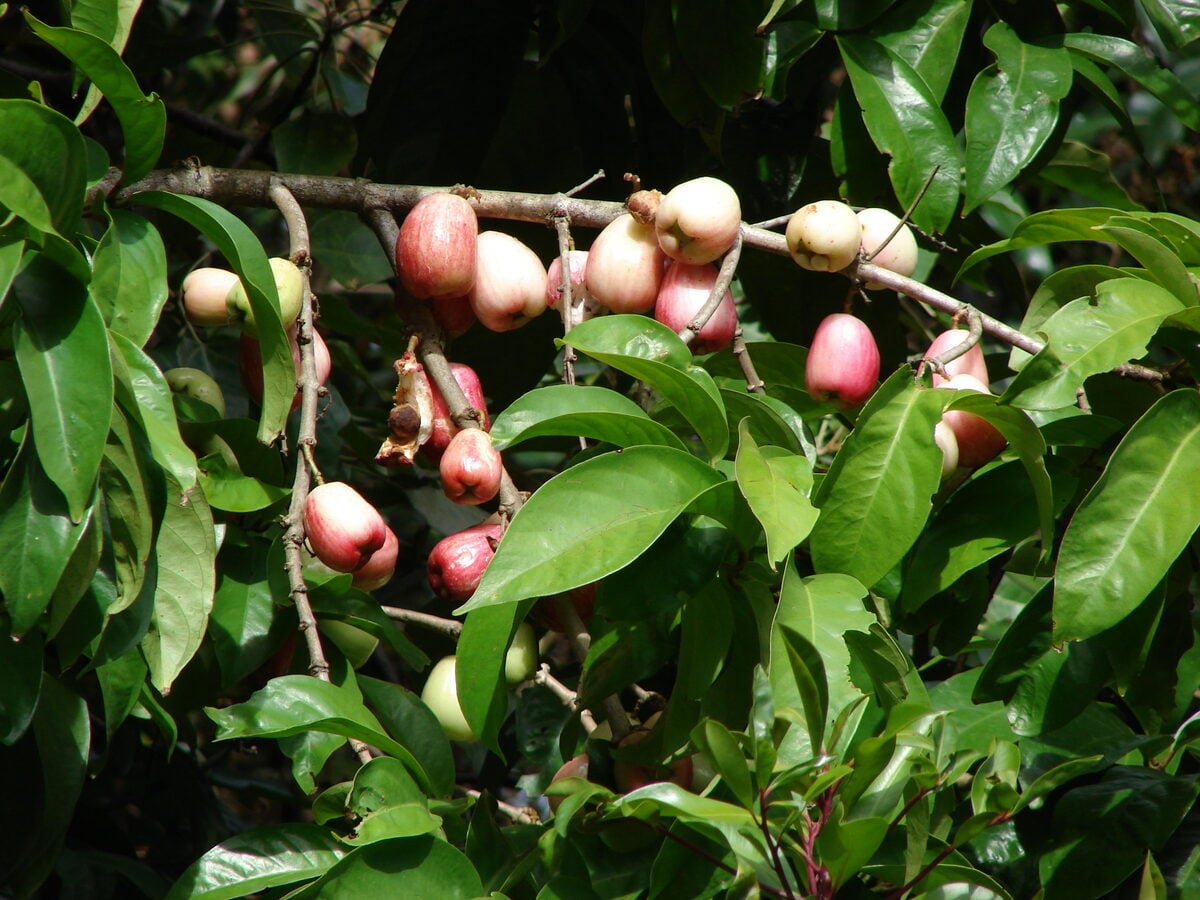
(c) Woraphot Bunkhwamdi, some rights reserved (CC BY-NC), uploaded by Woraphot Bunkhwamdi
Summary
Source: WikipediaSyzygium antisepticum, or shore eugenia, is native to the floristic region of Malesia.
Description
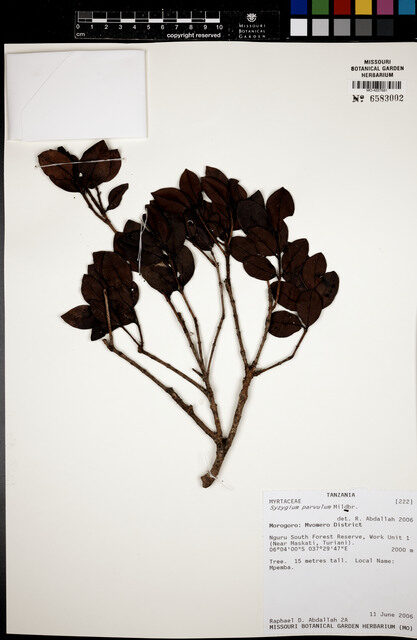
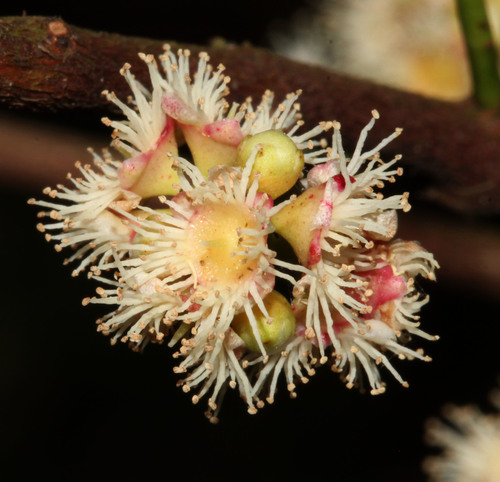
A small tree. It grows 7 m high but can be 34 m tall. The leaves are simple and opposite. They are narrowly oval. They are 7-13 cm long by 3-5 cm wide. Young leaves can be pale red. The flowers are small and white. The fruit are oval and 6 mm long by 5 mm wide. They are white.
Edible Uses
We have no specific information on edibility for the fruit of this species, but the fruits of many members of this genus are edible. The fruit is a whitish-red-violet, fleshy, globose berry about 5mm in diameter. Young shoots - cooked and eaten as a vegetable.
Traditional Uses
The young leaves are eaten raw. They are sour. The ripe fruit are eaten.
This uses section is brief — help expand it
Medicinal Uses
The plant is antiseptic and is used medicinally.
Distribution
A tropical plant. It grows near the coast and up to 1,800 m above sea level. It grows in forest and along river banks just behind the sand dunes.
Where It Grows
Asia, Brunei, Cambodia, Indochina, Indonesia, Laos, Malaysia, SE Asia, Singapore, Sri Lanka, Thailand,
Cultivation
It can be grown from seeds or by suckers or stem cuttings.
Propagation
Seed - best sown as soon as it is ripe.
Other Uses
The tannin-yielding bark is used for toughening fishing nets and for colouring clothes reddish-brown or black. The wood is sometimes used for construction, but it is usually not considered of much value. The wood is used in the construction of houses, ships and bridges, and for furniture and implements. We do not have any more specific information for the wood of this species, but it belongs to a group of timbers trees collectively known as 'kelat'. The general description of kelat timber is as follows:- The heartwood is a golden brown, greyish brown or brown, with pink or purplish glints; it is not clearly demarcated from the 1 - 4cm wide band of sapwood. The texture is fine; the grain slightly interlocked, sometimes wavy or irregular; there are resin deposits. The wood is heavy; moderately hard; somewhat durable, being moderately resistant to fungi and termites, but susceptible to dry wood borers. It seasons slowly, with a high risk of checking and distortion; once dry it is moderately stable in service. It works well with ordinary tools, nailing and screwing are good so long as the wood is pre-bored; gluing is correct. The wood is used for musical instruments, tool handles, furniture components, ship building, heavy carpentry, flooring, joinery etc.
Production
In NE Thailand ripe fruit are available April to May.
Synonyms
Also Known As
Aeba, Gelam tikas, Jambi hutan, Kok samek, Maak mek, Met chun, Obah, Pakmak, Phak mek, Samed, Samet chun
References (17)
- Burkill, I.H., 1966, A Dictionary of the Economic Products of the Malay Peninsula. Ministry of Agriculture and Cooperatives, Kuala Lumpur, Malaysia. Vol 1 (A-H) p 984 (As Eugenia grata)
- Cruz-Garcia, G. S., & Price, L. L., 2011, Ethnobotanical investigation of 'wild' food plants used by rice farmers in Kalasin, Northeast Thailand. Journal of Ethnobiology and Ethnomedicine 7:33 (As Syzygium gratum)
- Eiadthong, W., et al, 2010, Management of the Emerald Triangle Protected Forests Complex. Botanical Consultant Technical Report. p 51 (As Syzygium gratum)
- Jacquat, C., 1990, Plants from the Markets of Thailand. D.K. Book House p 67 (As Syzygium gratum)
- Japanese International Research Centre for Agricultural Science www.jircas.affrc.go.jp/project/value_addition/Vegetables (As Syzygium gratum)
Show all 17 references Hide references
- Jiwajinda, S., et al, 2002, Suppressive Effects of Edible Thai Plants on Superoxide and Nitric Oxide Generation. Asian Pacific Journal of Cancer Prevention, Vol 3, 2002 (As Eugenia grata)
- JSTOR Global Plants edible (As Syzygium gratum)
- Kachenchart, B., et al, 2008, Phenology of Edible Plants at Sakaerat Forest. In Proceedings of the FORTROP II: Tropical Forestry Change in a Changing World. Bangkok, Thailand. (As Syzygium gratum)
- Khumgratok, S., Edible Plants in Cultural Forests of Northeastern Thailand. Mahasarakham University Thailand. (As Syzygium gratum)
- Maituthisakul, P., et al, 2007, Assessment of phenolic content and free radical-scavenging capacity of some Thai indigenous plants. Food Chemistry 100: 1409-1418 (As Syzygium gratum)
- Maisuthisakul, P., 2012, Phenolic Constituents and Antioxidant Properties of some Thai Plants. Chp. 9 in Book Phytochemicals - A Global Perspective of Their Role in Nutrition and Health (As Syzygium gratum)
- Martin, F.W. & Ruberte, R.M., 1979, Edible Leaves of the Tropics. Antillian College Press, Mayaguez, Puerto Rico. p 207 (As Eugenia grata)
- Nakahara, K. et al, 2002, Antimutagenicity of Some Edible Thai Plants, and a Bioactive Carbazole Alkaloid, Mahanine, Isolated from Micromelum minutum. Journal of Agricultural and Food Chemistry. 50: 4796-4892 (As Syzygium gratum)
- Prixar, S., et al, 2006, Species composition, distribution and management of trees in paddy fields in central Laos. p 14 (As Syzygium gratum)
- Srichaiwong, P., et al, 2014, A Study of the Biodiversity of Natural Food Production to Support Community Upstream of Chi Basin, Thailand. Asian Social Science 10 (2): (As Syzygium gratum)
- Suksri, S., et al, 2005, Ethnobotany in Bung Khong Long Non-Hunting Area, Northeast Thailand. Kasetsart J., (Nat. Sci) 39: 519-533 (As Syzygium gratum)
- Thitiprasert, W., et al, 2007, Country report on the State of Plant Genetic Resources for Food and Agriculture in Thailand (1997-2004). FAO p 95 (As Syzygium gratum)