Astraeus hygrometricus
(Pers.) Morg.
Hygrometric earthstar
iNaturalist· cc-by
(c) Davide Puddu, some rights reserved (CC BY), uploaded by Davide Puddu
iNaturalist· cc-by-sa
(c) Óscar (fotosderianxo/xindilo), some rights reserved (CC BY-SA)
iNaturalist· cc-by-nc-sa
(c) António Pena, some rights reserved (CC BY-NC-SA)
Summary
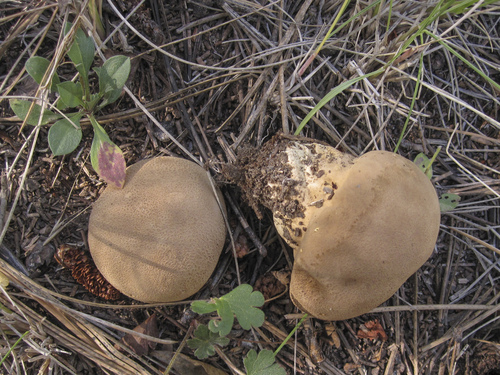
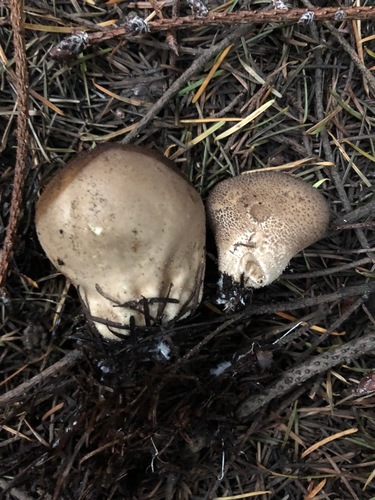
Source: WikipediaAstraeus hygrometricus, commonly known as the hygroscopic earthstar, the barometer earthstar, or the false earthstar, is a species of fungus in the family Diplocystaceae. Despite a similar overall appearance, A. hygrometricus is not related to the true earthstars of genus Geastrum, although historically, they have been taxonomically confused. The species was first described by Christiaan Hendrik Persoon in 1801 as Geastrum hygrometricus. In 1885, Andrew P. Morgan proposed that differences in microscopic characteristics warranted the creation of a new genus Astraeus distinct from Geastrum; this opinion was not universally accepted by later authorities. Several Asian populations formerly thought to be A. hygrometricus were renamed in the 2000s once phylogenetic analyses revealed they were unique Astraeus species, including A. asiaticus and A. odoratus. Similarly, in 2013, North American populations were divided into A. pteridis, A. morganii, and A. smithii on the basis of molecular phylogenetics. Young specimens resemble a puffball when unopened. In maturity, the mushroom displays the characteristic earthstar shape that is a result of the outer layer of fruit body tissue splitting open in a star-like manner. The false earthstar is an ectomycorrhizal species that grows in association with various trees, especially in sandy soils. A. hygrometricus was previously thought to have a cosmopolitan distribution, though it is now thought to be restricted to Southern Europe, and Astraeus are common in temperate and tropical regions. Its common names refer to the fact that it is hygroscopic (water-absorbing) and can open up its rays to expose the spore sac in response to increased humidity, then close them up again in drier conditions. The rays have an irregularly cracked surface, while the spore case is pale brown and smooth with an irregular slit or tear at the top. The gleba is white initially, but turns brown and powdery when the spores mature. The spores are reddish-brown and roughly spherical with minute warts, measuring 7.5–11 micrometers in diameter. Research has revealed the presence of several bioactive chemical compounds in Astraeus fruit bodies. North American field guides typically rate A. hygrometricus as inedible; while this may be accurate for the now-separate North American species, A. hygrometricus is commonly consumed in South and Southeast Asia.
Description
A mushroom found growing under trees on humus soil. The cap is round when young. It is 2.5-4 cm across. It is whitish brown. The outer layer opens and closes with alternate periods of wetting and drying.
Edible Uses
Young mushrooms are boiled and served with rice or used in curries. They are sold in markets and are popular.
Traditional Uses
The young mushrooms are boiled and served with rice. They are also used in curries.
This uses section is brief — help expand it
Distribution
A tropical plant. It grows under trees on humus soil. It likes acid sandy soils.
Where It Grows
Asia, China, Europe, Himalayas, India, Indochina, Kosovo, Nepal, SE Asia, Thailand,
Other Information
They are sold in markets. It is popular.
Notes
Also put in the family Diplocystidiaceae.
Nutrition
| Part | Moisture | kJ | kcal | Protein | Vit A | Vit C | Iron | Zinc |
|---|---|---|---|---|---|---|---|---|
| Mushroom | 83.4 | — | — | 11.7 | — | 3.2 | 2.7 | 0.9 |
Also Known As
Hed poch, Hed prouk, Putpura
References (9)
- Boa, E. R., Wild edible fungi and their importance to people. FAO Non Wood Forest Products Booklet 17
- Christensen, M., et al, 2008, Collection and Use of Wild Edible Fungi in Nepal. Economic Botany, 62(1), 2008, pp. 12–23
- Jacquat, C., 1990, Plants from the Markets of Thailand. D.K. Book House p 31
- Kaufmann, B. et al, 1999, The Great Encyclopedia of Mushrooms. Konemann. p 197
- Li, H., et al, 2020, Reviewing the world’s edible mushroom species: A new evidence-based classification system. Compr Rev Food Sci Food Saf. 2021;20:1982–2014.
Show all 9 references Hide references
- Mortimer, P. E. et al, 2012, Prized edible Asian mushrooms: ecology, conservation and sustainability. Fungal Diversity 56(1) p 31-47
- Sanmee, R. et al, 2003, Nutritive value of popular wild edible mushrooms from northern Thailand. Food Chemistry 82: 527-532
- Semwal, K. C., et al, 2014, Edible mushrooms of the Northwestern Himalaya, India: a study of indigenous knowledge, distribution and diversity. Mycosphere 5(3): 440–461
- Srichaiwong, P., et al, 2014, A Study of the Biodiversity of Natural Food Production to Support Community Upstream of Chi Basin, Thailand. Asian Social Science 10 (2):