Nephrolepis cordifolia
(L.) Presl.
Fishbone fern, Tuberous sword fern
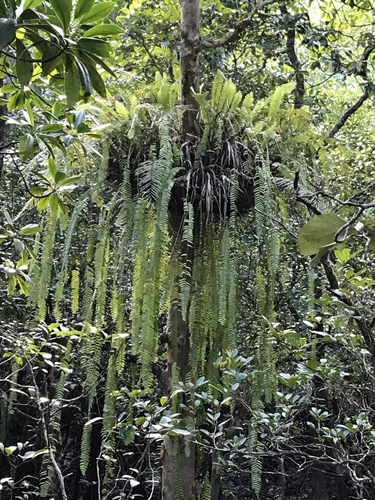
iNaturalist· cc-by-nc
(c) cyunf, some rights reserved (CC BY-NC), uploaded by cyunf
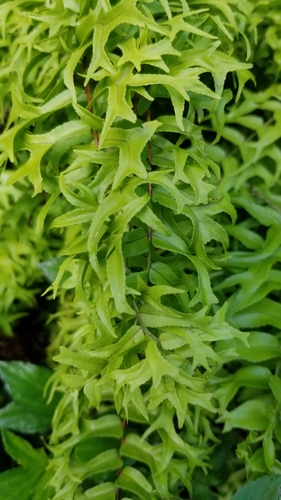
iNaturalist· cc-by-nc
(c) Penlock Chen, some rights reserved (CC BY-NC)
Summary
Source: WikipediaNephrolepis cordifolia is a fern native to the global tropics, including northeastern Australia and Asia. It has many common names including fishbone fern, tuberous sword fern, tuber ladder fern, erect sword fern, narrow sword fern and ladder fern, and herringbone fern. It is similar to the related fern Nephrolepis exaltata.
Description
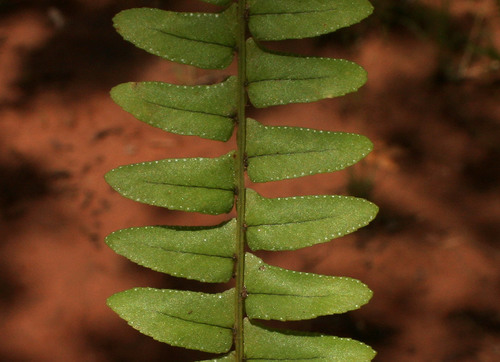
A fern. It can grow in the soil or attached to other plants. It keeps growing from year to year and forms large colonies. It grows about 30-120 cm high. The roots often bear tubers. These can be 1 cm long. The stalk of the fern frond is stiff and brown and often is slightly scaly. It is 10-30 cm long. The fronds are narrow and divided into leaflets along the stalk. The fronds are 30-120 cm long by 2-7 cm wide. The leaflets are many and do not have a leaf stalk. The leaflets are 1-3.5 cm long by 0.4-1 cm wide. There are blunt teeth along the edge. The bases overlap. The spore bodies are kidney shaped. They are close to the leaf edge. It produces fleshy tubers along the runners.
Edible Uses
The root tubers are boiled or dried and used in soups with chicken or pork; soft tubers are consumed as a drink for their water content. The tender parts of the plant are cooked and eaten, particularly the fleshy young tubers which are especially popular with children.
Traditional Uses
The root tubers are eaten. They are boiled. They are also dried. They are used to prepare soup with chicken or pork. The soft tubers are also used for drink because of the water they contain. The tender parts are cooked and eaten when food is scarce.
Medicinal Uses
It is used in medicine in Bangladesh.
Distribution
It grows in tropical and subtropical places. In Nepal it grows between 500-2400 m altitude. It will grow in dark places and dry atmosphere. It can tolerate frost. In Argentina it grows from sea level to 1,000 m above sea level. Melbourne Botanical Gardens. It suits hardiness zones 10-12.
Where It Grows
Africa, Argentina, Asia, Australia, Bangladesh, Bhutan, Bolivia, Brazil, Cambodia, China, East Africa, Guianas, Guyana, Hawaii, Himalayas, India, Indochina, Indonesia, Japan, Korea, Laos, Malaysia, Mexico, Mozambique, Myanmar, Nepal, New Caledonia, New Zealand, Nigeria, Norfolk Island, North America, Northeastern India, Pacific, Pakistan, Paraguay, Philippines, SE Asia, Sikkim, Singapore, South America, Sri Lanka, St. Kitts and Nevis, Suriname, Thailand, Tibet, USA, Vietnam, West Africa, Zambia, Zimbabwe,
Cultivation
Plants can be grown from root tubers or by splitting the plant. It can also be grown from spores or from small plants produced along the runners.
Other Information
The fleshy young tubers are eaten especially by children. It is sold in local markets in China. It is cultivated.
Notes
There are about 20 Nephrolepis species. They grow in the tropics. It is used in medicine in Bangladesh. Also put in the family Davalliaceae.
Synonyms
Also Known As
Bagan fern, Boston fern, Feng huang, Hidum uli, Ladder fern, Narrow sword fern, Pakis umbi pedang, Pani amala, Pani saro, Qiu jue, Rasmada, Shusni shak, Sword fern, Ta-wai
References (38)
- Andrews, S.B., 1990, Ferns of Queensland. A handbook to the ferns and fern allies. Queensland DPI p 250
- Aryal, K. P. et al, 2009, Uncultivated Plants and Livehood Support - A case study from the Chepang people of Nepal. Ethnobotany Research and Applications. 7:409-422
- Aryal, K. P., et al, 2018, Diversity and use of wild and non-cultivated edible plants in the Western Himalaya. Journal of Ethnobiology and Ethnomedicine (2018) 14:10
- Bhattarai, S. & Rajbhandary, S., 2017, Pteridophyte Flora of Manaslu Conservation Area, Central Nepal. American Journal of Plant Sciences, 2017, 8, 680-687
- Chaffey, C.H., 1999, Australian Ferns. Growing them successfully. Kangaroo Press. p 11, 186, 201,
Show all 38 references Hide references
- Cronin, L., 1989, The Concise Australian Flora. Reed. p 271
- Cundall, P., (ed.), 2004, Gardening Australia: flora: the gardener's bible. ABC Books. p 931
- Dangol, D. R. et al, 2017, Wild Edible Plants in Nepal. Proceedings of 2nd National Workshop on CUAOGR, 2017.
- Flora of Australia Volume 49, Oceanic Islands 1, Australian Government Publishing Service, Canberra. (1994) p 606
- Goudey, C.J., 1988, A Handbook of Ferns for Australia and New Zealand. Lothian. p 125
- Greig, D., 1996, Flowering Natives for Home Gardens. Angus & Robertson. p 272
- Hedrick, U.P., 1919, (Ed.), Sturtevant's edible plants of the world. p 437
- Hibbert, M., 2002, The Aussie Plant Finder 2002, Florilegium. p 210
- Hu, Shiu-ying, 2005, Food Plants of China. The Chinese University Press. p 272
- Hussey, B.M.J., Keighery, G.J., Cousens, R.D., Dodd, J., Lloyd, S.G., 1997, Western Weeds. A guide to the weeds of Western Australia. Plant Protection Society of Western Australia. p 14
- Islam, M., 1983, Utilisation of Certain Ferns and Fern Allies in the North-Eastern Region, India. J.Econ. Tax. Bot. Vol.4.No.3 pp 861-
- Joshi, K. and Joshi, A. R., 2008, Ethnobotanical Studies on Some Lower Plants of the Central Development Region, Nepal. Ethnobotanical Leaflets 12:832-40
- Khakurel, D., et al, 2021, Foods from the wild: Local knowledge, use pattern and distribution in Western Nepal. PLOS ONE.
- Lamoureux, C.H., 1976, Trailside Plants of Hawaii's National Parks. Hawaii Natural History Association. p 11
- Li, D. et al, 2017, Ethnobotanical survey of herbal tea plants from the traditional markets in Chaoshan, China. Journal of Ethnopharmacology. 205 (2017) 195-206
- Li, S., et al, 2020, Monpa, memory, and change: an ethnobotanical study of plant use in Mêdog County, South-east Tibet, China. Journal of Ethnobiology and Ethnomedicine. (2020) 16:5 p 20
- Lim, T. K., 2015, Edible Medicinal and Non Medicinal Plants. Volume 9, Modified Stems, Roots, Bulbs. Springer p 57
- Manandhar, N.P., 2002, Plants and People of Nepal. Timber Press. Portland, Oregon. p 333
- Marinelli, J. (Ed), 2004, Plant. DK. p 463
- Maroyi, A., 2014, Not just minor wild edible forest products: consumption of pteridophytes in sub-Saharan Africa. Journal of Ethnobiology and Ethnomedicine. 10:78
- Ojha, R. & Devkota, H. P., 2021, Edible and Medicinal Pteridophytes of Nepal: A Review. Ethnobotany Research & Applications 22:16
- Paczkowska, G. & Chapman, A.R., 2000, The Western Australian Flora. A Descriptive Calatogue. Western Australian Herbarium. p 25
- Pande, P.C. & Pangtey, Y.P.S., 1987, Studies on Ethnobotany - 1. on some less known edible and economic ferns of Kumaun Region of Western Himalaya. J. Econ. Tax. Bot. Vol 11 No.1 pp 81-85
- Pickering, H., & Roe, E., 2009, Wild Flowers of the Victoria Falls Area. Helen Pickering, London. p 116
- Sarker, S. K., & Enayet Hossain, A. B. M., 2009, Pteridophytes of Greater Mymensingh District of Bangladesh used as Vegetables and Medicines. Bangladesh J. Plant Taxon. 16(1) 47-56. p 55
- Singh, B., et al, 2012, Wild edible plants used by Garo tribes of Nokrek Biosphere Reserve in Meghalaya, India. Indian Journal of Traditional Knowledge. 11(1) pp 166-171
- Staples, G.W. and Herbst, D.R., 2005, A tropical Garden Flora. Bishop Museum Press, Honolulu, Hawaii. p 40
- Sukarya, D. G., (Ed.) 2013, 3,500 Plant Species of the Botanic Gardens of Indonesia. LIPI p 874
- Taram, M., et al, 2018, Wild Food Plant Resources of Komkar Adi Tribe of Upper Siang District in Arunachal Pradesh, India. Bulletin of Arunachal Forest Research, Vol. 33(2), 27-35
- Tent. pterid. 79. 1836, nom. cons.
- Uprety, Y., et al, 2011, Plant biodiversity and ethnobotany inside the projected impact area of the Upper Seti Hydropower Project, Western Nepal. Environ. Dev. Sustain. (2011) 13:463-492
- Uprety, Y., et al, 2012, Diversity of use and local knowledge of wild edible plant resources in Nepal. Journal of Ethnobotany and Ethnomedicine 8:16
- www.eFloras.org Flora of China