Angiopteris evecta
(G. Forst.) Hoffm.
King fern, Giant fern
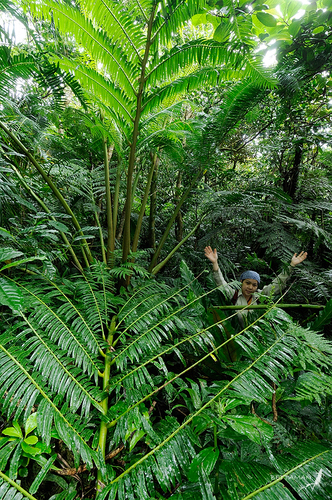
iNaturalist· cc-by-sa
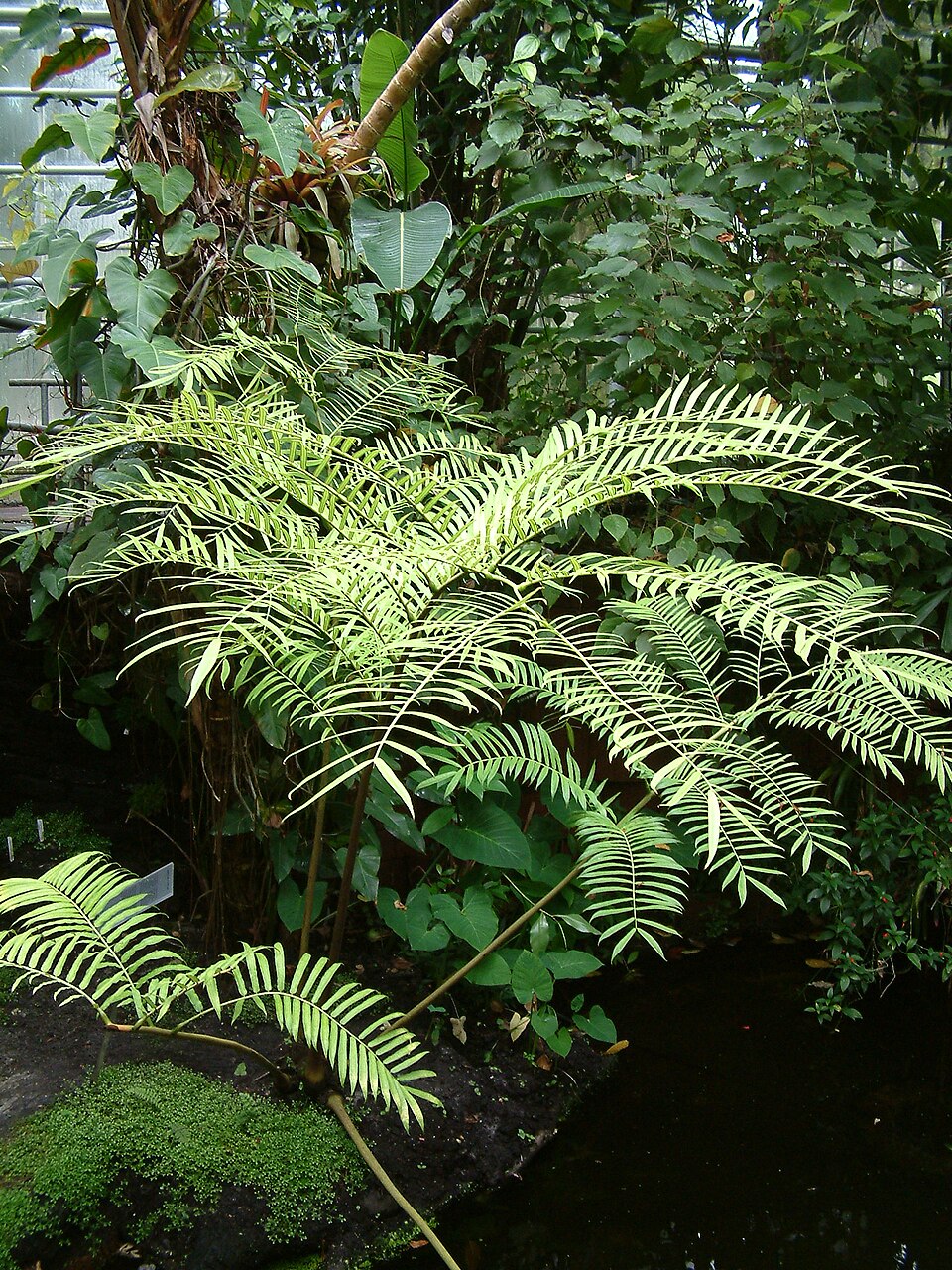
(c) Steve Fitzgerald, some rights reserved (CC BY-SA), uploaded by Steve Fitzgerald
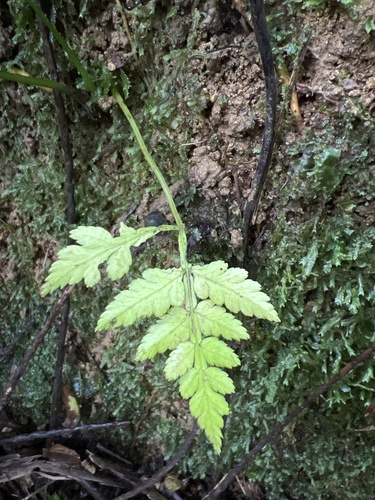
iNaturalist· cc-by-nc
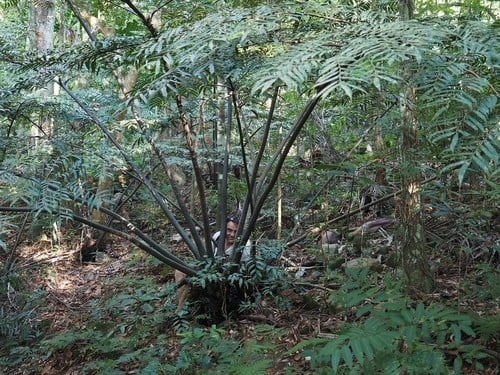
(c) Andria Kroner, some rights reserved (CC BY-NC), uploaded by Andria Kroner
iNaturalist· cc-by-nc
(c) Russell Cumming, some rights reserved (CC BY-NC), uploaded by Russell Cumming
Summary
Source: WikipediaAngiopteris evecta, commonly known as the king fern, giant fern, elephant fern, oriental vessel fern, Madagascar tree fern, or mule's foot fern, is a very large rainforest fern in the family Marattiaceae native to most parts of Southeast Asia and Oceania. It has a history dating back about 300 million years, and is believed to have the longest fronds of any fern in the world.
Description
A tree fern. It grows to 6 m high. The crown can be 12 m across. The erect rhizome or trunk can be 1 m high and 80 cm across in older plants. This trunk is fleshy with thick fleshy roots. It can just have a tuft of leaves coming from near ground level. Because there is no hard tissue, the water pressure inside the stalk keeps the leaves erect. This frond will therefore collapse in dry weather. Where the stem of the frond joins the trunk is a large ear-shaped leafy structure (stipule). The leaves are 2-7 m long and 1-2.5 m wide. The leaves can be divided 2 to 4 times. The small leaflets are 13 cm long and finely toothed around the edge. There are 3-7 pairs of spore bearing organs in double rows along the veins. The fronds are very fleshy and contain a lot of starch.
Edible Uses
Young unopened fronds (fiddleheads) are eaten fresh. The swollen leaf base is mixed with other vegetables. The stalks and rhizomes are processed into flour and are rich in starch, occasionally used to extract starch for consumption.
Traditional Uses
The young fiddle heads or unopened young fronds are eaten. The swollen leaf base is mixed with other vegetables. Flour can be made from the stalks and rhizomes.
Medicinal Uses
No medicinal uses mentioned in available data.
Known Hazards
Cannot tolerate dry conditions and will collapse during drought. Young plants (less than 3-4 years old) cannot survive frost. Can become invasive.
Distribution
A tropical plant. It is a lowland forest plant. They grow naturally on fertile, moist soil in the rain forest. Often they are near streams and waterfalls. It suits humid locations. They commonly grow in partial shade. They grow from sea level to 700 m altitude. In the Himalayas it grows up to 2,100 m above sea level. They can survive some frost once plants are 3-4 years old. They cannot tolerate dry conditions. In Adelaide Botanical Gardens hot house. It suits hardiness zones 10-12.
Where It Grows
Africa, American Samoa, Asia, Australia, Bangladesh, Bougainville, Central America, China, Costa Rica, East Africa, Fiji, French Polynesia, FSM, Hawaii, Himalayas, India, Indochina, Indonesia, Jamaica, Japan, Kosrae, Laos, Madagascar, Malaysia, Mariana Islands, Micronesia, Northeastern India, Pacific, Palau, Papua New Guinea, PNG, Philippines, Pohnpei, Polynesia, Rotuma, Ryuku Islands, Samoa, SE Asia, Sikkim, Society Islands, Solomon Islands, Tahiti, Taiwan, Thailand, Wallis and Futuna, West Indies,
Cultivation
They are normally grown from the stipules or leafy structure at the base of the leaflet. It may take 12-18 months for the shoots to form. It is difficult to grow this fern from spores. Small plantlets already developing from the base of the fronds can be removed and planted.
Propagation
Spores. A mycorrhizal association is believed to be necessary for germination. The spores should be either sown on soil obtained from around the roots of an established plant, or the spores should be sown around the base of a plant. Division of offsets - these are produced at the base of the ligules. Use a sharp knife and cut them from close to the rhizome of the parent plant and half bury them in a 50/50 mix of moist peat and sand. Keep in a moist environment (such as a closed frame) until buds and then roots and shoots develop, which c take several months. Pot each plant up in its entirity and plant out when fully established.
Other Uses
An essential oil is obtained from the plant. It is used to perfume coconut oil.
Production
Plants grow quickly. They grow slowly in cool areas.
Other Information
Occasionally used in Papua New Guinea to extract starch. It has been used in the Society Islands.
Notes
Wild pigs often uproot the plants to eat the fleshy roots. There are up to 100 (200) Angiopteris species. It can become invasive. Also put in the family Angiopteridaceae.
Synonyms
Also Known As
Bom, Bukka, Chahmah, Daomalai gidiba, Elephant fern, Mbalambala, Mati Alu, Mule's foot fern, Nabay, Pakis gajah, Pakuh gajah, Pustangabh, Turnip fern, Wan-kep-ret
References (33)
- Andrews, S.B., 1990, Ferns of Queensland. A handbook to the ferns and fern allies. Queensland DPI p 16
- Bodkin, F., 1991, Encyclopedia Botanica. Cornstalk publishing, p 83
- Burkill, I.H., 1966, A Dictionary of the Economic Products of the Malay Peninsula. Ministry of Agriculture and Cooperatives, Kuala Lumpur, Malaysia. Vol 1 (A-H) p 160 (Also as Angiopteris amboinensis)
- Chaffey, C.H., 1999, Australian Ferns. Growing them successfully. Kangaroo Press. p 11, 83 (Photos)
- Chin, W.Y., 1998, Ferns in the Tropics. Kangaroo. p 93
Show all 33 references Hide references
- Commentat. Soc. Regiae Sci. Gott. 12:29, t. 5. 1796
- Cundall, P., (ed.), 2004, Gardening Australia: flora: the gardener's bible. ABC Books. p 155
- Franklin, J., Keppel, G., & Whistler, W., 2008, The vegetation and flora of Lakeba, Nayau and Aiwa Islands, Central Lau Group, Fiji. Micronesica 40(1/2): 169–225, 2008
- Goudey, C.J., 1988, A Handbook of Ferns for Australia and New Zealand. Lothian. p 53
- Greig, D., 1996, Flowering Natives for Home Gardens. Angus & Robertson. p 49
- Hedrick, U.P., 1919, (Ed.), Sturtevant's edible plants of the world. p 55
- Heyne, K., 1927 ed, Nutt. Plant Ned. Ind. p 96 (As Angiopteris amboinensis)
- Hossain, U. & Rahman, A., 2018, Study and quantitative analysis of wild vegetable floral diversity available in Barisal district, Bangladesh. Asian J. Med. Biol. Res. 2018, 4 (4), 362-371
- Hibbert, M., 2002, The Aussie Plant Finder 2002, Florilegium. p 28
- Kar, A., 2004, Common wild vegetables of Aka tribe of Arunachal Pradesh. Indian Journal of Traditional Knowledge 3(3) pp 305-313
- Lamberton, K (Ed.), 2004, The Australian gardening encyclodepia. Murdoch Books, NSW Australia. p 165
- Lungphi, P., Wangpan, T. & Tangjang, S., 2018, Wild edible plants and their additional uses by the Tangsa community living in the Changlang district of Arunachal Pradesh, India. Pleione 12(2): 151 - 164. 2018.
- Maiden, J. H., 1889, The Useful Native Plants of Australia (including Tasmania). The Technology Museum of NSW, Sydney. p 7
- Marinelli, J. (Ed), 2004, Plant. DK. p 444
- Manju, S., and Sundriyal, R. C., 2001, Wild Edible Plants of the Sikkim Himalaya: Nutritive Values of Selected Species. Economic Botany 55(3): 377-390
- Medhi, P., Sarma, A and Borthakur, S. K., 2014, Wild edible plants from the Dima Hasao district of Assam, India. Pleione 8(1): 133-148
- Nicholson, N & H., 2000, Australian Rainforest Plants, V. Terania Rainforest Publishing. NSW. p 9
- Price, S.H. & J.L., Wild Food, Medicine and useful plants of the Wet tropics. Kwik Kopy, Cairns. p 5
- Sarker, S. K., & Enayet Hossain, A. B. M., 2009, Pteridophytes of Greater Mymensingh District of Bangladesh used as Vegetables and Medicines. Bangladesh J. Plant Taxon. 16(1) 47-56. p 50
- Srivastava, R. C., 2010, Traditional knowledge of Nyishi (Daffla) tribe of Arunachal Pradesh. Indian Journal of Traditional Knowledge. 9(1):26-37
- Staples, G.W. and Herbst, D.R., 2005, A tropical Garden Flora. Bishop Museum Press, Honolulu, Hawaii. p 39
- Sukarya, D. G., (Ed.) 2013, 3,500 Plant Species of the Botanic Gardens of Indonesia. LIPI p 855
- Sundriyal, M., et al, 1998, Wild edibles and other useful plants from the Sikkim Himalaya, India. Oecologia Montana 7:43-54
- Sundrayal, M., et al, 2004, Dietary Use of Wild Plant Resources in the Sikkim Himalaya, India. Economic Botany 58(4) pp 626-638
- Wild edible plants of Himachal Pradesh
- Williams, J.B., Harden, G.J., and McDonald, W.J.F., 1984, Trees and shrubs in rainforests of New South Wales and Southern Queensland. Univ. of New England, Armidale. p 17 (Drawing)
- World Checklist of Useful Plant Species 2020. Royal Botanic Gardens, Kew
- Yusuf, U. K., 2010, Ferns of Malaysian Rain Forest. A Journey Through the Fern World. Universiti Putra Malaysia Press p 32