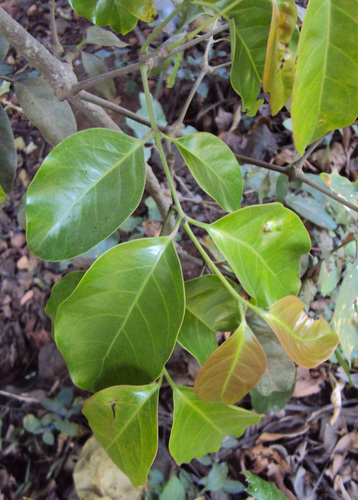
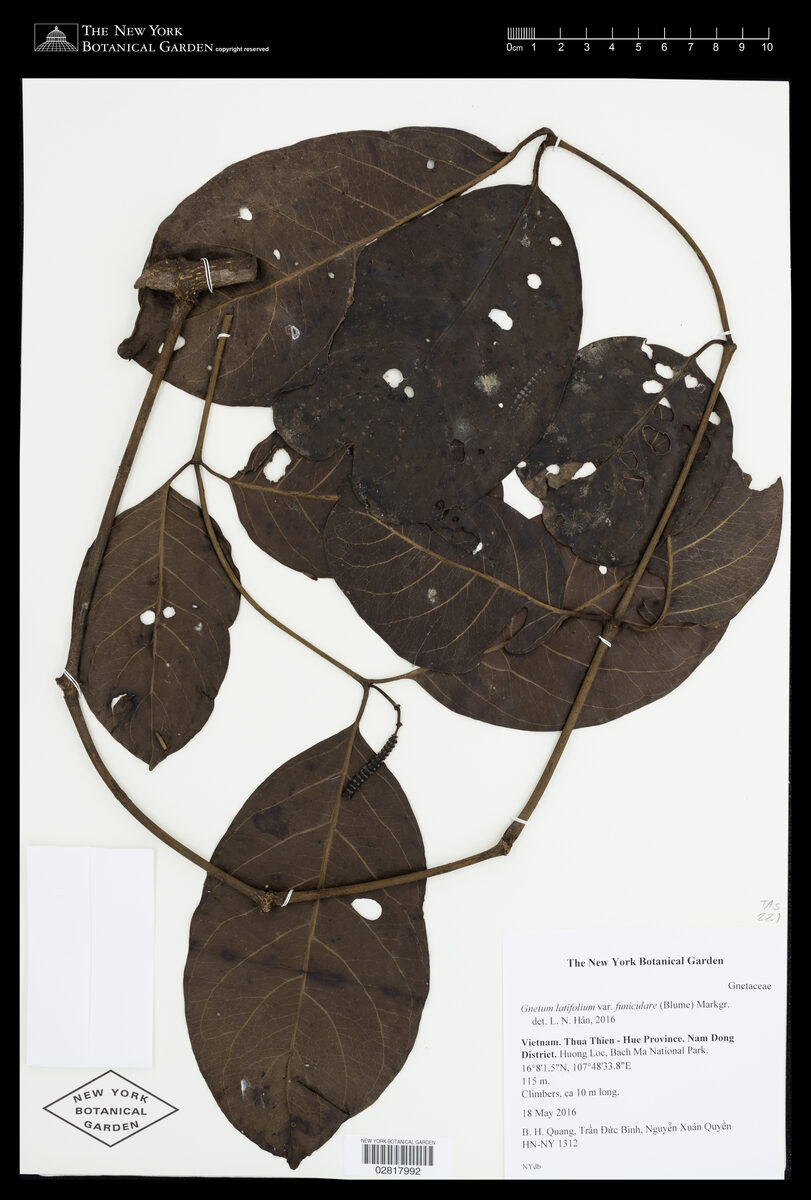
Gnetum montanum
Markgraf
Common jointfir
wikimedia· cc-by
Wikimedia Commons - Kware Ji from Shenzhen, China
wikimedia· cc-by-sa
Wikimedia Commons - KVDP
gbif· cc-by-sa
GBIF
Description
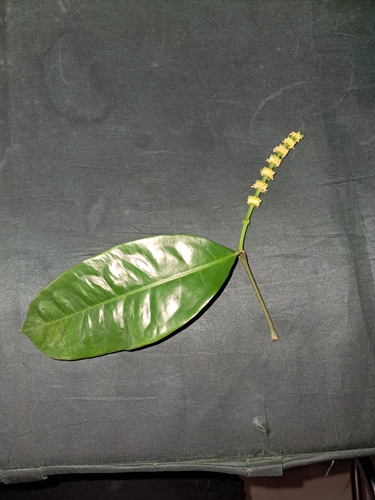
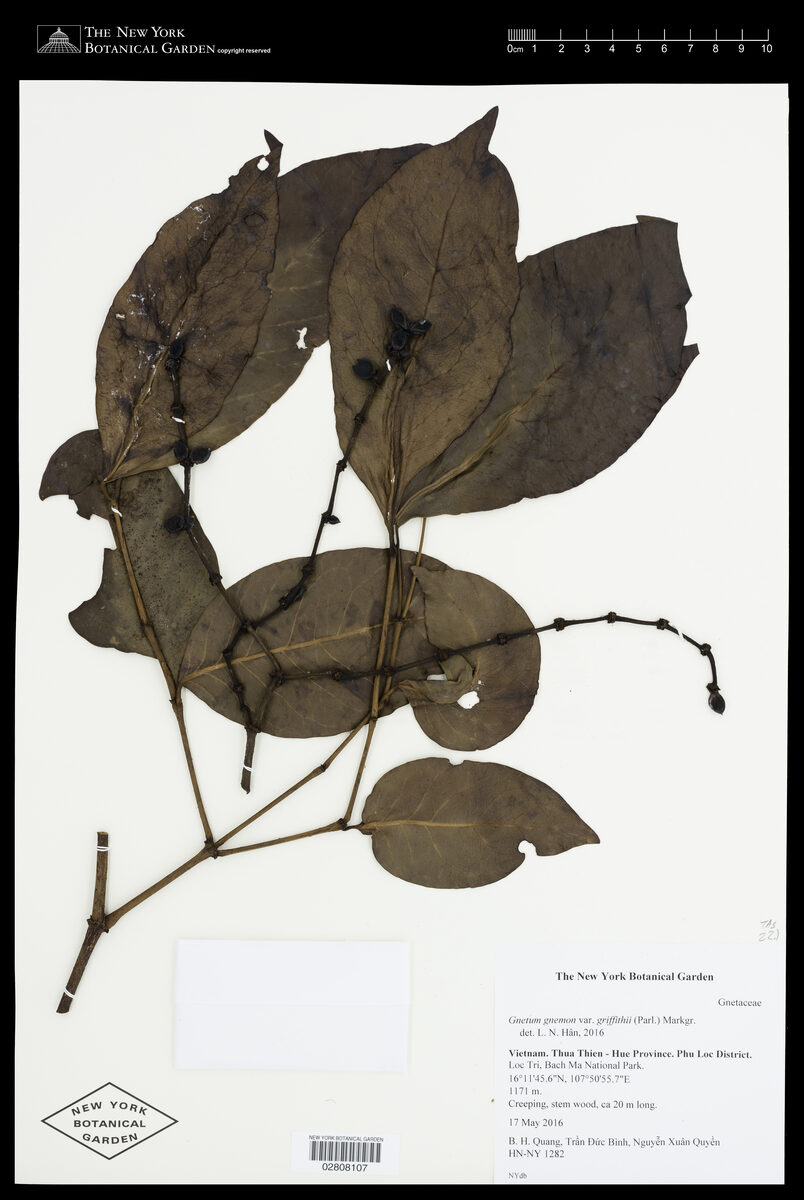
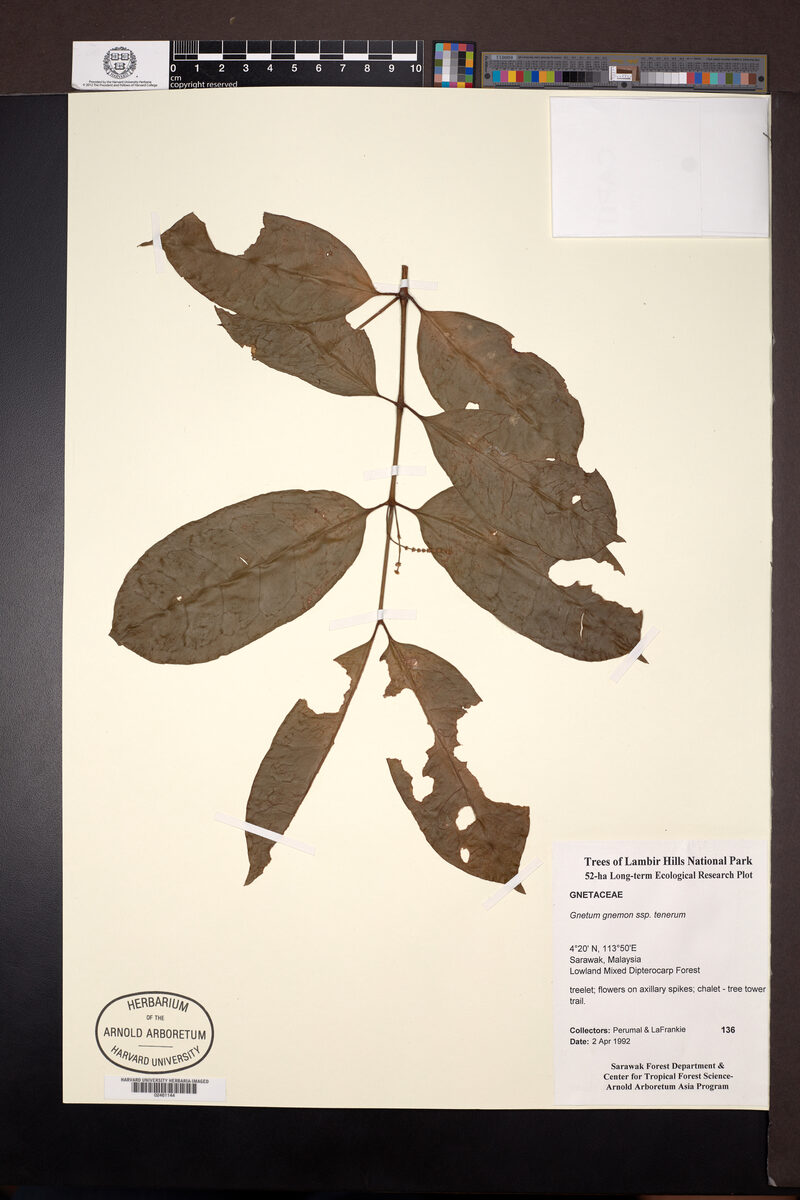
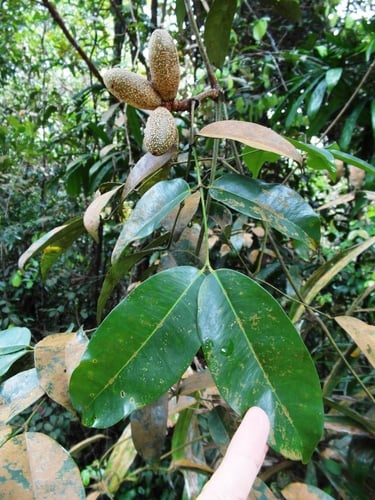
A vine or climber that grows to more than 10 m tall. The small branches are circular in cross section with wrinkles along them. The leaf stalk is 0.8-1.5 cm long and the leaf blade usually oblong and 10-25 cm long by 4-11 cm wide. They are leathery with 8-13 side veins on each side. The base of the leaf is rounded and the tip pointed. The male flower stalk is a loose arrangement 2.5-6 cm long. The male spikes are 2-3 cm long by 2-3 mm wide. There are 13-18 collars and 45-60 flowers on each spike. The female flower arrangement have 3-4 pairs of branches. The female spikes are 2-3 cm long by 4 mm wide. The seeds are reddish brown and oval shaped. They are about 1.5 cm long and 0.9 cm wide.
Edible Uses
The seeds are eaten raw, boiled, or fried, and yield an edible oil used for cooking and wine-making. The sap is consumed as a cold drink.
Traditional Uses
The seeds yield an edible oil, are eaten fried, and are used for making wine; the sap is used as a cold drink. The seeds are eaten raw or boiled.
This uses section is brief — help expand it
Medicinal Uses
None mentioned.
Known Hazards
None mentioned.
Distribution
A subtropical plant. It grows in forests between 200-2700 m altitude. In Nepal it grows between 300-1800 m altitude. It grows in moist forests. In Yunnan in China it grows between 700-1500 m above sea level. It grows in monsoon forest and subtropical broadleaved evergreen forest.
Where It Grows
Asia, Bhutan, Cambodia, China, Himalayas, India, Indochina, Laos, Myanmar, Nepal, Northeastern India, SE Asia, Sikkim, Thailand, Vietnam,
Cultivation
Plants can be grown from seed.
Other Uses
The fibres from the bark of the stem are used in making gunny bags, fishing nets, and ropes.
Production
In NE India plants flower and fruit February to December.
Other Information
It is sold in local markets.
Notes
The bark is useful for ropes. There are about 28 Gnetum species.
Nutrition
| Part | Moisture | kJ | kcal | Protein | Vit A | Vit C | Iron | Zinc |
|---|---|---|---|---|---|---|---|---|
| Fruit | 42.5 | — | — | — | — | 10.7 | — | — |
Synonyms
Also Known As
Gam, Ge mai mei, Gyut-nwe, Hkit-langru, Ke mei, Khlout, Ku sa, Laigulaili, Mai ma teng, Mameilet, Ma maeai, Ma muai, Mei-lar-iong-um, Mei-lariong-um, Milemjang, Muai, Mulongmuhu, Pai li guo, Pipli, Quenglangxi, Sot nui, Thanlping-rhui, Wo ni ai xi
References (20)
- Ambasta, S.P. (Ed.), 2000, The Useful Plants of India. CSIR India. p 241
- Bull. Jard. Bot. Buitenzorg, sér. 3, 10: 406.1930.
- Cao, Y., et al, 2020, Ethnobotanical study on wild edible plants used by three trans-boundary ethnic groups in Jiangcheng County, Pu’er, Southwest China. Journal of Ethnobiology and Ethnomedicine (2020) 16:66
- Cheng, Z., et al, 2022, Ethnobotanical study on wild edible plants used by Dulong people in northwestern Yunnan, China. Journal of Ethnobiology and Ethnomedicine (2022) 18:3
- Dobriyal, M. J. R. & Dobriyal, R., 2014, Non Wood Forest Produce an Option for Ethnic Food and Nutritional Security in India. Int. J. of Usuf. Mngt. 15(1):17-37
Show all 20 references Hide references
- Ferns, Useful Tropical Plants
- Fu Liguo, Yu Yongfu, Gilbert, M.G., Gnetaceae. Flora of China. Vol 4 p 104 www.eFloras.org
- Ghorbani, A., et al, 2012, A comparison of the wild food plant use knowledge of ethnic minorities in Naban River Watershed Nature Reserve, Yunnan, SW China. Journal of Ethnobiology and Ethnomedicine; 8:17
- Jeeva, S., 2009, Horticultural potential of wild edible fruits used by the Khasi tribes of Meghalaya. Journal or Horticulture and Forestry Vol. 1(9) pp. 182-192
- Jin, Chen et al, 1999, Ethnobotanical studies on Wild Edible Fruits in Southern Yunnan: Folk Names: Nutritional Value and Uses. Economic Botany 53(1) pp 2-14
- Luo, B., et al, 2019, Wild edible plants collected by Hani from terraced rice paddy agroecosystem in Honghe Prefecture, Yunnan, China. Journal of Ethnobiology and Ethnomedicine 15:56
- Manandhar, N.P., 2002, Plants and People of Nepal. Timber Press. Portland, Oregon. p 249
- McElwee, P. D., 2010, Resource Use Among Rural Agricultural Households Near Protected Area in Vietnam: The Social Costs of Conservation and Implications for Enforcement. Environmental Management 45:113-131
- Mozhui, R., et al, 2011, Wild edible fruits used by the tribals of Dimapur district of Nagaland, India. Pleione 5(1): 56 - 64.
- Patiri, B. & Borah, A., 2007, Wild Edible Plants of Assam. Geethaki Publishers.
- Sarma, H., et al, 2010, Updated Estimates of Wild Edible and Threatened Plants of Assam: A Meta-analysis. International Journal of Botany 6(4): 414-423
- Sawian, J. T., et al, 2007, Wild edible plants of Meghalaya, North-east India. Natural Product Radiance Vol. 6(5): p 418
- Turreira Garcia, N., et al, 2017, Ethnobotanical knowledgeof the Kuy and Khmer people in Prey Lang, Cambodia. Cambodian Journal of Natural History 2017 (1): 76-101
- Wiersema, J. H. & Leon, B., 2013, World Economic Plants. A Standard Reference CRC Press. 2nd Ed. p 329
- World Checklist of Useful Plant Species 2020. Royal Botanic Gardens, Kew