Alibertia sorbilis
Ducke
Brazil borojoa
gbif· cc-by
The New York Botanical Garden
gbif· cc-by
The New York Botanical Garden
gbif· cc-by
The New York Botanical Garden
Description
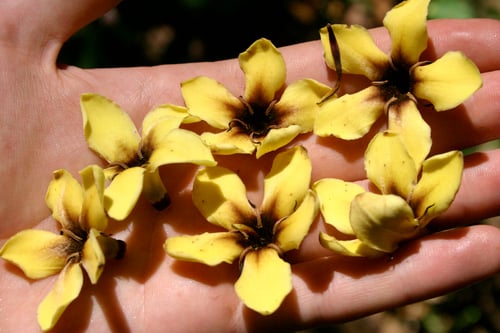
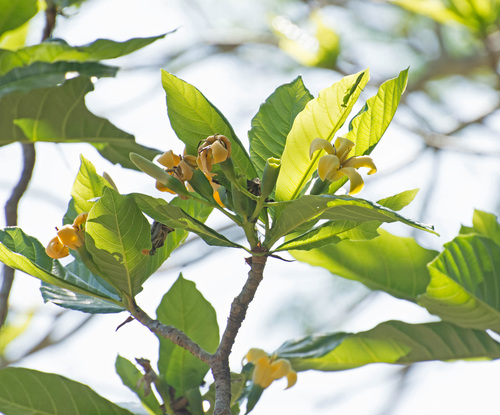
A shrub or small tree. It grows 4-6 m high. The leaves are large. They are 25-45 cm long by 15-20 cm wide. The base is heart shaped and they taper to the tip. The flowers are of one sex. The male flowers occur as many together. The female flowers occur singly. The fruit is round and 8-10 cm across. They are green to brown. It has several seeds inside. The seeds are almost a triangle shape and 2 cm long.
Edible Uses
The ripe fruit pulp is processed into juice, compotes, marmalades, ice cream, and wines.
Traditional Uses
The ripe fruit pulp is used to for juice, compotes, marmalades, ice-cream and wines.
This uses section is brief — help expand it
Distribution
A tropical plant.
Where It Grows
Amazon, Bolivia, Brazil, Colombia, Niue, Pacific, Peru, South America,
Cultivation
Plants can be grown by seeds. Seeds germinate in 25-55 days. It can also be grown from cuttings and grafting.
Synonyms
Also Known As
Borjo, Borojo, Borojo de monte, Huito, Parvi grande, Purui-grande, Purui grande, Purui, Puruhuyi
References (12)
- Acta Agron. 3:95. 1953 (As Borojoa sorbilis)
- Bircher, A. G. & Bircher, W. H., 2000, Encyclopedia of Fruit Trees and Edible Flowering Plants in Egypt and the Subtropics. AUC Press. p 18
- Encyclopedia of Life. (As Borojoa sorbilis)
- Grandtner, M. M. & Chevrette, J., 2013, Dictionary of Trees, Volume 2: South America: Nomenclature, Taxonomy and Ecology. Academic Press p 70
- Hermandez Bermejo, J.E., and Leon, J. (Eds.), 1994, Neglected Crops. 1492 from a different perspective. FAO Plant Production and Protection Series No 26. FAO, Rome. p17, 198 (As Borojoa sorbilis)
Show all 12 references Hide references
- Kermath, B. M., et al, 2014, Food Plants in the Americas: A survey of the domesticated, cultivated and wild plants used for Human food in North, Central and South America and the Caribbean. On line draft. p 35
- Paz, F. S., et al, 2021, Edible Fruit Plant Species in the Amazon Forest Rely Mostly on Bees and Beetles as Pollinators. Journal of Economic Entomology, XX(XX), 2021, 1–13
- Roa, J. A. G. & Boada, D. S. G., 2018, Fundación para el Fortalecimiento de la Fruticultura y Plantas Alimenticias no Convencionales en Colombia.
- Smith, N., Mori, S.A., et al, 2004, Flowering Plants of the Neotropics. Princeton. p 332 (As Borojoa sorbilis)
- Villachica, H., (Ed.), 1996, Frutales Y hortalizas promisorios de la Amazonia. FAO, Lima. p 59 (As Borojoa sorbilis)
- Wiersema, J. H. & Leon, B., 2013, World Economic Plants. A Standard Reference CRC Press. 2nd Ed. p 107 (As Borojoa sorbilis)
- World Checklist of Useful Plant Species 2020. Royal Botanic Gardens, Kew